ARVO Research Product Booth Planning by Application and Method


How should exhibitors organize an ARVO research product booth?
An ARVO research product booth should be organized around research tasks, methods, or workflow stages rather than the company catalog. Visitors should be able to find the relevant product group, review a small amount of useful evidence, ask a method-specific question, and reach the right specialist while backup stock stays out of sight.
A researcher usually arrives with a task or method in mind, not with the intention of browsing every product the company sells. The booth should begin with application language, narrow the choice to a relevant product group, present supporting evidence, and connect the visitor with the specialist who can answer the next question.
A 10x10 should focus on one research task. A 10x20 can support two clearly separated application paths. A 20x20 or 20x30 becomes useful when visitors need to compare methods, review several product groups, or speak with different specialists without losing their place in the display.
Product navigation is only one part of the exhibit. ARVO Annual Meeting booth planning places these application-led product zones within the larger footprint alongside meetings, demonstrations, shared storage, and event-wide visitor flow.
Why Exhibitors Choose Circle Exhibit
Clear scope, transparent quote review, nationwide booth support, and efficient setup planning for qualified rental and custom exhibit projects.
48hr
Setup Window
10+
Years Since 2014
U.S.
Trade Show Support
Real
Booth Project Proof
Choose the footprint by the number of research tasks, product groups, evidence points, and specialist conversations the booth must support. More display surface is useful only when it improves navigation and comparison.
Keep a 10x10 centered on one application or method and a tightly edited product group. Samples, evidence, and the specialist should remain within one viewing area. The 10x10 booth guide helps determine how much display surface can be used without crowding the conversation.
In a 20x20, visitors can move between several method or application zones and return to a central discussion area. Open edges improve access but require a clear category hierarchy. The 20x20 island guide supports that comparison-based layout.
A 10x20 can separate two applications or workflow stages while retaining one shared consultation point. Strong headers are essential because the longer frontage can otherwise read as unrelated products. See 10x20 booth planning for practical zoning options.
A 20x30 or larger exhibit suits a broad portfolio only when each zone has an owner and a defined visitor question. More surface area should improve navigation, not increase product density. Use 20x30 booth planning to organize multiple consultation paths.
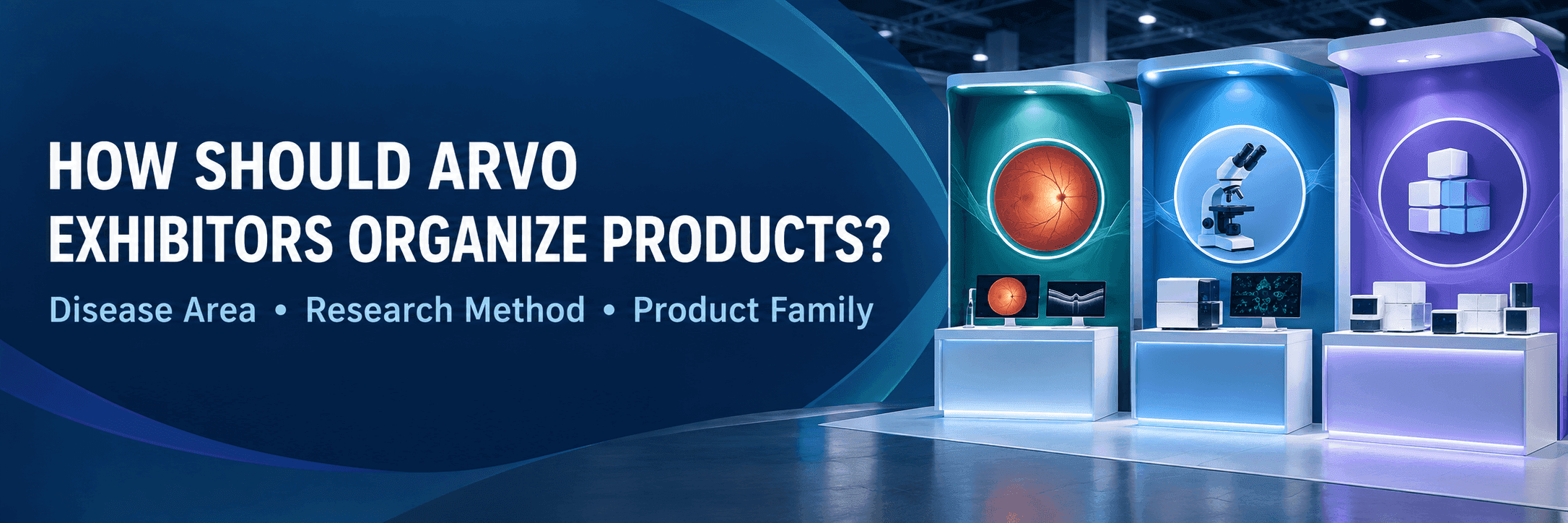
Product displays should not inherit the internal catalog structure by default. Disease area may lead when the application or evidence changes by condition; research method is often clearer when the workflow remains consistent; product family works when visitors arrive ready to compare systems or configurations. Use the ARVO product hierarchy guide before dividing the booth into product displays, evidence points, and specialist conversation areas.
The display should use researcher-facing categories, show a deliberate product selection, keep supporting proof beside the relevant group, and provide an obvious path from browsing to a specialist conversation.
Use research applications, methods, sample types, or workflow stages as the first navigation layer rather than internal product divisions.
Display only the items needed to explain each category. Additional options can remain in a digital reference, specialist conversation, or concealed stock area.
Place supporting data, application notes, diagrams, or comparisons beside the group they explain rather than on a separate evidence wall.
Give visitors a clear place to continue a method-specific discussion without blocking the next person who wants to browse.
This page covers research products, cell culture and bioassay tools, DNA analysis products, screening tools, consumables, and related laboratory supplies.
ARVO 2027 runs May 2–6 at the San Diego Convention Center; exhibits are open May 2–5.
Researchers usually approach the display through an application, method, sample type, or workflow stage before comparing products and speaking with a specialist.
Not Sure Which Booth Size You Need?
Not every exhibitor knows whether a 10x20, 20x20, 20x30, or larger booth is the right fit. Circle Exhibit can help review your event goals, product display needs, demo areas, meeting space, storage, budget scope, and setup timeline before you choose a booth size.
Using the Researcher’s Language
Giving Small Products Visual Weight
1
Start with Visitor Tasks
2
3
4
Rental for a Changing Portfolio
Rental is practical when product groups, graphics, shelves, and consultation needs may change between events. San Diego rental booth options allow the visible product mix to change without rebuilding the entire exhibit.
Custom for Repeated Product Architecture
Custom construction is useful when the same category system, integrated shelving, protected samples, lighting, or concealed inventory will be used repeatedly. Exhibit design engineering can resolve those built-in display and storage requirements.
Hybrid for Flexible Product Zones
A hybrid arrangement can use custom product fixtures or storage where consistency matters while rental walls, graphics, counters, and meeting elements change with the portfolio.
Organize cases and cartons by application or method area before move-in at the San Diego Convention Center. Zone-based packing reduces setup errors and speeds replenishment.
Display samples should arrive ready for presentation, while backup products remain labelled and concealed for controlled replenishment during exhibit hours.
Review counters, shelves, labels, lighting, and sightlines from the aisle. A product that reads well at desk distance may disappear on the show floor.
Match staff shifts to the product groups shown at that time, then run a final check of samples, evidence, inventory, labels, and handoff positions before opening.
Use ARVO Annual Meeting booth planning for the complete footprint, graphics and brand presentation for category navigation, and logistics and pre-show coordination for zone-based packing, samples, stock, and setup.
ARVO Research Product Display Rental vs. Custom Build
A modular rental display can work when product groups, graphics, shelving, and consultation priorities may change between events. Custom construction becomes more useful when the portfolio requires integrated shelving, protected samples, controlled lighting, or substantial concealed inventory across repeated programs.
How should a broad research product range be organized?
Begin with the visitor’s application, method, sample type, or workflow stage. Product families should appear after that first decision, not before it.
How many products should remain visible?
How can small lab products attract attention?
Where should technical specialists be positioned?
Is rental suitable for a changing product portfolio?
READY TO PLAN YOUR NEXT BOOTH?
Let’s Build a Booth That Fits Your Event
Share your event name, booth size, city, timeline, product display needs, and design references. Circle Exhibit will review your project direction and help you choose a rental-friendly or custom exhibit path.
3000+
Booth Projects Supported
50+
U.S. Event Cities
Transparent
Quote Review
Return to the main event hub when the decision involves total footprint, instrument demonstrations, meetings, event-wide storage, or general visitor flow.
For application headers, product labels, evidence panels, visual hierarchy, and category navigation across a broad research portfolio.
For zone-based packing, sample preparation, replenishment stock, setup order, concealed inventory, and final display checks.
For broader planning around technical product displays, evidence, specialist conversations, and scientific buyer expectations.