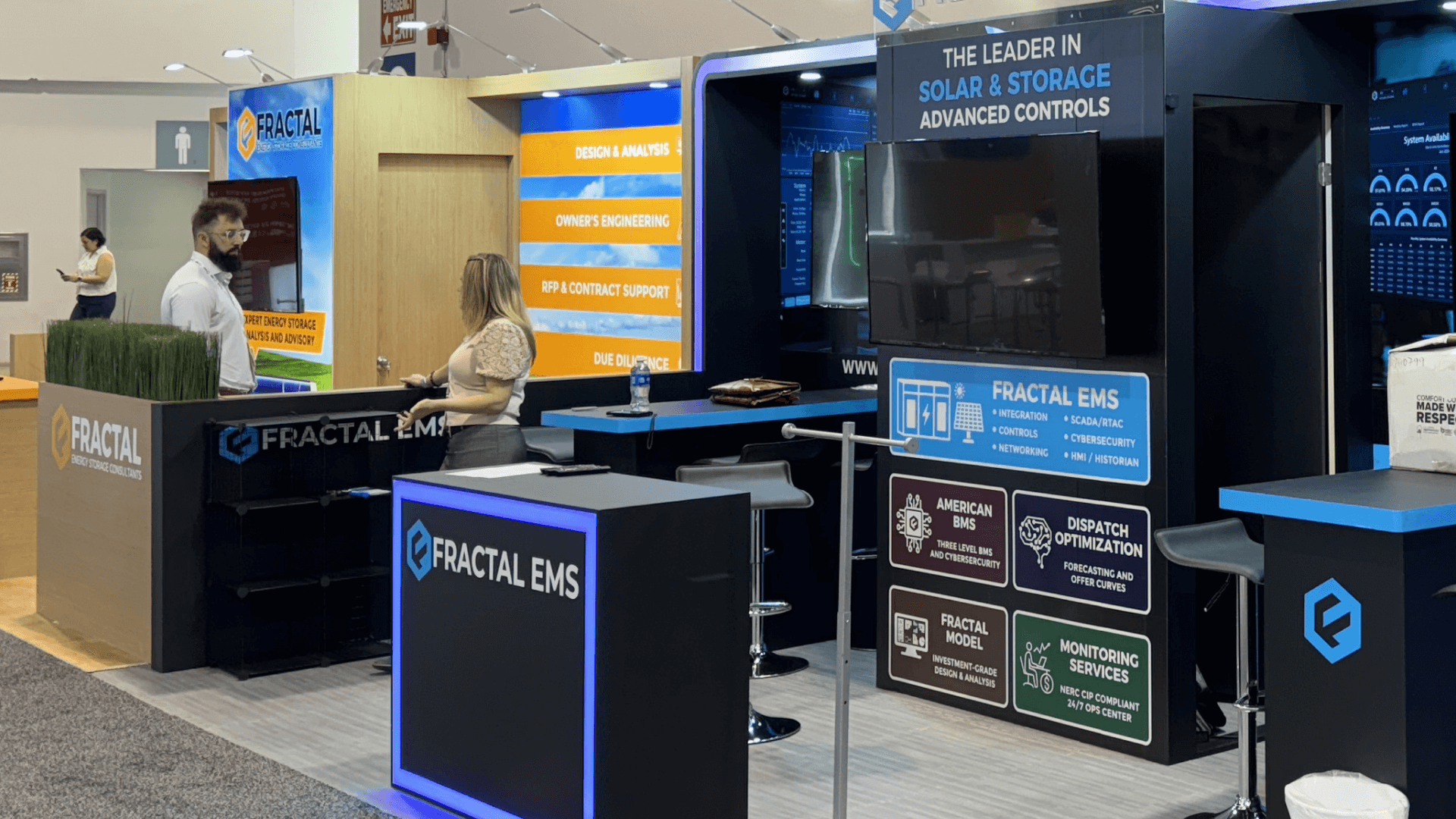
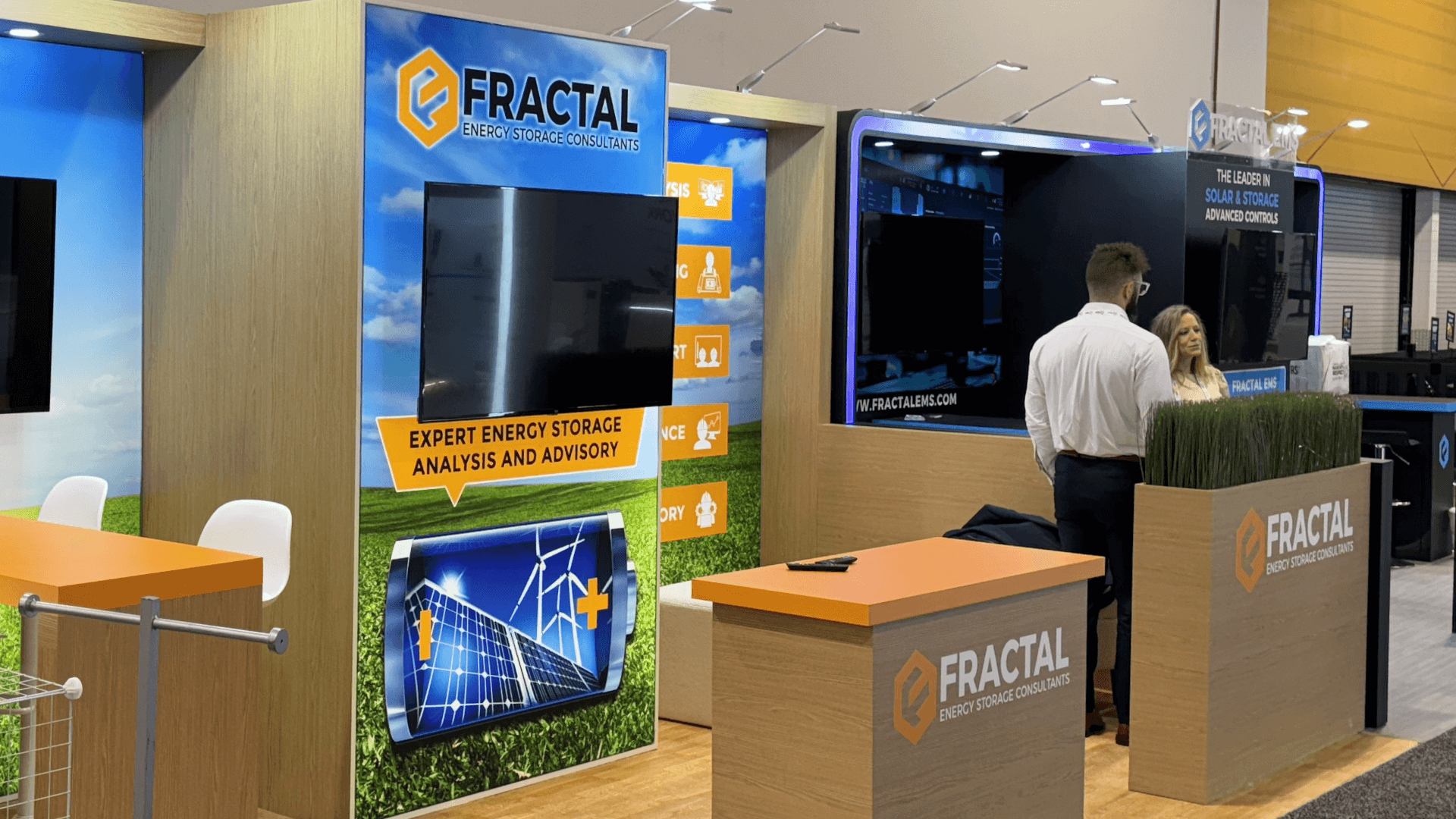
Fractal brought a 10x20 booth to RE+ 2024, built to present clean energy and power technology in a way that engineers, project teams, and buyers could understand quickly from the aisle. Instead of treating the footprint like a generic industrial back wall, the booth needed to support fast-read product messaging, a compact demo line, and short technical conversations without losing visual order. In a clean energy show where attendees compare solar, storage, grid, and electrification solutions in one pass, the layout had to make “what this booth does” readable in seconds while still supporting more serious discussion. Circle Exhibit’s project index confirms the Fractal project at RE+ 2024, and Circle Exhibit’s RE+ guide defines the show around solar, storage, hydrogen, wind, smart grid, and electric mobility.
Because RE+ traffic is technical and comparison-driven, we treated back-wall readability, demo placement, cable routing, and entry-edge control as part of the booth system from day one. That allowed the space to support quick product explanation at the front while still keeping the footprint calm and usable under continuous traffic. For a footprint like this, the logic behind a 10x20 trade show booth size guide is not more decoration. It is making a straight-line booth easier to read, easier to enter, and easier to operate under time pressure. Circle Exhibit’s 10x20 guide specifically recommends a message-first, demo-second, cable-controlled layout strategy for this size.
To keep the installation predictable, we planned the booth around early message hierarchy, compact demo behavior, and the sequence needed to get the front edge usable before traffic built. That same logic is why this case also connects naturally to design & engineering, because smaller engineering-led booths perform best when structural readiness, graphic mapping, and cable behavior are solved before fabrication starts. Circle Exhibit’s 10x20 guide emphasizes layout drawings, engineering review notes, graphics mapping, packing logic, and install sequencing as the core controls for this size.



💼
Client:
📅
Year/Exhibition:
📍
Location:
📐
Size:
🏢
Industry:
🏢
Venue Context:
Challenge
The main challenge was compression. A 10x20 clean energy booth has limited depth, which means every display surface, counter, and message layer carries more weight. Fractal needed the booth to explain energy-related technology quickly without forcing visitors deep into the footprint before they understood the value. In a show where attendees compare technical solutions in short passes, the booth had to act like a clear message stack first and an interaction point second. That challenge aligns directly with Circle Exhibit’s 10x20 booth guide, which says the back wall must work as the primary read while the demo line stays controllable from the aisle.
The second challenge came from execution. Smaller technical booths still depend on physical discipline: screen placement, cable routing, compact counter depth, and a clean install order all affect whether the booth feels credible on show day. That is why this case also supports booth fabrication and pre-build checks in Las Vegas. Even when the footprint is modest, the booth only performs well when the structure, graphics, and cable logic are resolved before show-floor pressure begins. Circle Exhibit’s 10x20 guide specifically highlights engineering review, graphics mapping, packing labels, and install order as the controls that reduce on-site surprises.
Design vs. On-site Execution
The concept was built around straight-line clarity. Instead of filling the booth with too many competing objects, the layout needed to organize the message so visitors could understand the product category almost immediately. The back wall carried the main read, the demo point stayed forward, and the visible surfaces were kept clean enough to make the booth feel technical rather than crowded. For a clean energy brand in a compact footprint, that meant treating the booth like a controlled sequence: headline first, proof second, conversation third. This closely follows Circle Exhibit’s published 10x20 design guidance.
On site, that concept only worked because the install sequence protected the same priorities as the layout. The back wall had to land cleanly, the demo touchpoint had to stay usable from the aisle, and cable paths had to stay off the entry edge. In a booth like this, layout logic and installation order are tightly connected. The goal was not to make the booth feel larger than it was, but to make it feel controlled, readable, and technically credible throughout the day.
If you’d like to see the same build from the project portfolio view (more photos and a quick visual summary), visit the Fractal in RE+ 2024 project page.
Aisle-First Message Wall
The back-wall message stack acted as the primary billboard, helping visitors understand the product category before they stepped into the booth. This follows Circle Exhibit’s 10x20 booth guidance directly.
Forward Demo Touchpoint
A compact demo point positioned near the aisle made it easier to turn pass-by attention into quick product explanation without forcing visitors deep into the footprint first.
Technical Proof Layer
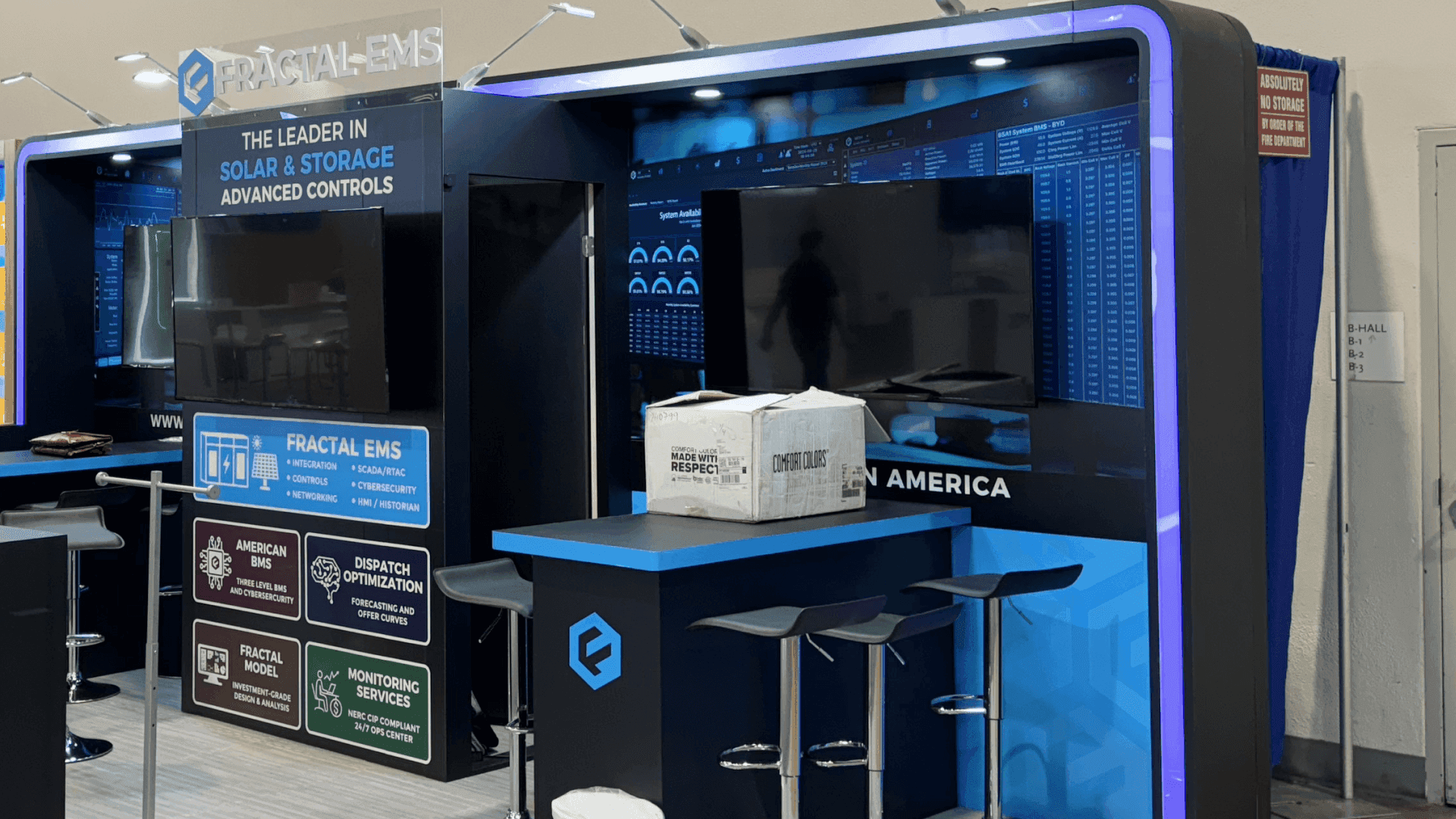
A structured proof zone helped connect the headline with more specific product detail, giving the booth enough technical depth without making the layout feel overloaded. This is an inference grounded in the 10x20 guide’s message-first, proof-second sequence.
Compact Conversation Edge
A shallow counter zone supported short buyer conversations while preserving the straight-line logic of the booth and keeping the aisle-facing edge readable. This is an inference supported by the 10x20 guide’s emphasis on shallow counters and controlled demo behavior.
On-site Highlights
This booth worked because the execution system protected the same qualities that made the concept effective: back-wall readability, controlled demo behavior, and clean entry flow. In a technical show environment, compact booths amplify mistakes quickly, so cable routing, freight order, graphic placement, and install sequencing all matter more. The following highlights show how show-floor execution helped keep the Fractal booth readable, stable, and operational under a compressed 10x20 format.
On-Site Execution Highlights
Back-Wall Alignment + Readability Control
Power + Cable Routing for Entry Protection
Drayage + Open-First Staging Control
Install Sequencing + Graphic Protection
Install Closeout + Demo Line Readiness
Outcome
The booth made clean energy technology easier to understand from the aisle, helping visitors move from quick recognition into more useful product conversations. This is an inference grounded in the booth’s confirmed RE+ context and the 10x20 message-stack strategy.
By keeping the demo touchpoint forward and the cable behavior controlled, the booth felt more like a working technical environment than a generic small display. This is an inference supported by the 10x20 execution guidance.
The 10x20 booth stayed readable enough for walk-up interaction while still holding enough structure for product proof and short buyer conversations.
Because the booth was planned around message hierarchy, cable discipline, and install order, it could open in a cleaner and more operational condition for show traffic.
What made this booth effective was not scale. It was the fact that the layout behaved like a controlled technical sequence. At a clean energy show, that matters more than decoration. Visitors do not just want to see a logo. They want to understand what kind of system is being shown, what proof supports it, and whether the booth feels easy to enter without confusion. By giving the booth a strong first-read wall, a forward demo point, and a compact conversation edge, the space turned technical comparison into something easier to approach. This framing is grounded in Circle Exhibit’s 10x20 execution guidance and the RE+ clean-energy show context.
Practical takeaway: if a clean energy booth needs to support technical messaging and quick buyer conversations inside a 10x20 footprint, do not solve it by adding more objects. Solve it with sequence and restraint. The strongest booths are the ones where the back-wall story, demo line, cable routing, and install order already work together before the hall opens.
Quick Q&A
Q: What made this Fractal booth different from a generic small industrial booth?
A: The project is explicitly tied to RE+ 2024, and Circle Exhibit’s RE+ content frames the show around technical clean energy comparison, which makes a message-first, proof-second booth strategy more useful than a generic product pile.
Q: Why was a 10×20 footprint suitable for this booth?
A: Circle Exhibit’s 10x20 guide says this size works best when the booth is treated as a straight-line experience with a strong back-wall read and a controlled demo touchpoint.
Q: What execution factor matters most for a compact clean energy booth?
A: Cable routing and demo-line control, because a single cable crossing the wrong place can break flow immediately in a 10x20 layout.
Q: Why is early engineering review important in a booth like this?
A: Circle Exhibit’s 10x20 guide highlights engineering review notes, graphics mapping, and install sequencing as the main ways to reduce on-site surprises in compact booths.
Q: What is the most overlooked detail in a 10×20 technical booth?
A: Late changes. The 10x20 guide explicitly says execution risk concentrates in queue behavior, cable paths, and late changes, which is why compact booths need decisions locked early.