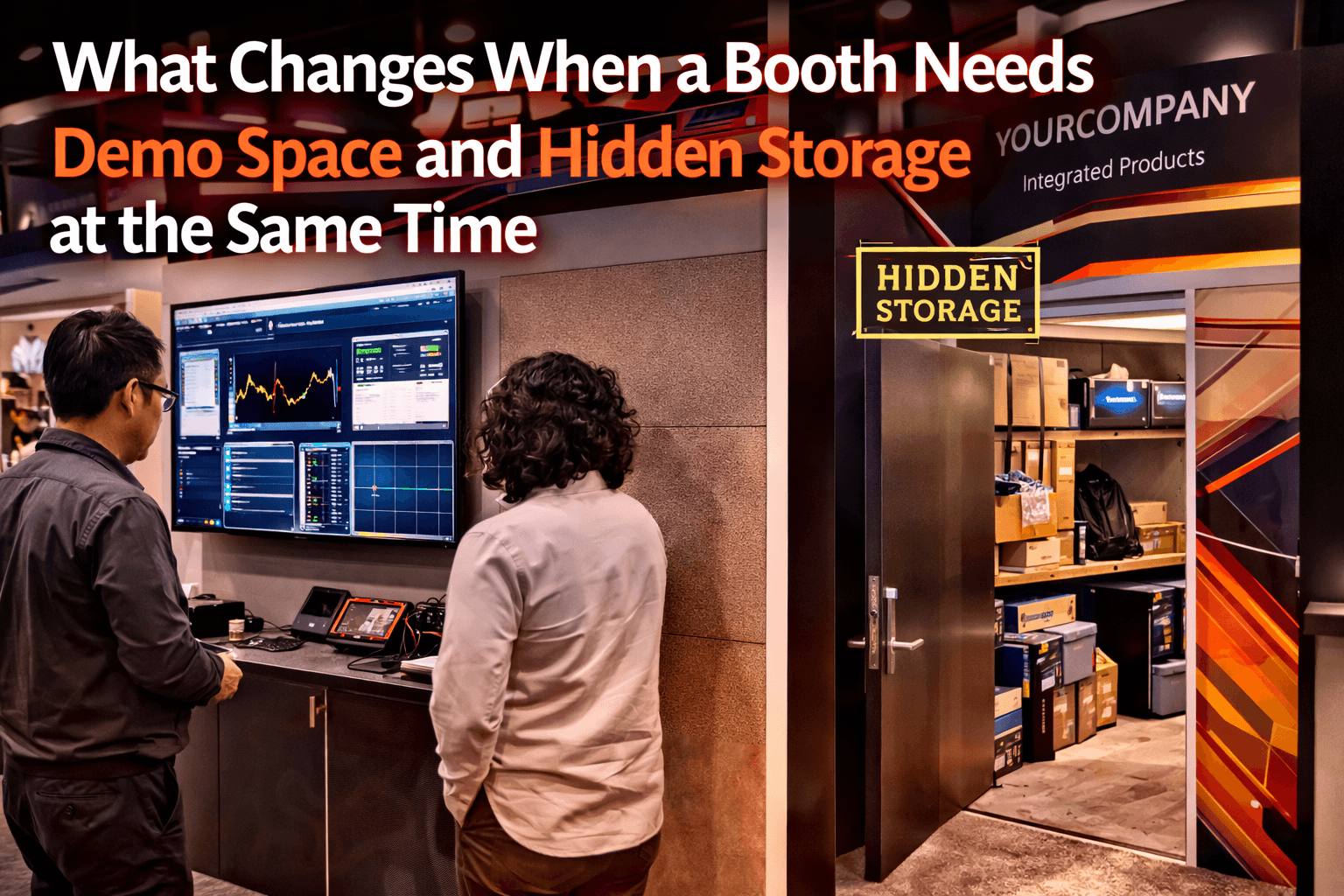
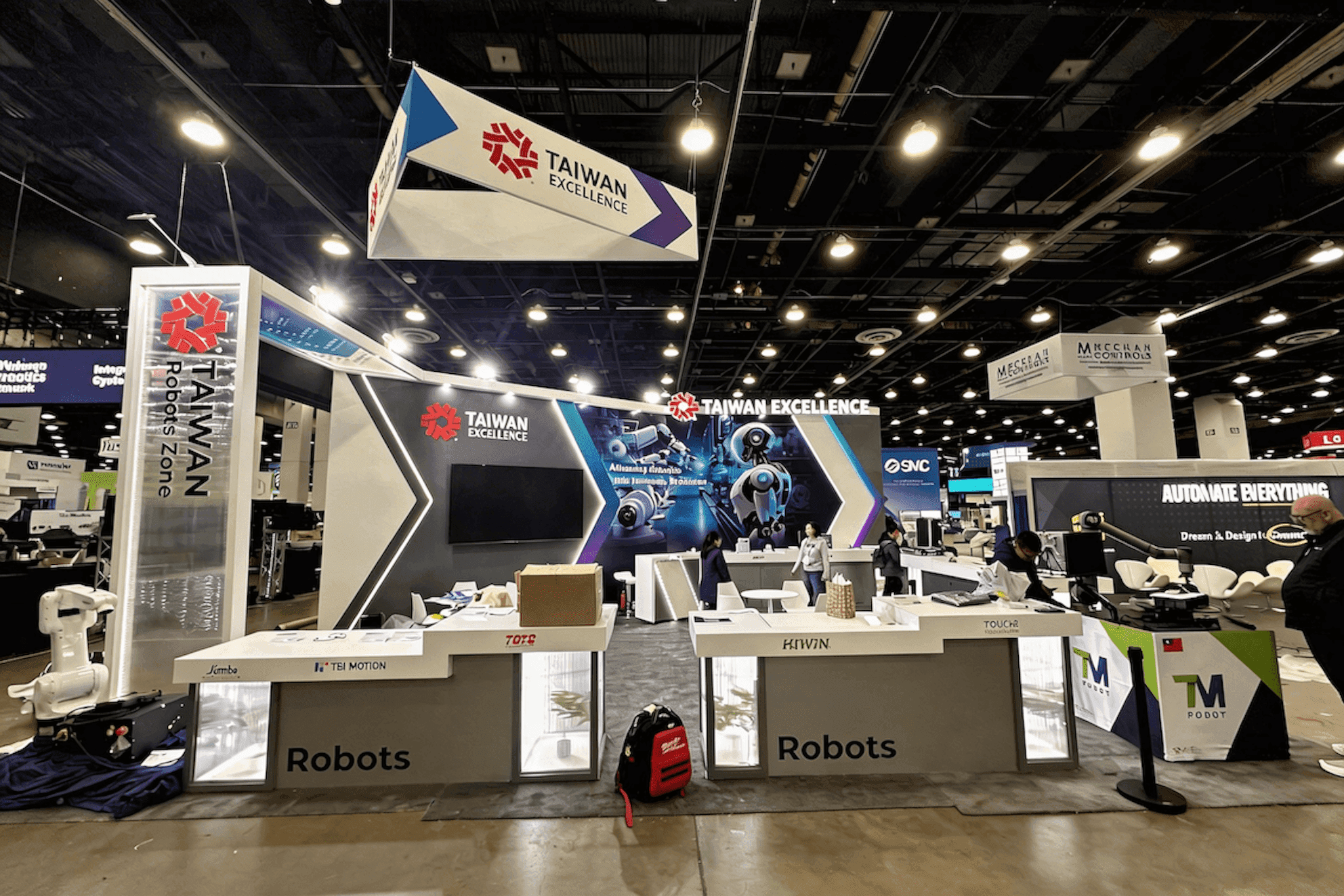
Trade show booth with a product demo area and concealed storage wall, showing hidden back-of-house space integrated into the visible layout

What Changes When a Booth Needs Demo Space and Hidden Storage at the Same Time

What Changes When a Booth Needs Demo Space and Hidden Storage at the Same Time

Circle Exhibit Team

Industry professionals

Exhibition industry professional dedicated to delivering the latest insights and curated recommendations to you.

Exhibition industry professional dedicated to delivering the latest insights and curated recommendations to you.

When a booth needs hidden storage, the layout changes immediately. Concealed storage affects circulation, wall planning, demo visibility, and how much usable space the booth really has.

When a booth needs hidden storage, the layout changes immediately. Concealed storage affects circulation, wall planning, demo visibility, and how much usable space the booth really has.

When a booth needs hidden storage, the layout changes immediately. Concealed storage affects circulation, wall planning, demo visibility, and how much usable space the booth really has.

Hidden storage is never just a back-of-house detail

A lot of exhibitors treat hidden storage like a simple add-on.

They know they need somewhere to keep:

  • extra product

  • literature

  • giveaways

  • staff bags

  • cleaning tools

  • personal items

  • spare hardware

  • backup demo material

So a storage closet or concealed wall gets added into the layout near the end.

That is usually where the booth starts changing in bigger ways than expected.

Because hidden storage is not just a utility choice.
It changes how the booth works.

The first thing it changes is usable floor space

This is the most obvious shift, but not always the most understood.

When a booth adds hidden storage, it is not only losing square footage on paper. It is losing visible, flexible floor that the demo zone might otherwise have used.

That affects:

  • where people stand

  • how the booth opens from the aisle

  • how deep the demo area feels

  • where staff can move

  • whether the booth still feels spacious or starts feeling compressed

That is why storage should be planned early, not inserted late.

A concealed wall creates more than storage, it creates a new edge

The moment you add hidden storage, you are also creating a wall condition.

That wall affects the booth in several ways:

  • it blocks sightlines

  • it changes entry angles

  • it influences where visitors stop

  • it creates a front side and a back side

  • it can either support the demo or crowd it

This is why hidden storage is really a layout decision disguised as an operational one.

If the storage wall sits in the wrong place, the booth loses openness.
If it sits in the right place, the booth gains control.

Demo space usually needs the cleanest visual priority

In most booths with active product demos, the demo area still needs to lead.

That means the visitor should be able to understand:

  • where the interaction is happening

  • where to stand

  • what to watch first

  • where the product story begins

If the hidden storage wall interrupts that first read, the booth starts feeling more closed than it should.

A storage solution should support the demo.
It should not visually compete with the part of the booth people came to experience.

Hidden storage usually works better beside the demo than behind the visitor path

This is one of the most common layout decisions.

A booth needs concealed storage, but where should it go?

In many cases, a side or rear-side position works better than a front-facing one.

That usually helps the booth keep:

  • a clearer front edge

  • better demo visibility

  • more natural entry

  • less visual heaviness at the aisle

If the storage wall moves too close to the front, the booth can start reading like a closed box with a demo squeezed into what is left.

That is almost always weaker than letting the demo lead and allowing storage to support from the side.

Circulation changes the moment the booth needs staff-only access

This is where hidden storage creates a second layer of movement.

Now the booth is not just serving visitor flow.
It also has to serve staff movement.

That means the layout needs to account for:

  • door swing or access opening

  • staff retrieval movement

  • paths that do not cut through the demo

  • moments when someone needs to step in and out without breaking the booth rhythm

If that circulation is not planned, the booth can become awkward very quickly. Staff keep crossing behind or beside the demo. The audience feels the disruption even if they do not know why. The booth starts looking less controlled.

That is why hidden storage changes circulation more than many teams expect.

Graphics have to work harder when a storage wall is present

This is where graphics and brand presentation matter.

A concealed storage wall does not have to look like a utility box.
But it also should not pretend to be the main hero surface if it is not.

The best approach usually gives that wall a clear supporting role.

That can mean:

  • clean brand messaging

  • a quiet category statement

  • a secondary graphic treatment

  • a visual finish that matches the booth without overpowering it

If the wall is graphically too loud, it competes with the demo.
If it is too plain, it feels like a leftover structure.

The right balance helps the booth stay intentional.

Booth size makes a big difference here

This is one reason booth size matters so much when hidden storage enters the plan.

A 20x20 trade show booth can support concealed storage, but the layout has to be disciplined. Every wall has more consequence, and every foot of lost openness matters more.

A 20x30 trade show booth usually gives more flexibility. It allows the booth to hold:

  • a more believable demo zone

  • cleaner visitor circulation

  • a less intrusive storage wall

  • stronger separation between front-of-house and support functions

That extra depth or width can make the difference between a booth that feels controlled and one that feels like the storage area is always a little too present.

Hidden storage should reduce clutter, not relocate clutter

This sounds simple, but it matters.

A concealed storage solution is only working if it actually makes the booth cleaner.

If the booth still has:

  • extra items sitting outside the closet

  • giveaway overflow near counters

  • literature stacked on demo surfaces

  • personal items drifting into view

  • staff opening and closing a poorly placed door all day

then the storage is not really solving the problem.

It is just moving part of the clutter and leaving the rest visible.

That usually means the storage size, access logic, or position was not planned well enough.

Builder planning matters because concealed storage affects the whole booth

This is one reason exhibitors benefit from working with a Las Vegas trade show booth builder that understands hidden storage as a structural and behavioral decision.

Because once storage enters the booth, it affects:

  • wall planning

  • circulation

  • sightlines

  • demo readability

  • usable square footage

  • staff movement

  • the booth’s overall sense of openness

A storage wall that looks smart on a plan can still feel heavy on the floor if it steals too much from the demo or interrupts the visitor path.

That is why the storage solution has to be designed as part of the booth logic, not attached to it later.

The strongest layouts usually keep this order clear

When a booth needs both demo space and hidden storage, the cleanest layouts usually protect this sequence:

1. Demo first

The visitor should still understand where the main interaction lives.

2. Circulation second

People need room to enter, pause, and move without conflict.

3. Storage third

The support function should stay useful without becoming visually dominant.

If that order holds, the booth usually feels much more controlled.

If it breaks, the storage wall starts influencing the booth more than the demo does.

Final thought

A booth that needs demo space and hidden storage is not a problem.

It just needs a different kind of planning.

The moment concealed storage becomes part of the booth, the wall strategy changes, the circulation changes, and the amount of truly usable demo space changes too.

That is why hidden storage should never be treated like an afterthought.

When it is planned early, the booth feels cleaner and more intentional.
When it is planned late, the booth usually feels tighter than expected.

That is the real change.


Planning a booth that needs both demo space and concealed storage?
Start with a stronger Las Vegas trade show booth builder approach, then choose the right footprint so the storage wall supports the layout instead of stealing from it.
Hidden storage is never just a back-of-house detail

A lot of exhibitors treat hidden storage like a simple add-on.

They know they need somewhere to keep:

  • extra product

  • literature

  • giveaways

  • staff bags

  • cleaning tools

  • personal items

  • spare hardware

  • backup demo material

So a storage closet or concealed wall gets added into the layout near the end.

That is usually where the booth starts changing in bigger ways than expected.

Because hidden storage is not just a utility choice.
It changes how the booth works.

The first thing it changes is usable floor space

This is the most obvious shift, but not always the most understood.

When a booth adds hidden storage, it is not only losing square footage on paper. It is losing visible, flexible floor that the demo zone might otherwise have used.

That affects:

  • where people stand

  • how the booth opens from the aisle

  • how deep the demo area feels

  • where staff can move

  • whether the booth still feels spacious or starts feeling compressed

That is why storage should be planned early, not inserted late.

A concealed wall creates more than storage, it creates a new edge

The moment you add hidden storage, you are also creating a wall condition.

That wall affects the booth in several ways:

  • it blocks sightlines

  • it changes entry angles

  • it influences where visitors stop

  • it creates a front side and a back side

  • it can either support the demo or crowd it

This is why hidden storage is really a layout decision disguised as an operational one.

If the storage wall sits in the wrong place, the booth loses openness.
If it sits in the right place, the booth gains control.

Demo space usually needs the cleanest visual priority

In most booths with active product demos, the demo area still needs to lead.

That means the visitor should be able to understand:

  • where the interaction is happening

  • where to stand

  • what to watch first

  • where the product story begins

If the hidden storage wall interrupts that first read, the booth starts feeling more closed than it should.

A storage solution should support the demo.
It should not visually compete with the part of the booth people came to experience.

Hidden storage usually works better beside the demo than behind the visitor path

This is one of the most common layout decisions.

A booth needs concealed storage, but where should it go?

In many cases, a side or rear-side position works better than a front-facing one.

That usually helps the booth keep:

  • a clearer front edge

  • better demo visibility

  • more natural entry

  • less visual heaviness at the aisle

If the storage wall moves too close to the front, the booth can start reading like a closed box with a demo squeezed into what is left.

That is almost always weaker than letting the demo lead and allowing storage to support from the side.

Circulation changes the moment the booth needs staff-only access

This is where hidden storage creates a second layer of movement.

Now the booth is not just serving visitor flow.
It also has to serve staff movement.

That means the layout needs to account for:

  • door swing or access opening

  • staff retrieval movement

  • paths that do not cut through the demo

  • moments when someone needs to step in and out without breaking the booth rhythm

If that circulation is not planned, the booth can become awkward very quickly. Staff keep crossing behind or beside the demo. The audience feels the disruption even if they do not know why. The booth starts looking less controlled.

That is why hidden storage changes circulation more than many teams expect.

Graphics have to work harder when a storage wall is present

This is where graphics and brand presentation matter.

A concealed storage wall does not have to look like a utility box.
But it also should not pretend to be the main hero surface if it is not.

The best approach usually gives that wall a clear supporting role.

That can mean:

  • clean brand messaging

  • a quiet category statement

  • a secondary graphic treatment

  • a visual finish that matches the booth without overpowering it

If the wall is graphically too loud, it competes with the demo.
If it is too plain, it feels like a leftover structure.

The right balance helps the booth stay intentional.

Booth size makes a big difference here

This is one reason booth size matters so much when hidden storage enters the plan.

A 20x20 trade show booth can support concealed storage, but the layout has to be disciplined. Every wall has more consequence, and every foot of lost openness matters more.

A 20x30 trade show booth usually gives more flexibility. It allows the booth to hold:

  • a more believable demo zone

  • cleaner visitor circulation

  • a less intrusive storage wall

  • stronger separation between front-of-house and support functions

That extra depth or width can make the difference between a booth that feels controlled and one that feels like the storage area is always a little too present.

Hidden storage should reduce clutter, not relocate clutter

This sounds simple, but it matters.

A concealed storage solution is only working if it actually makes the booth cleaner.

If the booth still has:

  • extra items sitting outside the closet

  • giveaway overflow near counters

  • literature stacked on demo surfaces

  • personal items drifting into view

  • staff opening and closing a poorly placed door all day

then the storage is not really solving the problem.

It is just moving part of the clutter and leaving the rest visible.

That usually means the storage size, access logic, or position was not planned well enough.

Builder planning matters because concealed storage affects the whole booth

This is one reason exhibitors benefit from working with a Las Vegas trade show booth builder that understands hidden storage as a structural and behavioral decision.

Because once storage enters the booth, it affects:

  • wall planning

  • circulation

  • sightlines

  • demo readability

  • usable square footage

  • staff movement

  • the booth’s overall sense of openness

A storage wall that looks smart on a plan can still feel heavy on the floor if it steals too much from the demo or interrupts the visitor path.

That is why the storage solution has to be designed as part of the booth logic, not attached to it later.

The strongest layouts usually keep this order clear

When a booth needs both demo space and hidden storage, the cleanest layouts usually protect this sequence:

1. Demo first

The visitor should still understand where the main interaction lives.

2. Circulation second

People need room to enter, pause, and move without conflict.

3. Storage third

The support function should stay useful without becoming visually dominant.

If that order holds, the booth usually feels much more controlled.

If it breaks, the storage wall starts influencing the booth more than the demo does.

Final thought

A booth that needs demo space and hidden storage is not a problem.

It just needs a different kind of planning.

The moment concealed storage becomes part of the booth, the wall strategy changes, the circulation changes, and the amount of truly usable demo space changes too.

That is why hidden storage should never be treated like an afterthought.

When it is planned early, the booth feels cleaner and more intentional.
When it is planned late, the booth usually feels tighter than expected.

That is the real change.


Planning a booth that needs both demo space and concealed storage?
Start with a stronger Las Vegas trade show booth builder approach, then choose the right footprint so the storage wall supports the layout instead of stealing from it.


Message

Leave your message and we will get back to you ASAP

Send a Message

We’ll Be in Touch!

Message

Leave your message and we will get back to you ASAP

Address:

4915 Steptoe Street #300

Las Vegas, NV 89122