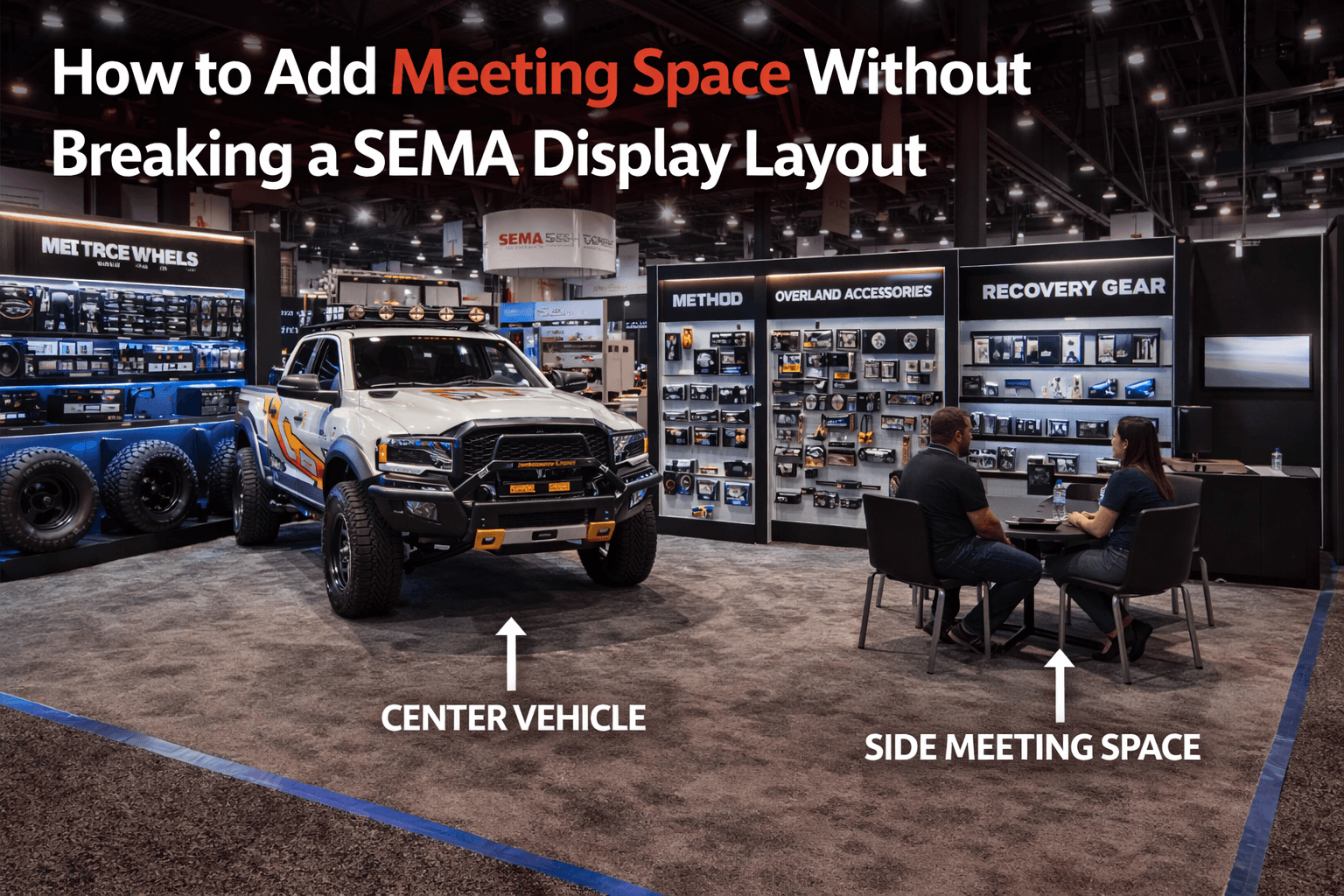
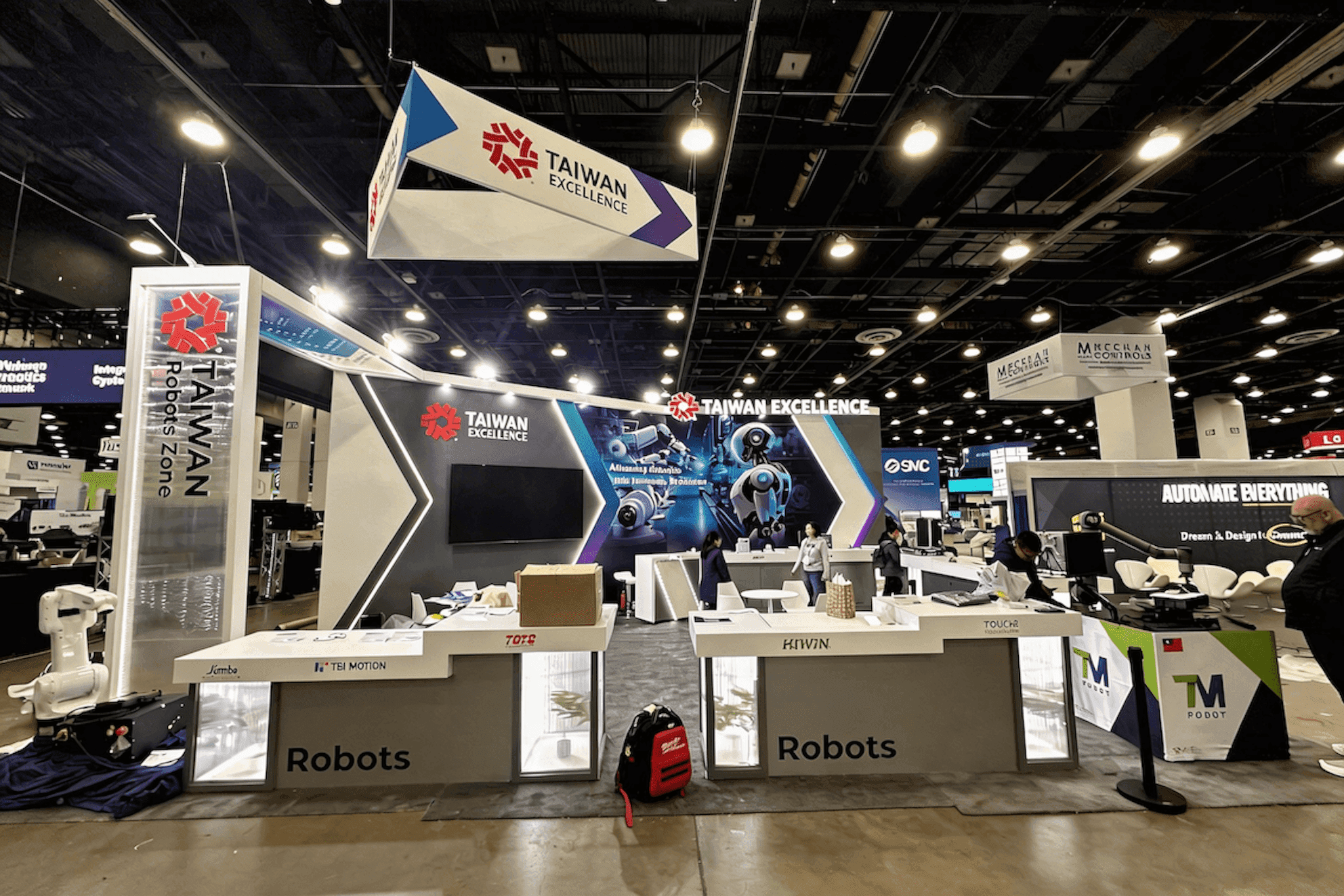
SEMA booth in Las Vegas with a center vehicle display, side meeting corner, product walls, and open circulation that keeps the meeting area secondary to the main display

How to Add Meeting Space Without Breaking a SEMA Display Layout

How to Add Meeting Space Without Breaking a SEMA Display Layout

Circle Exhibit Team

Industry professionals

Exhibition industry professional dedicated to delivering the latest insights and curated recommendations to you.

Exhibition industry professional dedicated to delivering the latest insights and curated recommendations to you.

At SEMA, meeting space has to stay secondary to the display logic. A better booth layout gives conversations somewhere to happen without letting the meeting area interfere with the vehicle, product zones, or circulation.

At SEMA, meeting space has to stay secondary to the display logic. A better booth layout gives conversations somewhere to happen without letting the meeting area interfere with the vehicle, product zones, or circulation.

At SEMA, meeting space has to stay secondary to the display logic. A better booth layout gives conversations somewhere to happen without letting the meeting area interfere with the vehicle, product zones, or circulation.

The meeting area is useful, but it should not lead the booth

A lot of SEMA exhibitors know they need space for real conversations.

That part is true.

The mistake usually comes later, when the meeting area starts getting treated like an equal visual priority to the display itself.

That is when the booth begins to lose shape.

At SEMA, the meeting space should support the booth.
It should not become the first thing the booth is trying to say.

The vehicle still has to win the first stop

Most vehicle booths work because the center display pulls attention quickly.

That first visual stop matters.

If the booth gives too much space, structure, or visual weight to the meeting area near the front edge, the center vehicle starts losing its authority. Visitors no longer get a clean read of what the booth is about. The display feels split between “look here” and “sit here.”

That usually weakens both.

The stronger layout keeps the vehicle, product story, and circulation in the first layer. The meeting space belongs after that.

A meeting area should follow interest, not try to create it

This is the core planning rule.

A SEMA meeting space is there for what happens after the first stop:

  • product questions

  • dealer or buyer conversations

  • project-specific discussions

  • deeper product comparisons

  • follow-up after someone understands the display

It is not there to replace the visual work the booth still needs to do.

That is why the meeting area usually performs best when it feels available but not dominant.

The side zone is usually safer than the front zone

Most SEMA booths break when the meeting space moves too far forward.

That creates several problems at once:

  • it competes with the vehicle for first attention

  • it interrupts the clean entry line

  • it makes the booth look occupied before a visitor enters

  • it pulls chairs, tables, and people into the most sensitive display area

A side meeting corner usually works better.

It gives the booth a place for serious talk without cutting across the center display. It also lets the booth stay open at the front, which is where the vehicle and product story still need the most room.

The meeting area should feel integrated, not isolated

There is another mistake that goes in the opposite direction.

Some booths push the meeting space so far back or so deep into the corner that it stops feeling connected to the display.

That can make the booth feel fragmented.

The better version is usually a side or rear-side meeting zone that still feels tied to the main booth logic. People should be able to move there naturally after engaging with the display. It should feel like the next layer of the booth, not like a separate room that happens to sit nearby.

That balance matters more than people expect.

A 30x40 booth usually gives this separation enough room to work

This is one reason a 30x40 trade show booth is such a useful footprint for SEMA vehicle displays.

That size often gives enough room to separate:

  • the center vehicle zone

  • the product display zone

  • the circulation path

  • the meeting area

In a tighter booth, the meeting space often steals from the vehicle or the product zone because there is nowhere else for it to go. In a better 30x40, the booth can let conversations happen without compressing the main display.

That is where the layout starts feeling deliberate instead of compromised.

Furniture can quietly ruin a booth edge

This gets overlooked all the time.

A meeting area is not only defined by where it sits. It is defined by what it brings into the booth:

  • chairs

  • tables

  • partitions

  • screens

  • hospitality surfaces

  • people staying in place longer than the rest of the crowd

All of these add visual and physical weight.

If that weight lands too close to the vehicle sightline or the main product zone, the booth begins to feel slower and more blocked. A meeting corner works better when it stays visually lighter than the display areas around it.

That usually means simpler furniture and fewer bulky barriers.

The meeting area should not interrupt circulation

This is where display layout and conversation layout usually collide.

If people have to pass through the meeting zone to move around the booth, the booth becomes awkward. If the meeting zone spills into the walkway, the booth starts feeling cluttered. If the meeting area sits in the path between the vehicle and the product wall, it interferes with the natural flow the display needed in order to make sense.

A better booth protects the circulation first.

Visitors should be able to:

  1. stop at the vehicle

  2. move toward the product zone

  3. continue into a conversation space if interest deepens

If the order gets reversed, the booth becomes harder to use.

Graphics should help the meeting space stay secondary

This is where graphics and brand presentation help more than many exhibitors realize.

A meeting corner should not need loud messaging to prove its importance.

It should borrow clarity from the larger booth instead of trying to become its own visual centerpiece.

That usually means:

  • cleaner, quieter messaging in the meeting zone

  • category clarity staying with the product area

  • stronger branding staying with the main display logic

  • the conversation space using visual support, not visual dominance

When the meeting area tries to look equally “heroic,” the booth becomes harder to prioritize.

Builder planning matters because meeting space changes booth behavior

This is one reason exhibitors benefit from working with a Las Vegas trade show booth builder that understands the booth as one connected environment.

Because adding meeting space changes more than furniture placement.

It affects:

  • sightlines

  • vehicle prominence

  • edge openness

  • crowd movement

  • product access

  • how long people remain in certain parts of the booth

A meeting corner that looks harmless on a floor plan can still weaken the booth once real traffic, chairs, and conversation behavior are added.

That is why the meeting zone has to be planned as part of the display logic, not as something dropped into leftover space.

A better SEMA booth usually follows this sequence

The strongest layouts usually keep this order clear:

1. Display first

The vehicle and product story create the first stop.

2. Product clarity second

The visitor understands what the booth is showing and why it matters.

3. Meeting space third

Conversation happens after the booth has already explained itself visually.

That order keeps the meeting area useful without letting it take over the booth.

Final thought

At SEMA, a meeting space is not a problem.

A badly prioritized meeting space is.

When the conversation area stays secondary to the display logic, the booth feels cleaner, more premium, and easier to understand. The vehicle still leads. The products still make sense. The booth stays open. And the people who are ready to talk have somewhere better to go than the center of the display.

That is usually the layout that works.


Planning a vehicle booth for SEMA Show?
Start with SEMA booth planning, then shape the layout with a Las Vegas trade show booth builder approach that keeps the display strong while giving conversations a better place to happen.
The meeting area is useful, but it should not lead the booth

A lot of SEMA exhibitors know they need space for real conversations.

That part is true.

The mistake usually comes later, when the meeting area starts getting treated like an equal visual priority to the display itself.

That is when the booth begins to lose shape.

At SEMA, the meeting space should support the booth.
It should not become the first thing the booth is trying to say.

The vehicle still has to win the first stop

Most vehicle booths work because the center display pulls attention quickly.

That first visual stop matters.

If the booth gives too much space, structure, or visual weight to the meeting area near the front edge, the center vehicle starts losing its authority. Visitors no longer get a clean read of what the booth is about. The display feels split between “look here” and “sit here.”

That usually weakens both.

The stronger layout keeps the vehicle, product story, and circulation in the first layer. The meeting space belongs after that.

A meeting area should follow interest, not try to create it

This is the core planning rule.

A SEMA meeting space is there for what happens after the first stop:

  • product questions

  • dealer or buyer conversations

  • project-specific discussions

  • deeper product comparisons

  • follow-up after someone understands the display

It is not there to replace the visual work the booth still needs to do.

That is why the meeting area usually performs best when it feels available but not dominant.

The side zone is usually safer than the front zone

Most SEMA booths break when the meeting space moves too far forward.

That creates several problems at once:

  • it competes with the vehicle for first attention

  • it interrupts the clean entry line

  • it makes the booth look occupied before a visitor enters

  • it pulls chairs, tables, and people into the most sensitive display area

A side meeting corner usually works better.

It gives the booth a place for serious talk without cutting across the center display. It also lets the booth stay open at the front, which is where the vehicle and product story still need the most room.

The meeting area should feel integrated, not isolated

There is another mistake that goes in the opposite direction.

Some booths push the meeting space so far back or so deep into the corner that it stops feeling connected to the display.

That can make the booth feel fragmented.

The better version is usually a side or rear-side meeting zone that still feels tied to the main booth logic. People should be able to move there naturally after engaging with the display. It should feel like the next layer of the booth, not like a separate room that happens to sit nearby.

That balance matters more than people expect.

A 30x40 booth usually gives this separation enough room to work

This is one reason a 30x40 trade show booth is such a useful footprint for SEMA vehicle displays.

That size often gives enough room to separate:

  • the center vehicle zone

  • the product display zone

  • the circulation path

  • the meeting area

In a tighter booth, the meeting space often steals from the vehicle or the product zone because there is nowhere else for it to go. In a better 30x40, the booth can let conversations happen without compressing the main display.

That is where the layout starts feeling deliberate instead of compromised.

Furniture can quietly ruin a booth edge

This gets overlooked all the time.

A meeting area is not only defined by where it sits. It is defined by what it brings into the booth:

  • chairs

  • tables

  • partitions

  • screens

  • hospitality surfaces

  • people staying in place longer than the rest of the crowd

All of these add visual and physical weight.

If that weight lands too close to the vehicle sightline or the main product zone, the booth begins to feel slower and more blocked. A meeting corner works better when it stays visually lighter than the display areas around it.

That usually means simpler furniture and fewer bulky barriers.

The meeting area should not interrupt circulation

This is where display layout and conversation layout usually collide.

If people have to pass through the meeting zone to move around the booth, the booth becomes awkward. If the meeting zone spills into the walkway, the booth starts feeling cluttered. If the meeting area sits in the path between the vehicle and the product wall, it interferes with the natural flow the display needed in order to make sense.

A better booth protects the circulation first.

Visitors should be able to:

  1. stop at the vehicle

  2. move toward the product zone

  3. continue into a conversation space if interest deepens

If the order gets reversed, the booth becomes harder to use.

Graphics should help the meeting space stay secondary

This is where graphics and brand presentation help more than many exhibitors realize.

A meeting corner should not need loud messaging to prove its importance.

It should borrow clarity from the larger booth instead of trying to become its own visual centerpiece.

That usually means:

  • cleaner, quieter messaging in the meeting zone

  • category clarity staying with the product area

  • stronger branding staying with the main display logic

  • the conversation space using visual support, not visual dominance

When the meeting area tries to look equally “heroic,” the booth becomes harder to prioritize.

Builder planning matters because meeting space changes booth behavior

This is one reason exhibitors benefit from working with a Las Vegas trade show booth builder that understands the booth as one connected environment.

Because adding meeting space changes more than furniture placement.

It affects:

  • sightlines

  • vehicle prominence

  • edge openness

  • crowd movement

  • product access

  • how long people remain in certain parts of the booth

A meeting corner that looks harmless on a floor plan can still weaken the booth once real traffic, chairs, and conversation behavior are added.

That is why the meeting zone has to be planned as part of the display logic, not as something dropped into leftover space.

A better SEMA booth usually follows this sequence

The strongest layouts usually keep this order clear:

1. Display first

The vehicle and product story create the first stop.

2. Product clarity second

The visitor understands what the booth is showing and why it matters.

3. Meeting space third

Conversation happens after the booth has already explained itself visually.

That order keeps the meeting area useful without letting it take over the booth.

Final thought

At SEMA, a meeting space is not a problem.

A badly prioritized meeting space is.

When the conversation area stays secondary to the display logic, the booth feels cleaner, more premium, and easier to understand. The vehicle still leads. The products still make sense. The booth stays open. And the people who are ready to talk have somewhere better to go than the center of the display.

That is usually the layout that works.


Planning a vehicle booth for SEMA Show?
Start with SEMA booth planning, then shape the layout with a Las Vegas trade show booth builder approach that keeps the display strong while giving conversations a better place to happen.
Message

Leave your message and we will get back to you ASAP

Send a Message

We’ll Be in Touch!

Message

Leave your message and we will get back to you ASAP

Address:

4915 Steptoe Street #300

Las Vegas, NV 89122