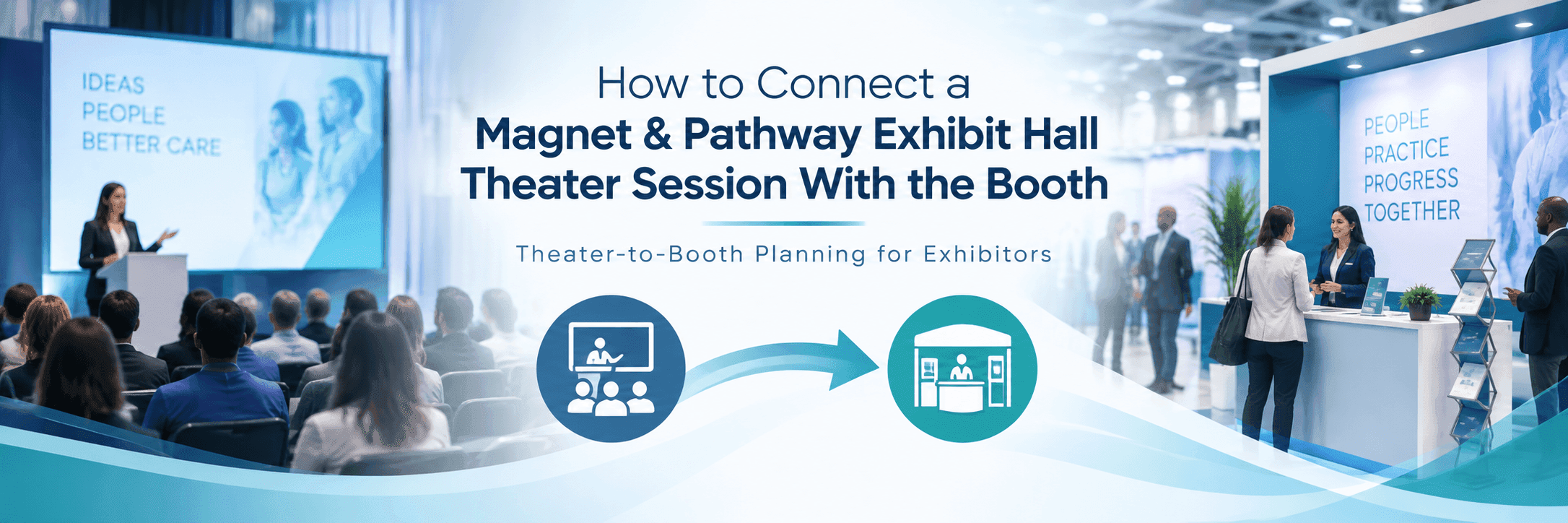
Give the Theater a Different Job From the Booth
The Exhibit Hall Theater is best used for material that needs more context than a typical show-floor exchange allows. It can frame a broader healthcare problem, explain a workflow, establish why a category matters, or show how several parts of a solution fit together before attendees begin considering what that solution could mean for their own organizations.
Here, shared context means the common understanding attendees should already have before the discussion becomes specific to one hospital, unit, workflow, or implementation need.
A useful Theater session leaves the audience far enough along that booth staff can begin with the next question instead of repeating the opening story. The Theater does not need to cover every feature or product detail; it needs to give attendees enough context to make the next interaction more useful.

The Theater and booth should share the same core message and visual language, while the booth adds more specific proof, questions, and next-step conversations.
Keep Individual Evaluation at the Booth
Once an attendee is interested, the booth can make the discussion specific to that organization, team, workflow, or implementation question. This is where a focused demo, product detail, or specialist conversation becomes more useful than another broad presentation.
Booth staff can respond to what the visitor actually wants to understand and decide whether the conversation needs more product depth, a specialist, or post-show follow-up. The Theater gives people a common starting point; the booth gives each visitor room to test the solution against their own setting.
Decide What Should—and Should Not—Be Repeated
The Theater and booth should feel like parts of the same story without delivering the same content. Keep the visual identity, central problem, and core terminology consistent while changing the depth, proof, demonstration, and next action.
What Can Stay Consistent | What Should Change |
|---|---|
Visual identity | Level of detail |
Core problem statement | Specific question being answered |
Key terminology | Examples and proof used |
High-level solution framing | Demonstration depth |
Core message | Next action for the attendee |
A Theater presentation does not need to be replayed at the booth, and booth staff do not need the same long script. Even the demo can change: the Theater may show a broader workflow, while the booth focuses on the part most relevant to a particular visitor.
Keeping that story recognizable across presentation screens, signage, and booth graphics is where graphics and brand presentation becomes useful. The visual language can stay consistent even as the content becomes more specific.
Give Attendees a Specific Reason to Continue at the Booth
A generic “visit our booth” message gives attendees little reason to change what they are already doing. A stronger transition tells them exactly what they can gain by continuing.
That might mean seeing a live workflow, asking how the solution fits a particular organization, comparing configurations, meeting a clinical or product specialist, or discussing implementation in more detail.
A handoff trigger is the specific reason to take that next step. When a nurse leader wants to move from the presentation into organization-specific evaluation, the booth needs a clear path into a deeper nurse-leader booth conversation without turning every visitor into a formal meeting.
Carry Context From Speaker to Booth Staff
A strong presentation can still lose momentum if booth staff do not know what attendees just heard. Visitors should not have to summarize the session before the team can continue the discussion.
Before the session, the speaker and booth team should agree on the main problem being discussed, the parts of the solution being emphasized, the questions attendees are likely to bring back, and which specialist is best prepared to handle each type of follow-up. They should also know exactly what next step the speaker is inviting people to take.
This is the context handoff: the essential information that needs to travel from the Theater to the booth team. With that context already in place, staff can start with the attendee’s actual question instead of restarting the product story.

After the Theater session, the booth should already be staffed and ready for focused demos, specialist discussions, lead capture, and several visitor interactions at once.
Prepare for the First 15 Minutes After the Session
The first few minutes after the Theater session are where the plan meets the show floor. If attendees reach the booth and find no available staff, an unprepared demo, or nowhere to continue the discussion, interest can disappear quickly.
Before the session ends, make sure:
at least one staff member remains available at the booth;
any demo referenced during the presentation is ready to run;
product, clinical, or technical specialists know when they may be needed;
the team knows whether the speaker is returning to the booth;
lead capture and follow-up tools are ready;
there is a clear place for quick questions, focused demos, and longer conversations.
Several visitors may arrive at once, and they will not all need the same thing. One may have a quick question, another may want a focused demo, while someone else may need a longer implementation discussion. The space should keep those activities from collecting around the same screen or blocking the entrance.
If that transition depends on screen placement, visitor flow, or a defined conversation or meeting area, those decisions belong in booth design and engineering, not in the presentation script itself.
FAQ
Should the Theater and booth use the same product demo?
Not necessarily. The Theater may use a broader demo to explain the workflow or solution context to a group, while the booth focuses on the part that matters to a particular organization or visitor. The two demos can share the same product story without repeating the same sequence or level of detail.
What is a good CTA at the end of an Exhibit Hall Theater presentation?
Give attendees a specific reason to continue rather than simply asking them to visit the booth. That could mean seeing a live workflow, asking an organization-specific question, comparing options, meeting a specialist, or continuing an implementation discussion.
Should the speaker return to the booth after the Theater session?
Not always. If attendees are likely to bring questions directly related to the session, having the speaker or another prepared specialist available can help preserve continuity. What matters is that someone at the booth can continue the discussion with the context the attendee already has.