Start With What Buyers Need to Verify
Begin with the product performance buyers need to see, then choose the simplest setup that proves it clearly. A sprinkler or nozzle may need moving water, while a filter, valve or pump may be better explained through controlled flow, readable gauges or visible components.
Spray pattern: use live water to show coverage, droplet behavior and distribution.
Flow change: use live water or a closed-loop system to show how valve movement, zone changes or flow adjustments affect the system.
Pressure response: use a controlled water display with readable gauges when equipment behavior under changing pressure matters.
Filter performance: use a contained live water or closed-loop display to show debris capture, pressure change or water condition before and after filtration.
Product structure: use a dry model, cutaway or transparent section when internal components and pipe connections matter more than active flow.
A more complex setup is not always more convincing. The right irrigation equipment demo method makes the main product claim easy to verify without adding unnecessary utilities, testing or reset work.
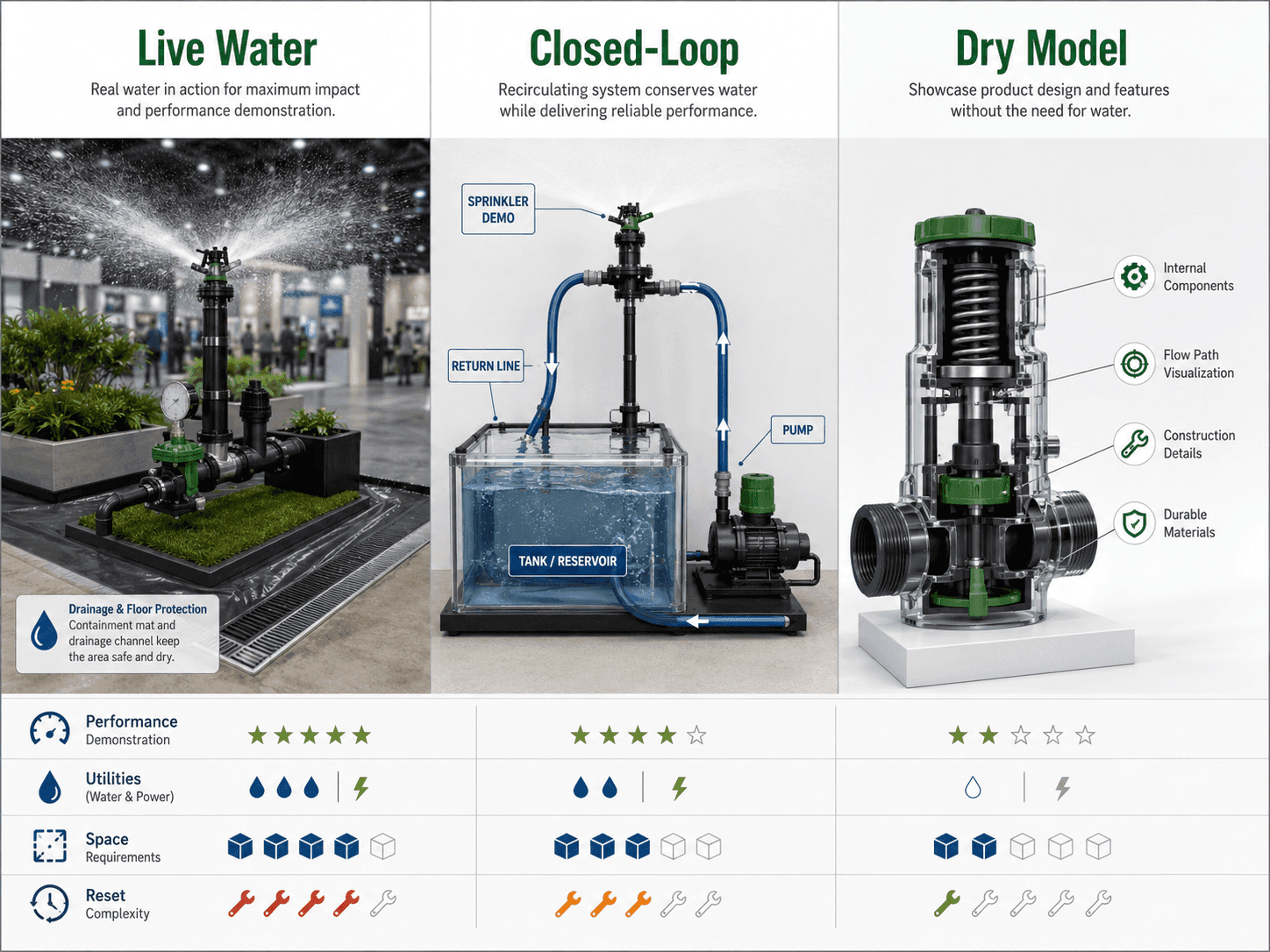
Live water shows operating performance, closed-loop systems support repeatable flow, and dry models make product structure easier to inspect without active water.
Live Water, Closed-Loop, and Dry Models Compared
For this comparison, a live water demo refers to a direct-supply or once-through setup in which water is discharged to drainage or wastewater capture rather than continuously recirculated. A closed-loop water display returns contained water through the equipment, while a dry model explains product structure or system logic without active flow.
Demo Method | Best For | Utilities | Space | Main Risk or Limitation | Reset Needs |
|---|---|---|---|---|---|
Live Water Demo | Spray pattern, pressure response, flow change and visible operating performance | Direct water supply, drainage or wastewater capture, power where required and floor protection | Operating area, splash control, viewing clearance and service access | Leaks, overspray, wet flooring or inconsistent supply pressure | Inspect connections, clear any overspray or collected water, restore pressure or flow and restart |
Closed-Loop Water Display | Repeatable pump, valve, flow meter and controlled filter demonstrations | Initial fill and final drain-down access, power, reservoir, return lines and either the product pump or a separate circulation pump | Equipment space, concealed hose routing, reservoir access and maintenance clearance | Containment leaks, air in the line, low water level, cloudy water or circulation interruption | Check the water level, prime the line, inspect connections and restart circulation |
Dry Model | Product structure, pipe routing, internal components, cutaways and side-by-side comparison | Usually no water utility; lighting, screens or small powered elements may still be needed | Less utility and service space, although a large cutaway may still require substantial floor area | Real flow, pressure or filtration performance cannot be directly verified | Usually minimal; reset moving parts, interactive elements or supporting media if used |
Use live water when buyers need to judge actual spray, pressure or flow behavior. A closed-loop display is easier to contain and repeat, while a dry model works better when internal structure and system connections matter more than active water.
The table is a planning comparison rather than a venue-compliance checklist. Final utility, wastewater and floor-protection requirements still need to be confirmed for the specific show site.
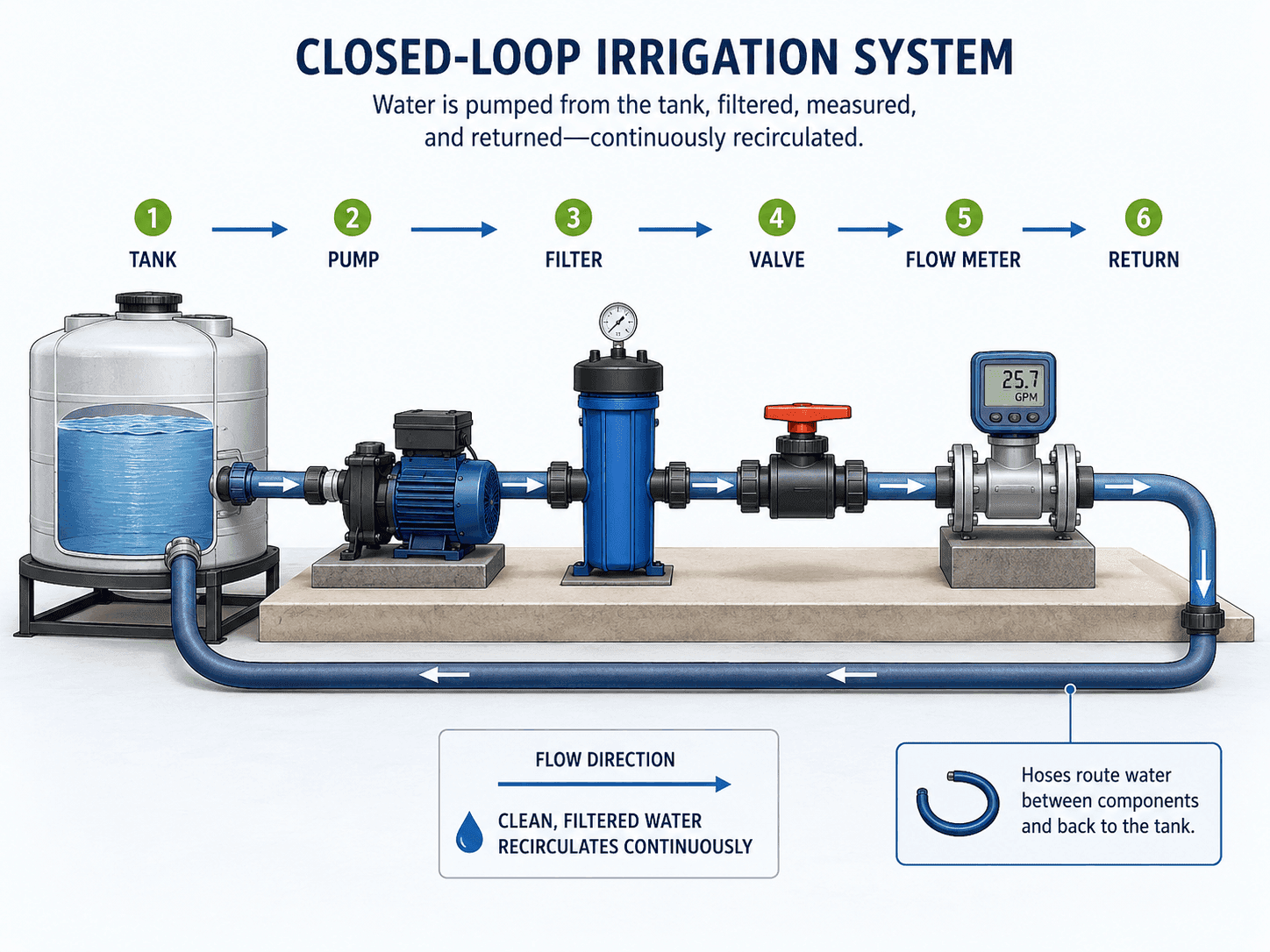
Water moves from the tank through the pump, filter, valve and flow meter before returning to the reservoir for the next demonstration.
Example: A Pump–Filter–Valve–Flow Meter Loop
A closed-loop water display can connect several irrigation components in one repeatable sequence:
Tank → Pump → Filter → Valve → Flow Meter → Return
Water moves from the tank through the pump and filter, passes the valve and reaches the flow meter before returning to the reservoir. Adjusting the valve position changes the flow reading, giving visitors a visible cause-and-effect relationship across the system.
Clear component labels, visible hose routing and readable flow data help the pump, filter, valve and flow meter register as one working loop rather than a row of separate products.
When the reservoir, operating equipment and return line require separate service access, a larger layout such as a 20x30 booth layout can help separate the working loop, visitor viewing area and maintenance path.
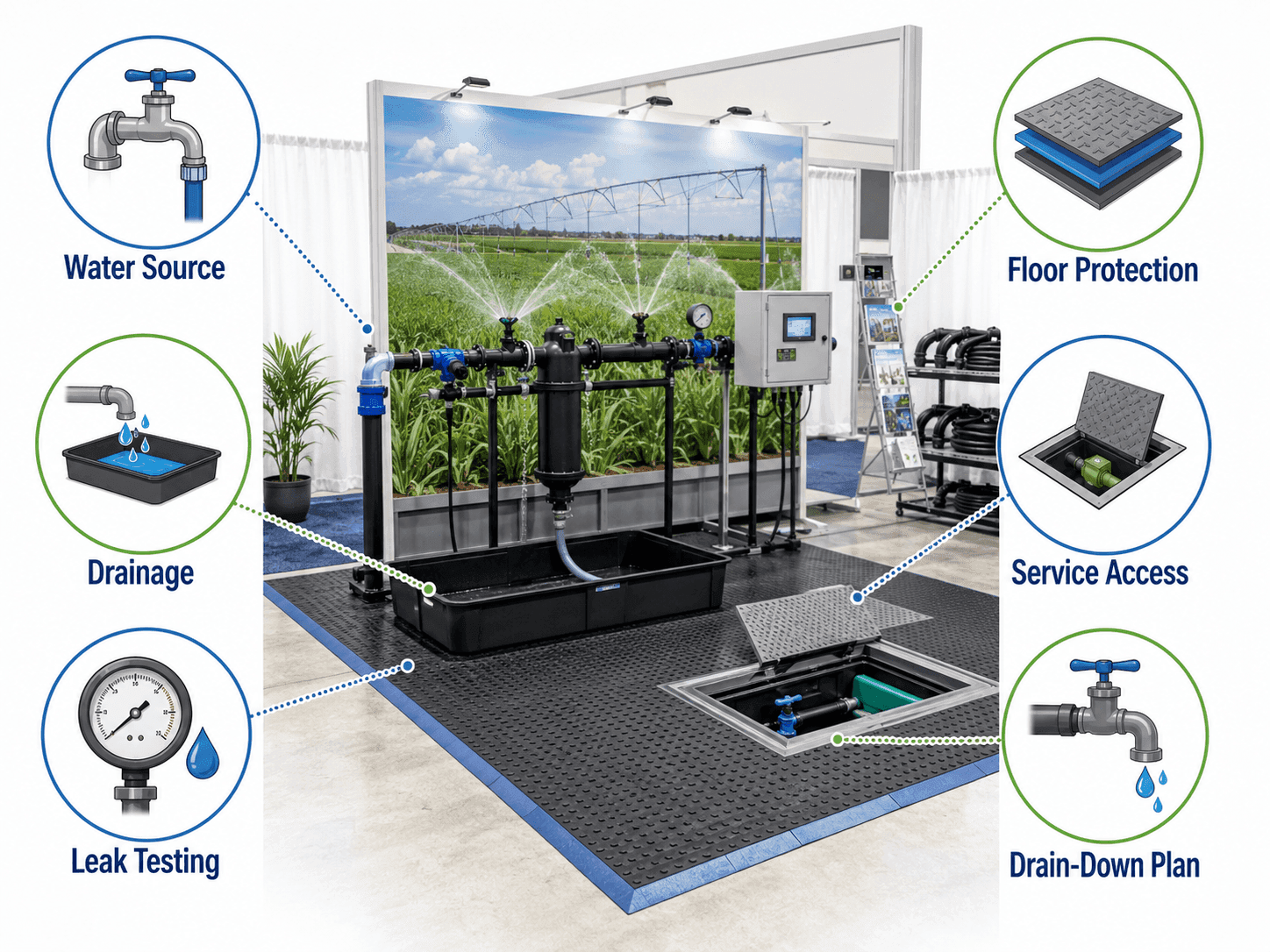
A working water display should confirm supply, drainage, containment, service access and final drain-down before booth installation begins.
Plan Water, Drainage, and Service Access Before Move-In
A working water display should be planned as an operating system, not simply as a group of products. Before move-in, confirm the water source, drainage or wastewater collection, hose routing, floor protection and service access around the equipment.
Check the following before installation:
Confirm the water source, connection point and supply route.
Verify the approved drainage point or wastewater collection method.
Complete leak testing on the tank, pump, fittings, hoses and return line.
Protect the floor from splashes, seepage and condensation.
Keep the pump, filter, valves and reservoir accessible for service.
Prepare a drain-down plan for shutdown, packing and dismantling.
Water delivery, wastewater handling and the drain-down sequence should be confirmed during pre-show logistics coordination, before freight and installation timing are finalized.
For Irrigation Show displays planned for the Las Vegas Convention Center, venue-specific utility, floor-protection and move-in requirements should be checked before the system is finalized.
The display should be as easy to stop, drain and reach as it is to operate.
Frequently Asked Questions
Is a Live Water Demo Necessary for Irrigation Equipment?
Not always. A live water demo is useful when buyers need to see spray pattern, pressure response, flow change or filter performance in operation. A closed-loop display can support repeatable flow testing, while a dry model may be enough when the product story centers on structure and connections.
How Does a Closed-Loop Irrigation Display Work?
A closed-loop irrigation display moves contained water from a tank through the pump and connected equipment, then returns it to the reservoir. Valves, filters and flow meters can run repeatedly without a continuous water supply or drainage after each demonstration.
When Is a Dry Irrigation Model More Practical?
A dry irrigation model works well when buyers need to inspect internal components, pipe routing, valve construction or filter media rather than active water performance. Cutaways and transparent sections can make those details visible while reducing water, drainage and leak-testing requirements.
Once the demonstration method is selected, the next step is fitting the equipment, utilities, service access and installation sequence into the wider Irrigation Show equipment display planning.