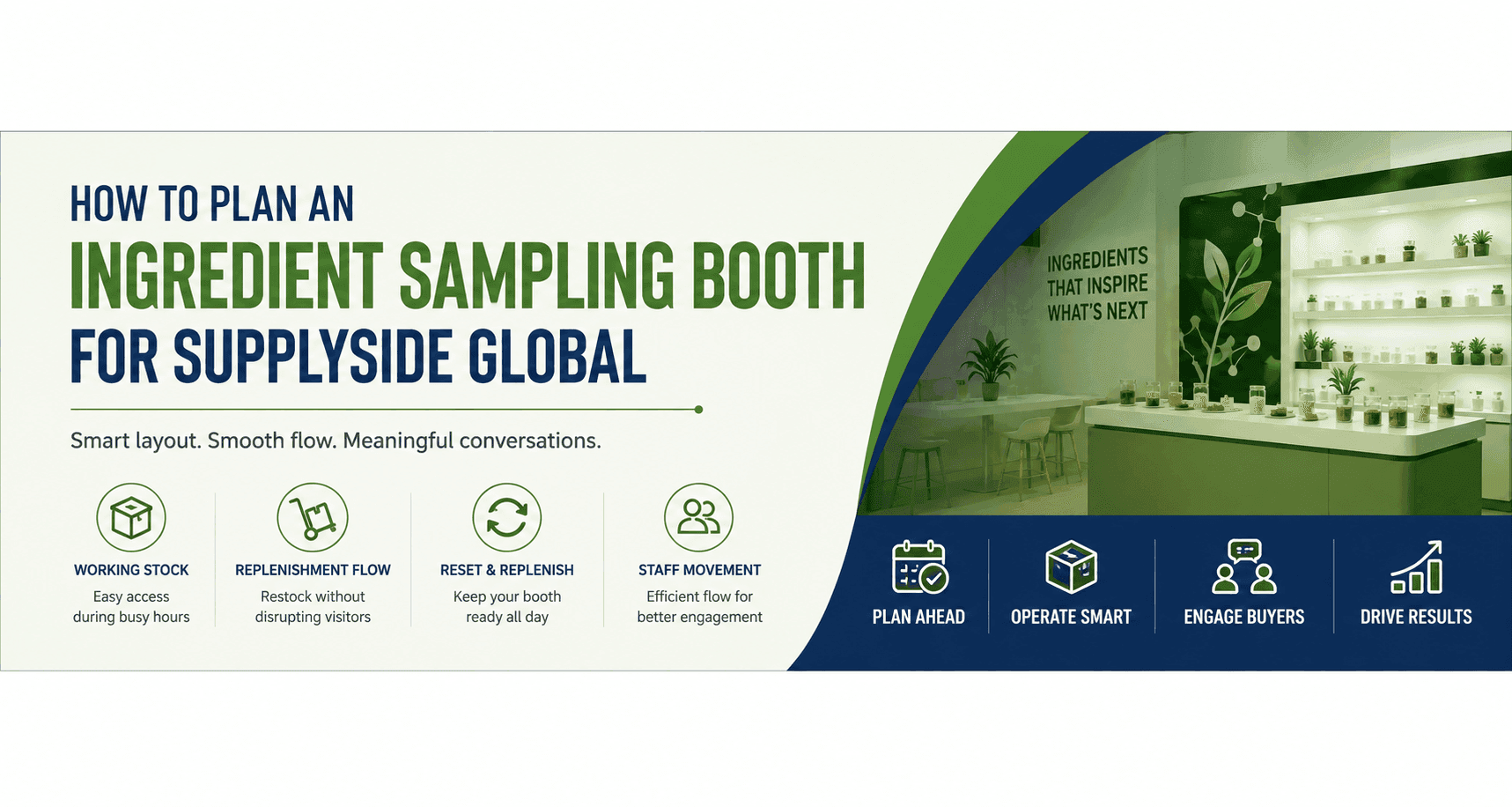
Separate Working Stock From Reserve Inventory
The sampling counter does not need to hold everything required for the entire show day.
It needs enough working stock—the samples and supplies staff expect to use in the near term—to keep the active sampling period moving.
The rest can be organized in layers:
Working stock
Items used continuously or expected to be needed soon.
Backup stock
Replacement material kept nearby for quick replenishment.
Reserve inventory
Larger quantities that do not need to occupy the active sampling area.
This distinction avoids two opposite problems.
If everything is stored at the counter, staff lose working space and the visitor-facing area becomes cluttered.
If backup inventory is too far away, someone has to leave the active booth area every time a basic item runs low.
Enough storage is not the same as usable storage. What matters is whether the right material can be reached at the right time.
Keep Replenishment Out of the Visitor Path
A sampling counter can be positioned well for visitors and still operate poorly for staff.
The problem often appears in the route between storage and the counter.
During a busy period, the same few feet of space may be used by:
visitors approaching the sample
staff carrying replacement stock
team members returning used materials
buyers stopping for a conversation
Imagine the working stock at the counter runs low while several visitors are still waiting. If the only route to backup inventory crosses the visitor approach, every replenishment interrupts the front of the booth.
A better route usually reaches the sampling point from the side or staff-facing area.
It does not need to be hidden. It only needs to let staff replace working stock without turning every restock into a visitor-flow problem.
Plan the Counter for Handoff, Cleanup, and Reset
The counter is not only a place to serve samples.
During the day it may also hold:
supporting product material
replacement supplies
serving tools
used items
waste
short-term stock
information used during quick conversations
If all of those functions share the same visible surface, the counter becomes harder to maintain after each traffic wave.
A simple distinction helps:
Visitor-facing side
Keep the sample, product presentation, and immediate interaction clear.
Staff-facing side
Keep the materials required to serve, replace, remove, and reset.
A reset means replenishing working stock, clearing used materials, and returning the sampling area to a ready state before the next busy period.
The visible experience stays simpler when the operational work behind it already has a place.
Test Staff Movement During Busy Sampling Periods
An empty floor plan does not reveal how a sampling booth will operate at peak traffic.
Test the staff path against a busier moment.
Can one person replenish while another serves visitors?
Can backup material be reached without interrupting someone who is already talking with the team?
Can used items leave the counter without crossing the main visitor approach?
Does a staff member have to leave the booth every time a frequently used supply runs out?
Can the counter be reset while the rest of the booth continues operating?
These questions expose conflicts that are easy to miss when the booth is evaluated only by furniture placement and aisle clearance.
The staff path does not need to be large. It needs to remain usable when the booth is busy.
When a Small Booth Runs Out of Operational Space
A compact booth can support ingredient sampling when the operating requirements remain simple.
A smaller inline footprint may work when:
the sampling program is focused
the amount of working stock is limited
only a few people staff the booth
replenishment is simple
cleanup requirements are light
The space becomes more difficult when sampling, storage, restocking, staff movement, product display, and longer conversations all depend on the same area.
At that point, the booth has not simply become crowded.
It has run out of operational space.
A 20x20 booth plan can create more separation between visitor-facing activity and the staff work required to keep the program running, but the additional footprint only helps when those operational needs are intentionally planned.
The question is not whether a larger booth looks more impressive. It is whether the team can keep the sampling program functioning throughout the day.
Reset Between Traffic Peaks, Not Only at the End of the Day
Sampling activity is rarely constant from opening to close.
Traffic rises and falls, creating natural opportunities to reset the booth.
A short reset may include:
replenishing working stock
clearing used materials
removing waste
restoring the product display
replacing literature
checking remaining sample quantities
returning tools or supplies to their assigned locations
The reset does not need to become a formal procedure that visitors notice.
But someone should own it.
If every staff member assumes another person will replenish or clean the area, small problems accumulate until the counter looks improvised and basic supplies become harder to find.
A few minutes between traffic peaks can prevent that buildup.
Where Sampling Operations Usually Break Down
Operational Gap | What Happens During the Show | Better Planning Question |
|---|---|---|
Working and reserve inventory are stored together | Staff search through too much material while the counter is active | What needs to stay immediately accessible? |
Backup stock is too far from the sampling point | Staff repeatedly leave the active booth area | What should remain inside the booth for quick replenishment? |
Restocking crosses the visitor approach | Staff and visitors compete for the same movement space | Can replacement stock reach the counter from the side or staff area? |
No one owns the reset | Used materials, low stock, and clutter build up between busy periods | Who checks and restores the sampling area during traffic breaks? |
Storage is planned only by total volume | Everything fits, but frequently used items remain difficult to retrieve | What is used most often, in what order, and by whom? |
The common issue is not usually a lack of storage volume. It is that storage, staff movement, and replenishment were planned separately instead of as one operating system.
Pre-Show Sampling Readiness Checklist
Working Stock
Confirm how much product should remain at the counter.
Separate immediate-use supplies from backup and reserve inventory.
Keep frequently used materials within a short staff path.
Avoid turning the visible counter into bulk storage.
Staff Access
Confirm how staff reach backup stock during busy periods.
Keep replenishment away from the main visitor approach where possible.
Identify where used materials and waste leave the counter.
Make sure operational supplies do not block product displays or visitor materials.
Show-Hour Reset
Assign responsibility for replenishment.
Assign responsibility for periodic reset.
Check sample quantities before expected traffic peaks.
Restore the visible counter between busy periods.
Confirm that replacement stock can be accessed without interrupting ongoing conversations.
FAQ
How much storage does an ingredient sampling booth need?
Storage should be based on what staff need to access during show hours, not total shipment volume alone. Separating working stock, backup material, and reserve inventory makes the available space easier to use.
Should backup samples be stored under the sampling counter?
Some working stock can stay close to the counter, but storing the full reserve there can reduce staff working space and create clutter. Backup and reserve inventory are usually easier to manage when they have separate locations.
How often should a sampling booth be reset?
Use natural breaks between busy sampling periods. Restocking supplies, clearing used materials, and restoring the display before the next traffic wave is usually more effective than waiting until the end of the day.