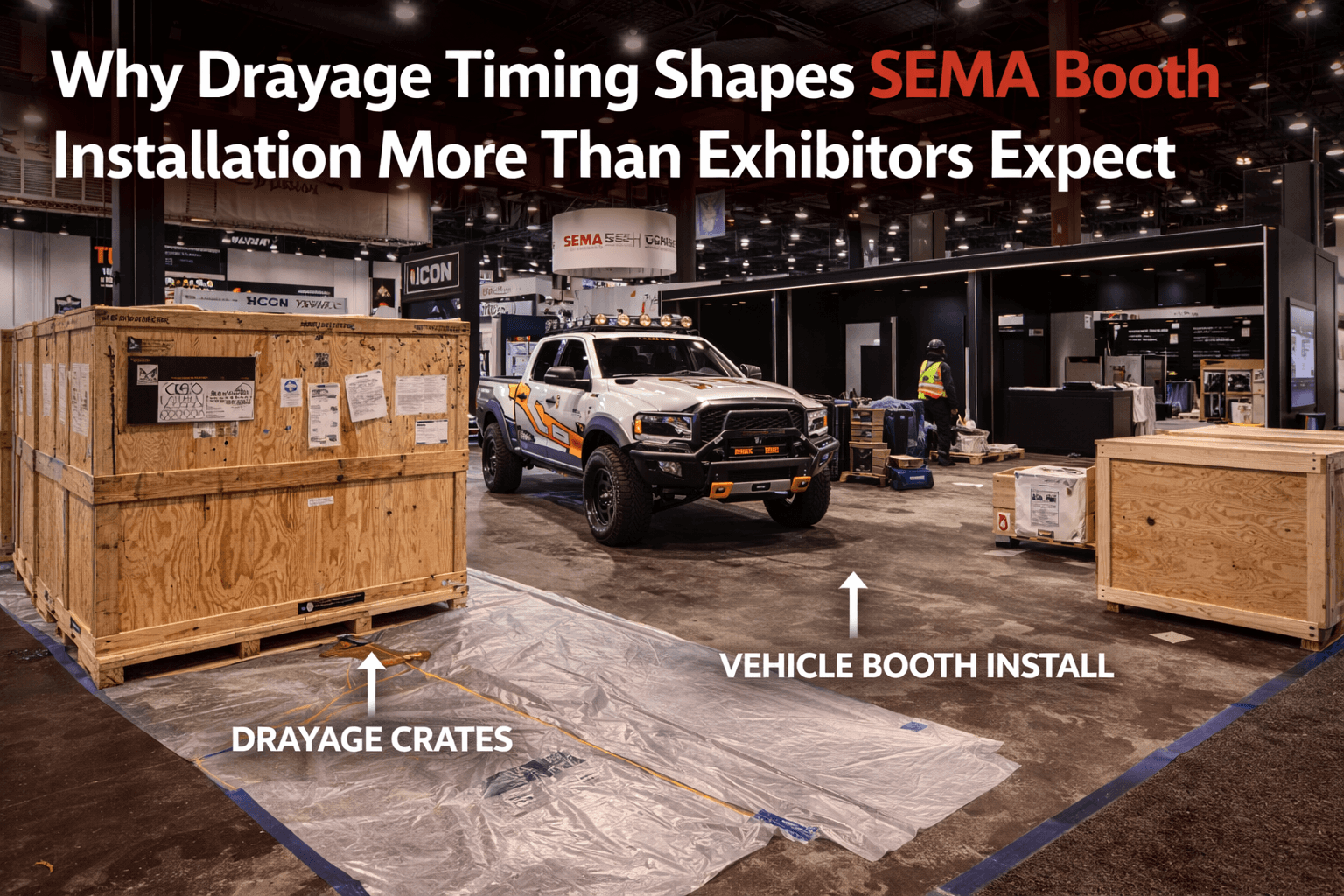
SEMA booth installation in Las Vegas with drayage crates, a display vehicle, protected floor covering, and active setup work around the booth

Why Drayage Timing Shapes SEMA Booth Installation More Than Exhibitors Expect

Why Drayage Timing Shapes SEMA Booth Installation More Than Exhibitors Expect

Circle Exhibit Team

Industry professionals

Exhibition industry professional dedicated to delivering the latest insights and curated recommendations to you.

Exhibition industry professional dedicated to delivering the latest insights and curated recommendations to you.

At SEMA, drayage timing controls how early the booth becomes workable. When freight hits the floor in the wrong order or at the wrong moment, the whole install starts reacting instead of progressing cleanly.

At SEMA, drayage timing controls how early the booth becomes workable. When freight hits the floor in the wrong order or at the wrong moment, the whole install starts reacting instead of progressing cleanly.

At SEMA, drayage timing controls how early the booth becomes workable. When freight hits the floor in the wrong order or at the wrong moment, the whole install starts reacting instead of progressing cleanly.

Most install stress starts before the booth is even built

A lot of exhibitors think booth installation problems begin with labor, layout, or last-minute adjustments on site.

Often, they begin earlier.

They begin when freight reaches the floor at the wrong time, in the wrong order, or under the wrong assumptions.

That is where drayage timing starts shaping the install long before the booth looks like a booth.

Drayage is not just about whether the freight arrives

It is about when the booth becomes usable.

That is the part many exhibitors underestimate.

A booth does not become workable the moment its materials reach the building. It becomes workable when the right materials reach the booth in the right order, with enough room left for crews to move, stage, and build without fighting the delivery itself.

If drayage timing is off, the freight may technically be there, but the booth still is not ready to move cleanly.

Early freight can still create late progress

This sounds backward, but it happens all the time.

Crates arrive. Cases show up. Materials start stacking near the booth. The team sees freight on site and assumes progress is about to accelerate.

Sometimes the opposite happens.

Now the install crew is sorting, shifting, opening, and protecting materials that should not yet be in the way. Instead of building forward, the booth starts spending time managing freight pressure.

That is why drayage timing matters so much.

It changes whether the first hours of install are productive or reactive.

A vehicle booth makes the timing even more sensitive

At SEMA Show, the booth often includes more than structure and branding.

It may include:

  • a display vehicle

  • heavy product crates

  • shelving systems

  • tire and wheel displays

  • flooring protection

  • branded walls that cannot be finished too early

That means drayage timing is not just supporting the install.

It is shaping the order of the install.

If the booth has to absorb too much freight before the vehicle path is protected, before the center is clear, or before the staging zones are organized, the whole install starts tightening up in the wrong places.

The booth becomes workable only after the floor clears

This is one of the most practical truths on a show floor.

A booth is not workable because freight is present.
It is workable because freight has stopped controlling the space.

That usually happens only when:

  • the correct crates are accessible

  • nonessential materials are still out of the way

  • the vehicle path is protected

  • the main structure can move first

  • the crew can work without building around unopened cases

Until then, the booth is still negotiating with delivery instead of using delivery.

Wrong order is often worse than slow timing

Many teams focus only on speed.

They want freight as early as possible.

But earlier is not always better.

If graphics arrive before structure is ready, pressure goes up.
If flooring materials arrive before heavy movement is finished, protection gets harder.
If product display elements land before the vehicle path is resolved, the center starts closing too early.

That is why wrong order can be more damaging than slow timing.

A slightly later but better-sequenced booth usually installs more cleanly than a booth flooded with freight too early.

Drayage timing shapes staging, not just delivery

A lot of install quality depends on what happens between “delivered” and “installed.”

That space is staging.

And staging is where bad drayage timing becomes visible.

If the freight schedule is working, the booth can stage materials in layers.
If the freight schedule is not working, staging turns into overflow.

That difference affects everything:

  • how fast crates get opened

  • how much walking crews have to do

  • how much finished flooring stays protected

  • how soon the center display area becomes usable

  • whether the booth feels organized or crowded from the start

A 30x40 booth gives more room, but also more ways to get sequencing wrong

This is one reason a 30x40 trade show booth often works well for SEMA installs.

That footprint gives enough room to separate:

  • staging

  • vehicle path

  • structure zone

  • product display zone

  • final circulation

But that only helps if the freight timing supports the logic of those zones.

If drayage timing is off, a larger booth does not automatically feel easier.
It can simply give the install more square footage to mismanage.

A better 30x40 install uses the extra room to create order, not just storage.

Vehicle booths feel drayage pressure faster

That is because vehicle booths usually have less freedom to improvise.

The vehicle path needs space.
The floor needs protection.
The center needs to stay honest.
The booth cannot just fill in wherever there is room.

That makes freight timing more important, not less.

If crates land too aggressively around the vehicle zone, the booth starts shrinking before the display vehicle even arrives. If the delivery rhythm is cleaner, the install crew can keep the center open until the right moment.

That one difference often decides whether the booth feels controlled or compromised.

Logistics planning is really what turns freight into progress

This is where logistics and pre-show coordination become the real control point.

The question is not only:

When does the freight arrive?

The better questions are:

  • what should arrive first

  • what should stay unopened

  • what must remain clear

  • what can wait until the vehicle is set

  • what belongs to structure first versus finish later

When those answers are clear, the drayage timeline starts helping the booth.

When those answers are vague, the delivery schedule becomes something the crew has to survive instead of use.

Builder planning matters because freight affects layout before layout is visible

This is one reason exhibitors benefit from working with a Las Vegas trade show booth builder that thinks about freight as part of the build sequence.

Because that is what it is.

Freight timing affects:

  • how structure starts

  • how flooring is protected

  • how vehicle entry stays possible

  • how product areas get staged

  • how quickly the booth begins to feel real instead of temporary

A rendering cannot show that pressure.
A good builder plan can.

The strongest installs usually follow a usable-freight rhythm

The cleanest SEMA installs usually do not feel rushed, even when the schedule is tight.

They follow a rhythm like this:

1. The booth receives only what it can actually use first

Essential structure and protected access come before visual completion.

2. The center stays clear long enough for the vehicle plan to remain real

The booth does not crowd its own main display zone too early.

3. Staging supports build order, not panic storage

Materials are positioned for sequence, not just for temporary convenience.

4. Finish materials arrive into stable conditions

Graphics, flooring, and display elements go in when the booth is ready for them.

5. The booth tightens after the freight pressure drops

Work shifts from reacting to refining.

That is usually what makes the install feel professional.

Final thought

At SEMA, drayage timing affects much more than delivery.

It affects when the booth becomes buildable, when the center becomes usable, and when the crew can stop reacting and start finishing properly.

That is why exhibitors feel drayage timing more than they expect.

Not because it is dramatic on its own.
Because it quietly controls the first moment the booth can actually start working the way it was planned to work.

Planning a vehicle booth for SEMA Show?
Start with SEMA booth planning, then connect it to stronger logistics and pre-show coordination so drayage timing supports the build instead of slowing it down.

Most install stress starts before the booth is even built

A lot of exhibitors think booth installation problems begin with labor, layout, or last-minute adjustments on site.

Often, they begin earlier.

They begin when freight reaches the floor at the wrong time, in the wrong order, or under the wrong assumptions.

That is where drayage timing starts shaping the install long before the booth looks like a booth.

Drayage is not just about whether the freight arrives

It is about when the booth becomes usable.

That is the part many exhibitors underestimate.

A booth does not become workable the moment its materials reach the building. It becomes workable when the right materials reach the booth in the right order, with enough room left for crews to move, stage, and build without fighting the delivery itself.

If drayage timing is off, the freight may technically be there, but the booth still is not ready to move cleanly.

Early freight can still create late progress

This sounds backward, but it happens all the time.

Crates arrive. Cases show up. Materials start stacking near the booth. The team sees freight on site and assumes progress is about to accelerate.

Sometimes the opposite happens.

Now the install crew is sorting, shifting, opening, and protecting materials that should not yet be in the way. Instead of building forward, the booth starts spending time managing freight pressure.

That is why drayage timing matters so much.

It changes whether the first hours of install are productive or reactive.

A vehicle booth makes the timing even more sensitive

At SEMA Show, the booth often includes more than structure and branding.

It may include:

  • a display vehicle

  • heavy product crates

  • shelving systems

  • tire and wheel displays

  • flooring protection

  • branded walls that cannot be finished too early

That means drayage timing is not just supporting the install.

It is shaping the order of the install.

If the booth has to absorb too much freight before the vehicle path is protected, before the center is clear, or before the staging zones are organized, the whole install starts tightening up in the wrong places.

The booth becomes workable only after the floor clears

This is one of the most practical truths on a show floor.

A booth is not workable because freight is present.
It is workable because freight has stopped controlling the space.

That usually happens only when:

  • the correct crates are accessible

  • nonessential materials are still out of the way

  • the vehicle path is protected

  • the main structure can move first

  • the crew can work without building around unopened cases

Until then, the booth is still negotiating with delivery instead of using delivery.

Wrong order is often worse than slow timing

Many teams focus only on speed.

They want freight as early as possible.

But earlier is not always better.

If graphics arrive before structure is ready, pressure goes up.
If flooring materials arrive before heavy movement is finished, protection gets harder.
If product display elements land before the vehicle path is resolved, the center starts closing too early.

That is why wrong order can be more damaging than slow timing.

A slightly later but better-sequenced booth usually installs more cleanly than a booth flooded with freight too early.

Drayage timing shapes staging, not just delivery

A lot of install quality depends on what happens between “delivered” and “installed.”

That space is staging.

And staging is where bad drayage timing becomes visible.

If the freight schedule is working, the booth can stage materials in layers.
If the freight schedule is not working, staging turns into overflow.

That difference affects everything:

  • how fast crates get opened

  • how much walking crews have to do

  • how much finished flooring stays protected

  • how soon the center display area becomes usable

  • whether the booth feels organized or crowded from the start

A 30x40 booth gives more room, but also more ways to get sequencing wrong

This is one reason a 30x40 trade show booth often works well for SEMA installs.

That footprint gives enough room to separate:

  • staging

  • vehicle path

  • structure zone

  • product display zone

  • final circulation

But that only helps if the freight timing supports the logic of those zones.

If drayage timing is off, a larger booth does not automatically feel easier.
It can simply give the install more square footage to mismanage.

A better 30x40 install uses the extra room to create order, not just storage.

Vehicle booths feel drayage pressure faster

That is because vehicle booths usually have less freedom to improvise.

The vehicle path needs space.
The floor needs protection.
The center needs to stay honest.
The booth cannot just fill in wherever there is room.

That makes freight timing more important, not less.

If crates land too aggressively around the vehicle zone, the booth starts shrinking before the display vehicle even arrives. If the delivery rhythm is cleaner, the install crew can keep the center open until the right moment.

That one difference often decides whether the booth feels controlled or compromised.

Logistics planning is really what turns freight into progress

This is where logistics and pre-show coordination become the real control point.

The question is not only:

When does the freight arrive?

The better questions are:

  • what should arrive first

  • what should stay unopened

  • what must remain clear

  • what can wait until the vehicle is set

  • what belongs to structure first versus finish later

When those answers are clear, the drayage timeline starts helping the booth.

When those answers are vague, the delivery schedule becomes something the crew has to survive instead of use.

Builder planning matters because freight affects layout before layout is visible

This is one reason exhibitors benefit from working with a Las Vegas trade show booth builder that thinks about freight as part of the build sequence.

Because that is what it is.

Freight timing affects:

  • how structure starts

  • how flooring is protected

  • how vehicle entry stays possible

  • how product areas get staged

  • how quickly the booth begins to feel real instead of temporary

A rendering cannot show that pressure.
A good builder plan can.

The strongest installs usually follow a usable-freight rhythm

The cleanest SEMA installs usually do not feel rushed, even when the schedule is tight.

They follow a rhythm like this:

1. The booth receives only what it can actually use first

Essential structure and protected access come before visual completion.

2. The center stays clear long enough for the vehicle plan to remain real

The booth does not crowd its own main display zone too early.

3. Staging supports build order, not panic storage

Materials are positioned for sequence, not just for temporary convenience.

4. Finish materials arrive into stable conditions

Graphics, flooring, and display elements go in when the booth is ready for them.

5. The booth tightens after the freight pressure drops

Work shifts from reacting to refining.

That is usually what makes the install feel professional.

Final thought

At SEMA, drayage timing affects much more than delivery.

It affects when the booth becomes buildable, when the center becomes usable, and when the crew can stop reacting and start finishing properly.

That is why exhibitors feel drayage timing more than they expect.

Not because it is dramatic on its own.
Because it quietly controls the first moment the booth can actually start working the way it was planned to work.

Planning a vehicle booth for SEMA Show?
Start with SEMA booth planning, then connect it to stronger logistics and pre-show coordination so drayage timing supports the build instead of slowing it down.

Message

Leave your message and we will get back to you ASAP

Send a Message

We’ll Be in Touch!

Message

Leave your message and we will get back to you ASAP

Address:

4915 Steptoe Street #300

Las Vegas, NV 89122