What the Exhibit Quote Is Actually Pricing
The rental structure is only one part of an exhibit quote. What matters is how much production, equipment, and coordination are required to turn that structure into a show-ready booth.
Scope Area | What Changes the Rental Scope | What Exhibitors Should Confirm |
|---|---|---|
Booth configuration | The same footprint may use a simple open layout or include storage rooms, towers, counters, partitions, and modified structural elements | Which structural elements and modifications are part of the proposal |
Graphics | More surfaces, larger formats, illuminated graphics, or new production increase the production scope | Which graphics are new, reused, replaced, or backlit |
Demo & AV requirements | Multiple screens, demo stations, mounts, media equipment, or concealed wiring add equipment and coordination | Number of demo points, screens, mounts, power needs, and client-supplied equipment |
Lighting & product display | Specialty lighting, shelving, product mounts, and illuminated display elements add fabrication and installation work | Which elements must be integrated before show-site setup |
Freight & material handling | Shipment volume, arrival method, and handling requirements affect how exhibit materials reach the booth | Advance warehouse or direct-to-show planning, shipment volume, and handling responsibility |
Installation sequence | More components and dependencies require additional assembly, graphics, AV, product placement, and final checks | What installation and dismantle work is included in the exhibit scope |
Show-ordered services | Electrical, internet, rigging, and other organizer or venue services may follow a separate ordering path | Which services are included, coordinated, or ordered separately |
The useful comparison is therefore not just structure against structure. It is one working scope against another.
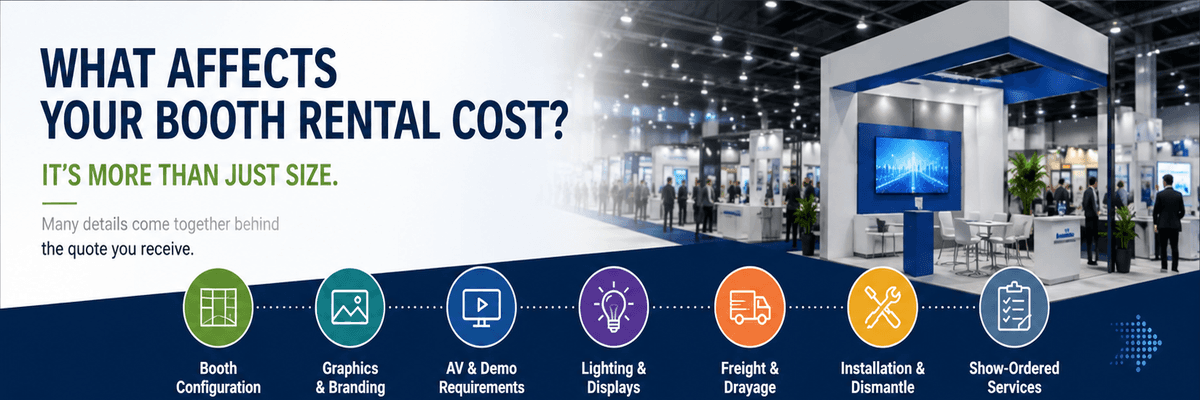
Booth rental quotes can change based on configuration, graphics, AV, freight, drayage, installation, and other show-site requirements.
Two 20x20 Booths, Two Very Different Scopes
Consider two exhibitors renting the same 20x20 footprint.
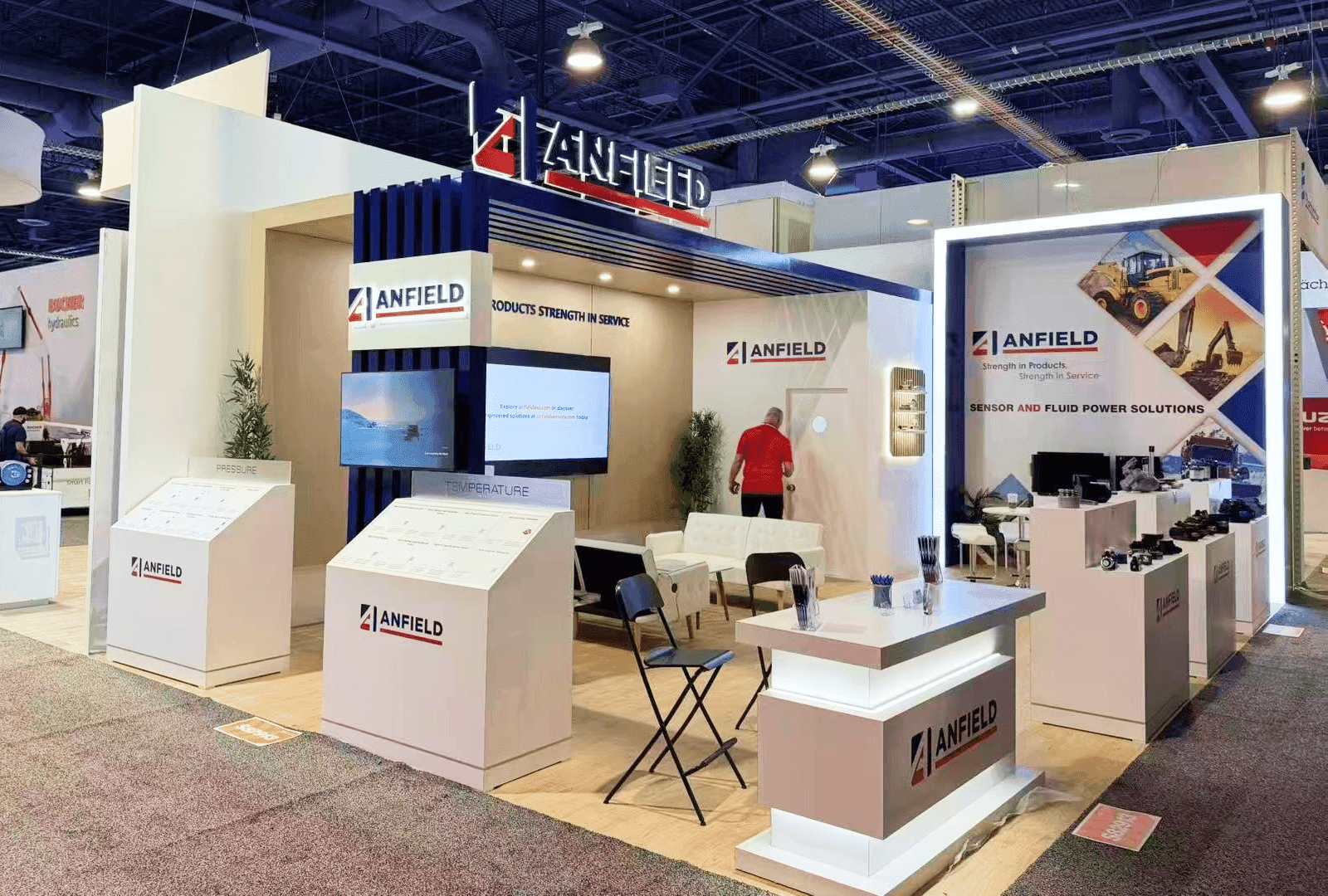
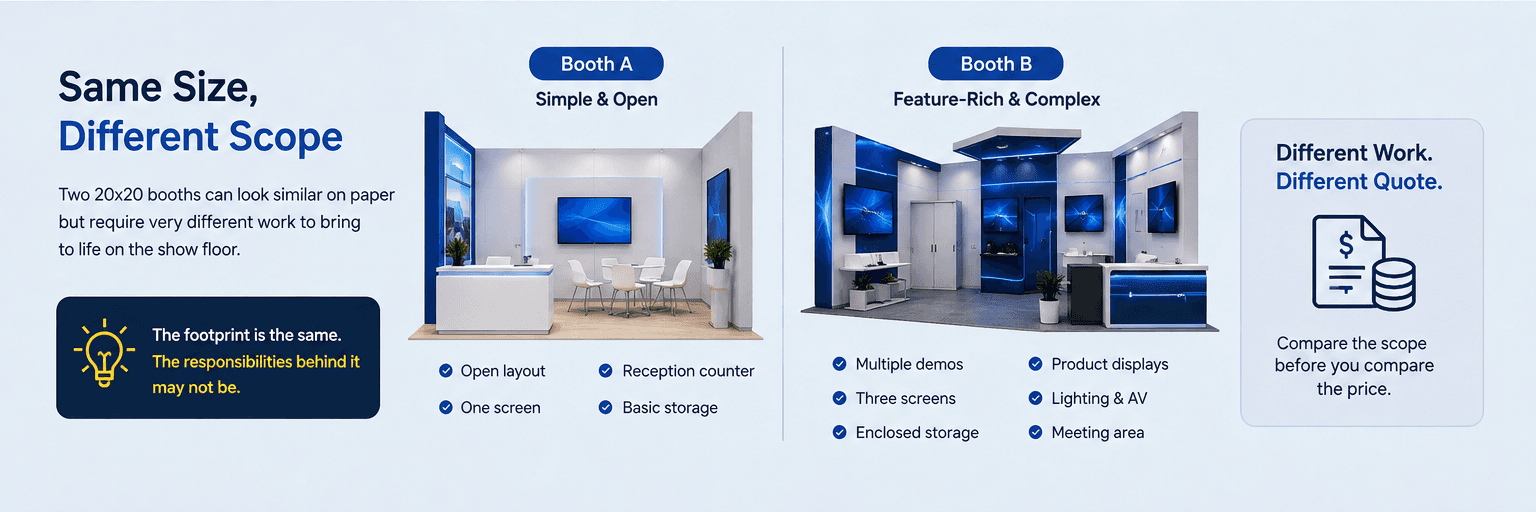
Booth A is relatively simple: one reception counter, one large screen, open conversation space, basic storage, and straightforward branded graphics.
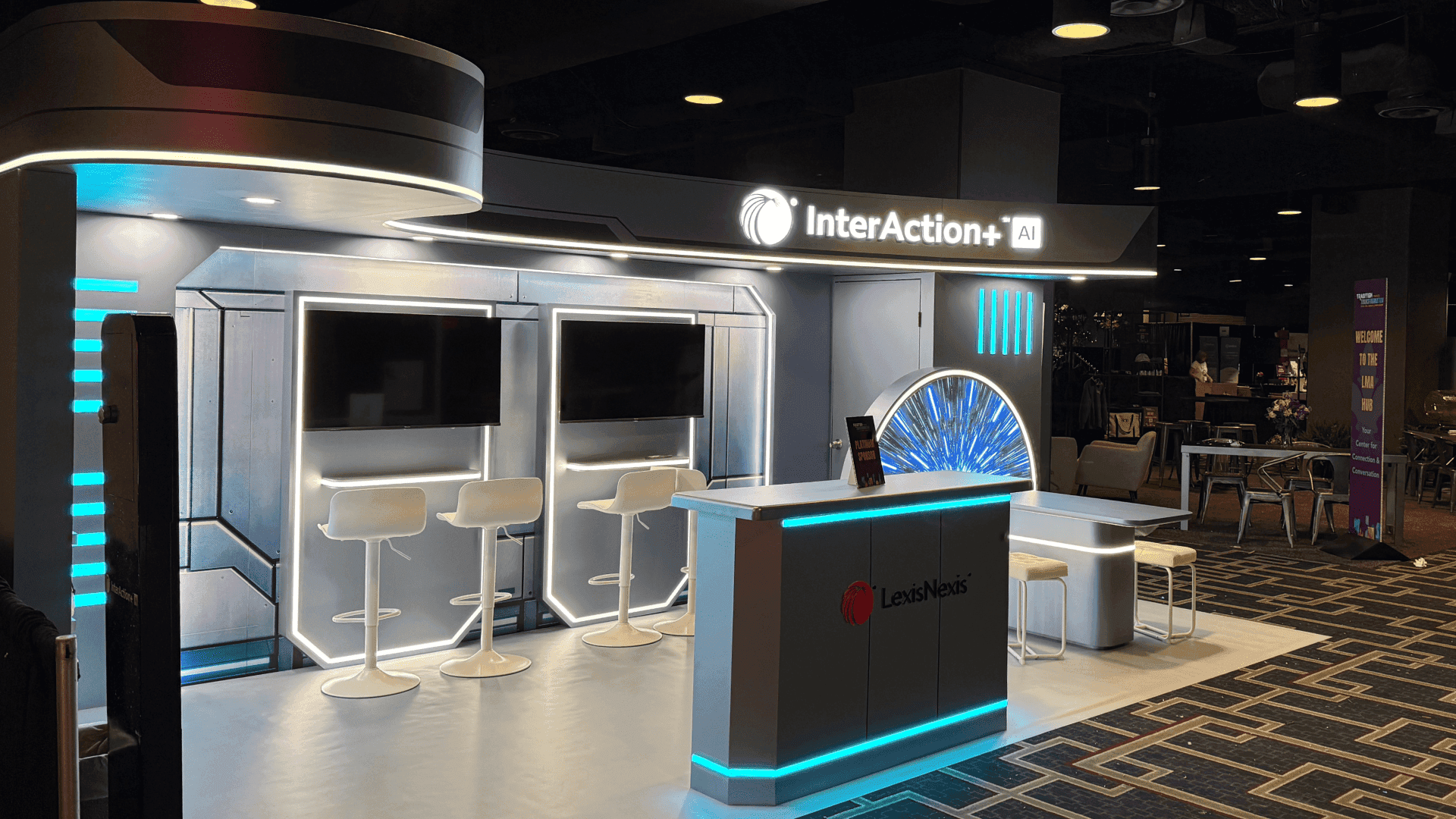
Booth B uses the same 20x20 footprint for two active demo stations, three screens, illuminated graphics, enclosed storage, product mounting, and a seated meeting area.
Both occupy 400 square feet. Booth B, however, creates more production work, equipment dependencies, electrical coordination, graphic installation, and show-site sequencing.
The footprint is the same. The work required to make the booth show-ready is not.
That is why a 20x20 rental price alone does not tell an exhibitor whether two quotes are comparable.
Why Square Footage Alone Does Not Explain the Quote
Booth size still matters. A larger footprint generally means more structure, flooring, graphics, freight volume, and installation work.
But footprint is only the starting point.
A relatively open 20x20 rental booth design may be simpler to produce than another 20x20 booth carrying several technology demonstrations, illuminated displays, specialized shelving, and concealed equipment.
Booth size sets the footprint; booth functions determine much of the working scope.
The better question is not simply how large the booth is, but what needs to operate inside it at the same time.
Once reception, demos, meetings, displays, storage, and AV begin working together, the project changes even though the contracted floor area has not.
Feature Density Can Matter More Than Footprint
One useful way to understand rental complexity is feature density: how many elements inside the booth require design, production, equipment, power, installation, or coordination.
That can include:
multiple screens
live product demonstrations
lightboxes
specialty lighting
product mounts
shelving
enclosed storage
meeting areas
media equipment
additional graphic surfaces
None of these features automatically makes a booth better. They simply create different production and execution requirements.
A booth with relatively few elements may move through prebuild checks and show-site setup differently from one where several display, electrical, AV, and storage components depend on each other.
That difference belongs in the scope before pricing is compared.
Two 20x20 booths can use the same 400-square-foot footprint while requiring very different production, equipment, and installation scopes.
Freight, Drayage and Installation Work as One Sequence
Freight, material handling, and booth installation may appear as separate items during budgeting, but operationally they are connected.
The sequence is closer to:
Freight arrival → material handling → booth materials available → structural installation → graphics and AV → product placement → final show-ready checks
Whether exhibit materials move through an advance warehouse or direct-to-show plan can also affect the assumptions behind that sequence.
If materials are not available when installation begins, later work can be affected. A booth with more components, AV equipment, or specialized displays can also require a different installation sequence from a simpler configuration.
This is where pre-show logistics coordination becomes relevant. It connects shipment timing with what the installation team needs on the floor and when those materials need to be available.
Drayage is relevant here because it affects the execution dependency behind the quote—not because this article needs to become a material-handling guide.
Separate the Exhibit Quote From Show-Ordered Services
Another source of confusion is assuming that every show-related responsibility sits inside the exhibit proposal.
That is not always the case.
A proposal may cover the rental structure, graphics, AV hardware, pre-show preparation, and installation coordination, while electrical, internet, rigging, material handling, or organizer-specific services follow a separate ordering path.
Exact responsibilities vary by show, venue, and proposal.
Show-service boundaries can also differ by facility. At major Las Vegas venues such as the Las Vegas Convention Center, exhibitors should confirm these responsibilities before treating two proposal totals as equivalent.
The important question is not simply:
What is included?
It is:
Who is responsible for each part of getting the booth show-ready?
That keeps the comparison focused on responsibility and scope rather than turning it into another rental-inclusions checklist.
Compare the Scope Before You Compare the Total
A lower proposal total does not necessarily mean a lower price for the same project.
One proposal may appear lower because graphics installation, AV setup, freight coordination, show-site supervision, or another responsibility sits outside its scope. Another may appear higher because more of that work has already been assigned.
Before comparing final totals, confirm whether both proposals are based on the same:
booth configuration
graphics scope
AV and lighting requirements
freight responsibility
installation responsibility
show-service assumptions
Two rental quotes are comparable only when they are based on the same functional and show-site responsibilities.
If those assumptions differ, the totals are not yet an apples-to-apples comparison.
The goal is not to make every proposal look identical. It is to understand what each proposal is actually solving before deciding which number represents better value.
FAQ
Why can two 20x20 trade show booth rental quotes be so different?
Two 20x20 booths can use very different structures, graphics, AV, lighting, storage, product displays, and installation sequences. The footprint is identical, but the production and show-site responsibilities may be very different.
Does booth size still affect rental cost?
Yes. Booth size affects structural volume, flooring, graphics, freight, and installation requirements. But size alone does not explain the full quote. The number of functions and dependencies inside the footprint also changes the working scope.
Are electrical, drayage, and other show services always part of a booth rental quote?
Not necessarily. Responsibility varies by proposal, show, and venue. Exhibitors should confirm which services are included in the exhibit scope, which are being coordinated, and which follow a separate ordering process.