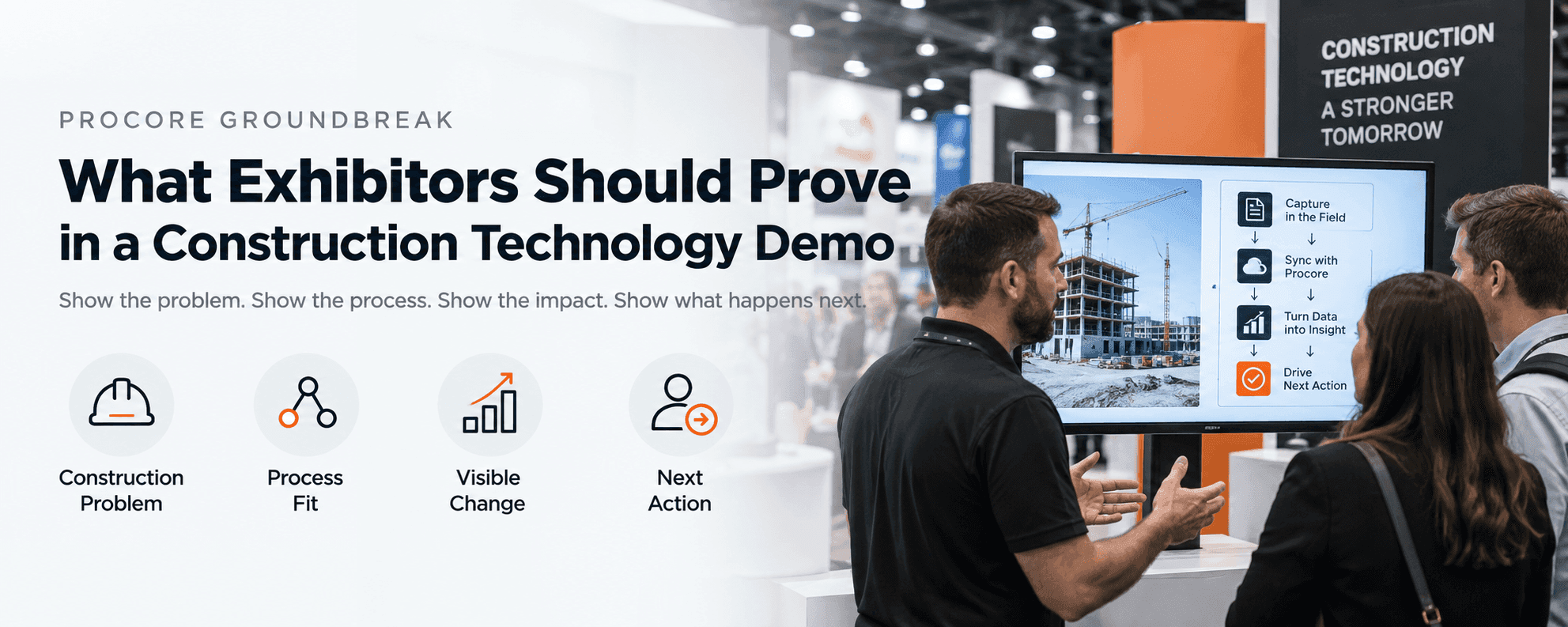
Groundbreak Demo Proof Check
A useful demo gives visitors evidence they can evaluate rather than simply giving them more product information.
Proof Area | Weak Booth Evidence | Stronger Groundbreak Proof |
|---|---|---|
Construction problem | A product category or feature statement | A field, project, cost, documentation, safety, or handoff problem the buyer already recognizes |
Process fit | A list of integration logos or connected systems | A clear view of where data enters, what Procore and the partner technology each do, and where the result goes next |
Visible change | Another dashboard, feature tour, or AI output | A specific change in how information, responsibility, or action moves through the project |
Next action | A report, alert, or result with no clear owner | Who receives the result, where it is recorded, and what action follows |
Weak proof tells the visitor what the product contains. Stronger proof helps the visitor judge whether the technology belongs in a real construction process.
A Groundbreak technology demo should show where Procore and partner technology fit in the construction process, not just display software features.
Show the Construction Problem Before the Product
A Groundbreak buyer should be able to recognize the construction problem before having to understand the product behind it.
That problem might be a field observation that still has to be re-entered later, a responsibility handoff that is difficult to track, project information that reaches the office too late to act on, or data that still requires manual review before anyone knows what should happen next. Other exhibitors may be addressing documentation, cost visibility, safety, coordination, or AI-assisted project analysis.
A demo is easier to evaluate when it starts with a situation the visitor already deals with and then shows what changes once the solution enters that process.
If the visitor has to understand the platform architecture before understanding why the product matters, the demonstration is starting too far downstream.
Show Where the Technology Fits in the Existing Process
At Groundbreak, knowing what the product does is only part of the evaluation. Visitors also need to understand where it enters the construction process they already use.
A simplified relationship might look like:
Field → Procore → Partner Technology → Office / Operations → Action
Procore may act as the system of record, a workflow center, or a handoff point. The partner technology may capture information, analyze project data, connect another system, or turn an existing record into a more useful next action.
What matters is whether the visitor can follow that connection without needing a full architecture explanation. They should be able to see where information comes from, where the partner solution changes the process, and where the result goes next.
The booth does not need to reproduce every step in the workflow. It only needs enough context for the buyer to understand where the technology fits and why that connection matters.
Show a Change the Buyer Can Actually See
A useful Groundbreak demo should make the change visible rather than simply proving that the product has more features.
That change might look like:
Manual handoff → connected handoff
Raw field data → actionable information
Disconnected record → shared project visibility
Multiple systems → connected process
A field issue that once required a separate update later in the day, for example, may now move into a shared project record with a clear owner and next action.
The change should be clear enough that the visitor can explain what improved without repeating a list of product features.
If the demo finishes on another dashboard, alert, or screen but the visitor still cannot explain what changed, the technology may have been demonstrated without the value actually being proven.
Show What Happens After the Output
A construction technology demo should not stop at the dashboard, AI result, report, or alert.
At Groundbreak, buyers also need to understand what happens after that output appears. Does a field team receive an action? Does a project manager review responsibility? Does the information return to Procore? Does it move into finance, operations, or another business system?
A useful demonstration should make three things clear:
Who receives the result?
Where is it recorded?
What action follows?
This matters because information is only useful when somebody can act on it.
A system may generate a useful insight, but the demonstration is incomplete if the visitor cannot see how that insight moves into the existing project process. Construction teams are not only evaluating whether software can generate information; they are also evaluating whether that information can move through the project without creating another disconnected step.
Match the Proof to the Buyer
The core proof can stay the same, but the evidence worth emphasizing changes with the person evaluating it.
Groundbreak Buyer | What They Are More Likely to Evaluate |
|---|---|
Field / Superintendent | Whether the next action becomes clearer or easier to complete |
Project Manager | Coordination, responsibility, and status visibility |
Technology / IT | System fit, data flow, integration, and compatibility with existing tools |
Finance / Operations | Whether project information moves cleanly into an established business process |
Owner / Executive | Visibility, control, risk, and the quality of information reaching decisions |
The booth does not need five separate demonstrations. One core proof path can remain consistent while staff emphasize the evidence that matters most to the person in front of them.

Effective booth proof helps construction buyers see what changes, who receives the result, and whether the solution deserves deeper technical evaluation.
Know Where Booth Proof Should Stop
A Groundbreak booth does not need to prove everything a construction buyer may eventually want to know.
Long-term ROI, full implementation success, enterprise security, every integration scenario, complex ERP configuration, organization-wide deployment, or long-term AI performance usually require more evidence than a show-floor demonstration can provide.
Booth Proof vs. Deeper Evaluation
Good Booth Proof | Better Left for Deeper Evaluation |
|---|---|
Where the technology fits in the current process | Full implementation design and rollout planning |
One visible change in a construction workflow | Performance across a full enterprise deployment |
How one relevant Procore or system connection works | Complete integration architecture and edge cases |
Who receives the result and what action follows | Security, governance, permissions, and administrative review |
Enough evidence to justify further evaluation | Long-term ROI, adoption, and business impact validation |
The booth has done its job once the buyer understands the construction problem, where the technology fits, what visibly changes, and why the solution deserves a closer evaluation.
Questions about integration, implementation, compatibility, deployment, pricing, or a detailed workflow usually mean the conversation has moved beyond booth proof and into a technical review, longer product demo, commercial discussion, or post-show evaluation.
Once those proof decisions are settled, the remaining challenge is operational. The booth still has to support the screens, devices, visitor stops, specialist handoff, storage, and reset routine required to deliver that proof repeatedly. Those physical decisions belong in Groundbreak technology demo booth planning.
FAQ
How much should a Groundbreak technology demo try to prove?
A Groundbreak demo only needs to prove the construction problem, where the technology fits in the existing process, what visibly changes, and what action follows. Deeper implementation, integration, or deployment questions can move into a longer evaluation.
Does a Procore integration demo need to show the entire workflow?
No. The booth only needs enough context for the buyer to understand where Procore and the partner technology interact, what the partner adds, and why that connection matters to the construction process.
When should a Groundbreak demo move into a technical conversation?
Once the buyer understands the core proof and starts asking about implementation, compatibility, integration, deployment, or a specific use case, the show-floor demo has done its job and the conversation can move deeper.
A useful Groundbreak demo is not the one that shows the most software. It is the one that gives the right buyer enough evidence to understand where the technology fits, what changes when it is used, and why the solution deserves a closer evaluation.