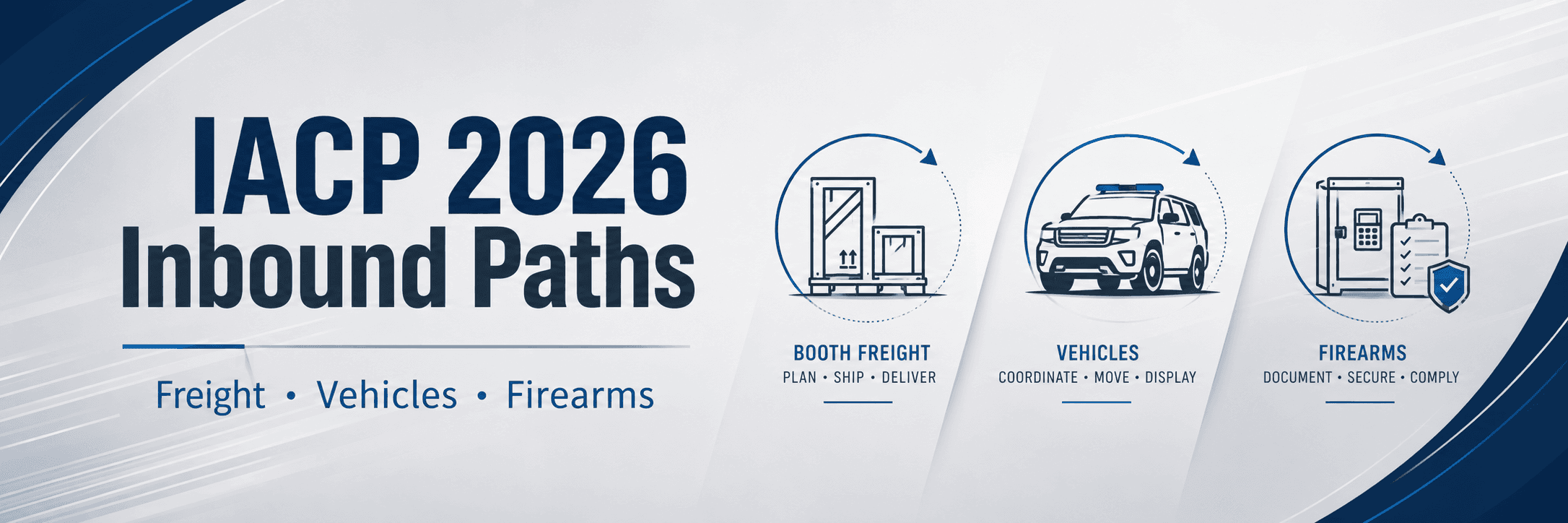
IACP Inbound Routing Matrix
Asset | Inbound Path | Route Endpoint | What Can Begin Next |
|---|---|---|---|
Booth structure, graphics, counters, and ordinary equipment | Freeman freight / Target Move-In | Assigned booth space | The applicable installation work can begin once materials are available |
Display vehicle or mobile unit | Vehicle registration / assigned arrival / spotting | Final vehicle position | Surrounding booth work can continue around the fixed unit |
Firearms / applicable controlled products | Separate firearm shipment / IACP Armory intake | IACP Armory | Inbound routing is complete; the show-day Armory workflow begins later |
The three routes create different handoff points: booth freight becomes available for installation, the vehicle becomes a fixed show-floor object, and a firearm shipment completes its inbound movement at the IACP Armory.

IACP booth freight, vehicles, and firearms follow different inbound paths because each asset reaches a different operational endpoint.
At IACP, the Asset Type Determines the Inbound Route
The first logistics decision is not the arrival date. It is the asset class.
Booth structure, graphics, counters, and ordinary equipment enter a freight stream whose useful endpoint is material availability for installation. A display vehicle follows a different process whose endpoint is its assigned position on the show floor. Firearms follow a controlled-product path whose pre-show endpoint is the IACP Armory.
Those endpoints change the meaning of “arrived.” Two assets can reach the show on the same day without becoming available for the same task. Freight can unlock installation, a spotted vehicle can release the surrounding floor area for the next stage of work, and Armory intake can complete a firearm shipment without placing that product in the booth.
Timing becomes useful only after the endpoint and next dependency are clear. Classify the asset first; then schedule the process that actually applies to it.
Booth Freight Should Arrive When the Build Can Use It
Ordinary booth freight becomes useful when the next installation task is ready for it. Flooring, structure, counters, fixtures, graphics, and their supporting materials all enter a build sequence, so arrival timing should be judged by what the crew can do once those materials become available.
A Target Move-In time should therefore be treated as an installation-availability input, not as an isolated shipping date. If flooring needs to be completed before structure is set, or counters and fixtures depend on finished wall sections, those dependencies matter more than simply getting every crate to the booth as early as possible.
Earlier arrival does not automatically create a faster build. Materials that reach the floor before the crew, space, or preceding task is ready can sit without advancing the exhibit.
Booth freight should arrive when it can unlock the next installation task, not simply as early as possible.
A Display Vehicle’s Inbound Route Ends at Its Final Booth Position
A display vehicle should not be treated as ordinary booth freight. Its inbound sequence starts with vehicle registration and the assigned arrival or Target Time, then continues through the approved entry process, freight-door access, and Freeman escort or spotting onto the show floor.
Vehicle registration → assigned arrival / Target Time → approved entry → Freeman spotting → final booth position
Once spotting is complete, the vehicle has reached the endpoint of its inbound movement.
The next problem is no longer how the unit enters the hall, but how the usable exhibit is organized around that fixed position. IACP vehicle booth planning starts from there, addressing the vehicle envelope, access, viewing space, and the footprint that remains around the unit.
Vehicle logistics gets the unit into position; booth planning works outward from that position.
A Firearm Shipment Ends at the IACP Armory—not at the Booth
Firearms do not enter IACP as part of the ordinary booth-freight stream. Their pre-show movement follows a separate controlled-product shipment process into the IACP Armory rather than ending at the exhibit space.
For inbound planning, Armory intake is the endpoint. The firearms have completed the movement assigned to that asset class even though they will later appear in the booth during show hours.
After Armory intake, the planning question changes from pre-show routing to show-day operation. The IACP daily Armory-to-booth workflow begins from that handoff.
For inbound planning, the firearm shipment ends at the Armory.
The three inbound paths should converge around the next booth dependency rather than one shared “everything arrives” date.
The Three Routes Should Converge at Different Times
An IACP booth does not become ready because every asset arrives on the same day. Each inbound path reaches a different endpoint, and each endpoint unlocks a different part of the work.
Physical booth readiness comes from the ordinary freight stream. Once flooring, structure, fixtures, counters, graphics, and supporting materials are available, the crew can advance the physical installation without waiting for every other exhibit asset.
Vehicle readiness occurs when the display vehicle reaches its final booth position. Until spotting is complete, the access needed to bring the unit onto the floor may still affect nearby work. Once the vehicle is in place, that access requirement can close and installation can continue around a fixed object.
Controlled-product readiness follows a different definition. Firearms complete their inbound movement when they enter the IACP Armory process. Physical booth installation does not require them to reach the exhibit space with the structure, graphics, or vehicle.
The useful sequence is therefore not freight, vehicle, and firearms arriving together. Physical installation can advance first, the vehicle can enter when its position becomes necessary, and firearms can remain on their separate Armory track until the show-day process needs them.
The three paths should converge when the next booth task requires them—not when every asset can be forced onto the same arrival date.
What Must Be Complete by IACP’s Final Display-Ready Deadline?
IACP’s final display-ready deadline provides a fixed point for backward planning, not a requirement that every inbound path finish at the same moment. For IACP 2026, exhibits are expected to be assembled and display-ready by 2:00 p.m. on October 24.
By then, the physical exhibit needs to be complete and any display vehicle whose position affects the build should already be where the plan requires it. Controlled-product shipments remain on their own Armory timeline; the relevant test is whether that path reaches its required destination before the show-day workflow depends on it.
The deadline anchors the finished exhibit. Each inbound path still works backward from its own next dependency.
FAQ
Can a display vehicle arrive with ordinary booth freight?
Not as part of the same inbound process. Ordinary booth freight follows the assigned freight and Target Move-In path, while a display vehicle follows its own registration, arrival, entry, and spotting sequence before reaching its final booth position.
Are firearms delivered directly to an IACP exhibitor booth?
No. Firearm shipments follow a separate controlled-product path into the IACP Armory rather than being delivered as ordinary booth freight to the exhibit space.
Should all IACP booth assets arrive on the same day?
No. Booth freight, display vehicles, and firearms can reach their required destinations at different times. What matters is that each inbound path is complete before the next dependent booth task needs that asset.