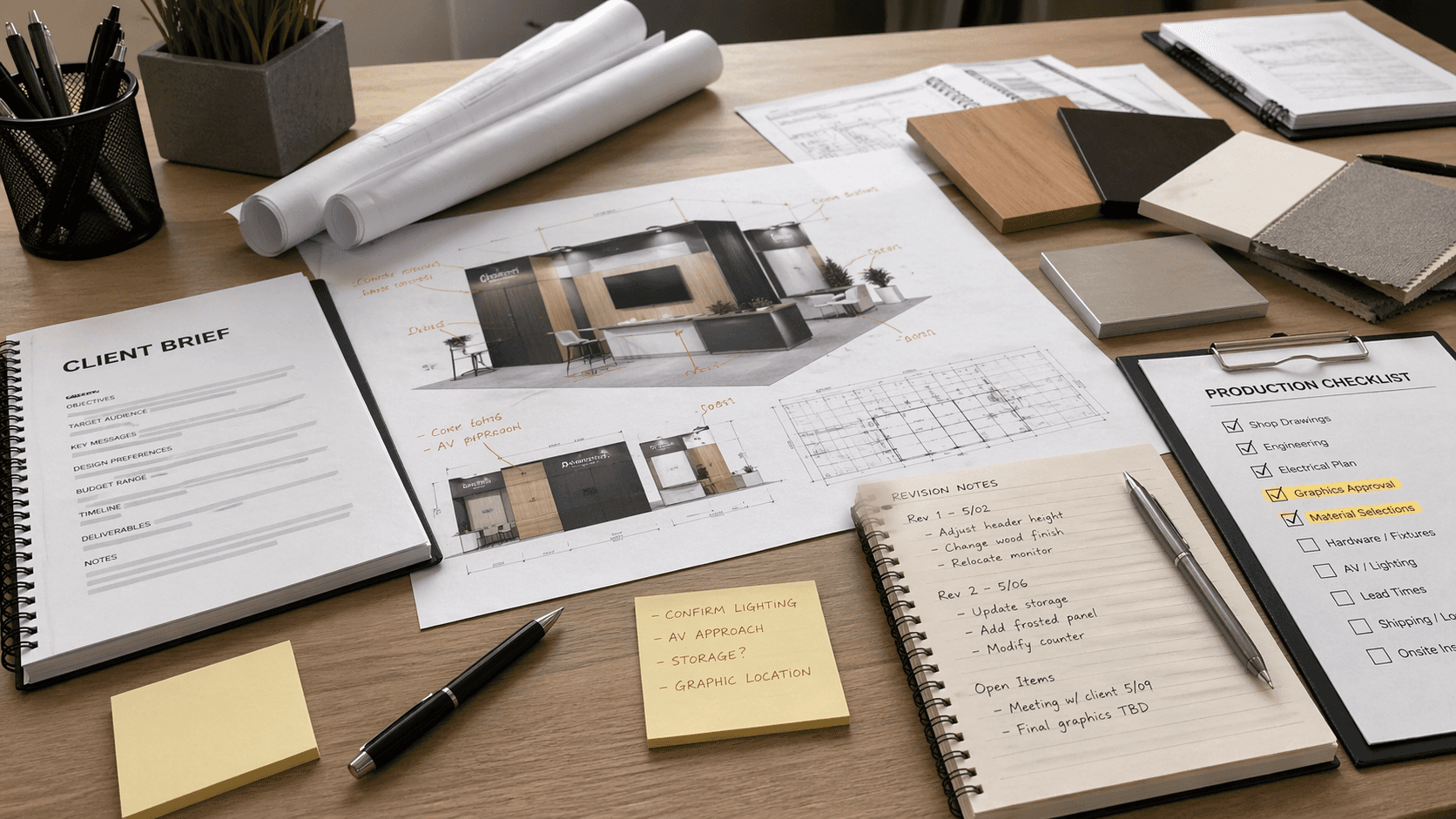
Trade show booth planning desk with client brief, production checklist, marked drawings, and material samples before fabrication starts

What Booth Builders Need From Exhibitors Before Fabrication Starts

What Booth Builders Need From Exhibitors Before Fabrication Starts

Circle Exhibit Team

Industry professionals

Exhibition industry professional dedicated to delivering the latest insights and curated recommendations to you.

Exhibition industry professional dedicated to delivering the latest insights and curated recommendations to you.

Before fabrication starts, clear inputs protect schedule, cost, and execution quality. The better the handoff from exhibitor to builder, the cleaner the project usually moves into production.

Before fabrication starts, clear inputs protect schedule, cost, and execution quality. The better the handoff from exhibitor to builder, the cleaner the project usually moves into production.

Before fabrication starts, clear inputs protect schedule, cost, and execution quality. The better the handoff from exhibitor to builder, the cleaner the project usually moves into production.

Fabrication does not start with materials

It starts with clarity.

A lot of exhibitors think fabrication begins when the shop starts cutting panels, building frames, printing graphics, or preparing hardware.

That is only the visible part.

In reality, fabrication begins earlier, at the point where the builder has enough reliable information to stop interpreting and start producing. If that information is weak, incomplete, or still moving, the project may appear to be advancing, but the production phase is already carrying risk.

That is why the builder’s most important materials at the beginning are not wood, metal, or graphics.

They are inputs.

Most production pressure starts with missing or unstable inputs

A booth project rarely becomes difficult because one single document is absent.

It usually becomes difficult because several important things are only half-clear at the same time.

That may include:

  • a layout that is approved in principle but not fully locked

  • product counts that are still shifting

  • AV requirements that are partially confirmed

  • graphics dimensions that depend on late content

  • storage needs that were mentioned but not properly planned

  • meeting or demo expectations that are still evolving

None of these problems look dramatic on their own.

Together, they make fabrication much harder to start cleanly.

Builders need decisions, not just preferences

This is one of the biggest differences between concept and production.

In the earlier phase, it is normal for the project to revolve around direction, reference, mood, and preference. That is part of the creative process.

Before fabrication starts, that is not enough anymore.

The builder needs to know what is real.

That usually means clear answers to questions like:

  • What booth size are we actually building?

  • Which zones are essential?

  • What is fixed and what is optional?

  • What equipment must be physically supported?

  • What storage or utility needs are real, not just preferred?

  • What finish level is expected in visible areas?

A builder can work with changing ideas early.
A builder cannot fabricate cleanly from changing assumptions.

The booth size must be truly settled

This sounds basic, but it affects almost everything.

A 20x20 trade show booth is not just a different dimension from a larger footprint. It changes how the booth is engineered, how storage is handled, how demo space behaves, how the graphics scale, and how labor flows during install.

That is why builders need the footprint locked before fabrication starts.

If size is still emotionally open, then production logic is not really stable yet either.

Even a small change in footprint can affect:

  • structure depth

  • counters and display placement

  • wall spans

  • storage volume

  • graphics sizing

  • packing logic

  • field sequence

That is why size confirmation is not a minor detail.
It is a production decision.

Builders need a real brief, not a loose wish list

A useful client brief does not need to be long.

But it does need to be specific enough to support action.

A strong brief usually clarifies:

What the booth must do

Demo, meeting, display, sampling, storage, lead capture, or product education.

What the booth must hold

Products, screens, hardware, literature, concealed storage, hospitality, or operator space.

What the booth must communicate

Category, positioning, use case, or launch priority.

What the booth must look like

Open, premium, technical, rugged, minimal, immersive, or product-led.

Without that level of clarity, the builder is forced to translate goals while also trying to prepare the project for fabrication.

That usually creates more revision pressure later.

Product and equipment lists matter more than many exhibitors expect

A booth builder cannot fabricate around vague content.

If the booth includes:

  • display products

  • demo hardware

  • monitors

  • touchscreens

  • shelving units

  • hanging signs

  • lighting features

  • storage requirements

then those things need to be described early enough to affect the build properly.

This is especially important when exhibitors are still speaking in general terms like:

  • “a few screens”

  • “some product shelving”

  • “a small storage area”

  • “a meeting table if possible”

Those phrases are understandable in conversation, but they are too soft for production.

The builder needs enough detail to know what the booth is physically supporting.

Drawings must describe the booth as a buildable object

This is where many projects quietly get weaker.

A drawing package can look complete and still leave fabrication exposed if it mainly describes appearance instead of construction logic.

Before the shop starts, the builder needs drawings that help answer:

  • how the booth goes together

  • where key joins happen

  • what surfaces are visible and finish-critical

  • where access must remain possible

  • what breaks down for shipping

  • how different materials meet

  • what dimensions are final

A booth can be visually approved and still not be fabrication-ready.

That is why clearer drawings protect more than the design.
They protect the build.

Graphics information cannot stay vague too long

This is where many projects begin to compress their own timeline.

Graphics usually affect:

  • panel sizing

  • lightbox dimensions

  • placement logic

  • message hierarchy

  • final finish timing

If the builder still does not know:

  • what graphics surfaces are real

  • which dimensions are locked

  • what file timing to expect

  • what content changes are still likely

then fabrication planning starts carrying uncertainty it should not have to carry.

This does not mean every final graphic file must exist immediately.
It does mean the graphic system itself must be real enough to build around.

That is part of what protects execution quality.

Builders also need logistics awareness before production starts

This is where logistics and pre-show coordination begin much earlier than many exhibitors assume.

A booth that is hard to fabricate cleanly is often also hard to pack, ship, stage, and install cleanly.

That is why builders need early clarity on things like:

  • target show and venue context

  • shipping expectations

  • access sensitivity

  • move-in priorities

  • whether the booth needs special staging logic

  • whether certain parts must stay protected until later phases

Fabrication does not happen in isolation.
It creates the conditions for everything that comes next.

If those later conditions are ignored too early, the booth becomes harder to execute even if the shop work itself looks fine.

Prebuild and fabrication planning depend on better early answers

This is where booth fabrication and prebuild checks become easier or harder before they even begin.

A strong fabrication process depends on clear exhibitor inputs because those inputs determine:

  • what gets built first

  • what needs testing in prebuild

  • what tolerances matter most

  • what finish areas need more scrutiny

  • what parts must be labeled more carefully

  • what field sequence the booth will depend on

If the exhibitor handoff is unclear, prebuild ends up spending time solving questions that should have been settled earlier.

That weakens the whole process.

Approval structure matters as much as design detail

This gets missed all the time.

A builder does not only need information.
A builder also needs to know who can finalize information.

Before fabrication starts, the project gets much safer when the builder understands:

  • who approves drawings

  • who signs off on changes

  • who decides scope tradeoffs

  • who owns graphics timing

  • who can confirm equipment and display counts

If that approval structure is vague, then even good information becomes unstable because no one is fully empowered to lock it.

That is one of the biggest hidden causes of production delay.

Better inputs protect cost as well as schedule

This is an important point.

Exhibitors often think of clearer inputs as something that mainly helps the builder.

It helps the exhibitor too.

When the project enters fabrication with cleaner inputs, it usually protects:

Schedule

The shop spends less time waiting, rechecking, or revising.

Cost

Fewer changes happen after production logic is already in motion.

Execution quality

The booth is more likely to be built the way it was meant to be built.

Install efficiency

The field receives a booth with better logic already built into it.

That is why clearer input is not just courtesy.
It is project protection.

Builder planning gets stronger when exhibitors help lock reality early

This is one reason exhibitors benefit from working with a Las Vegas trade show booth builder that actively pushes for clearer inputs before production starts.

Because a strong builder is not asking for clarity to slow the project down.

A strong builder is asking for clarity so the project can move forward without carrying avoidable confusion into fabrication.

That usually means the builder is trying to lock:

  • booth function

  • footprint

  • real equipment needs

  • draw-ready geometry

  • graphics logic

  • field-sensitive priorities

The earlier those become real, the better the project usually performs later.

The cleanest fabrication starts usually have these inputs locked

The strongest projects usually enter production with these five things clear:

1. Booth function

Everyone agrees what the booth must actually do.

2. Footprint and zone logic

The size and layout priorities are no longer drifting.

3. Product, AV, and storage requirements

The builder knows what the booth must physically support.

4. Drawings and graphics framework

The shop is not being asked to guess at major build decisions.

5. Approval ownership

The project knows who can finalize the remaining details quickly.

When those five things are in place, fabrication usually starts much cleaner.

Final thought

Before fabrication begins, the most valuable thing an exhibitor can give a booth builder is not urgency.

It is clarity.

That includes real scope, real dimensions, real equipment needs, real graphics logic, and real decision ownership. Those inputs protect schedule, cost, and execution quality because they let the builder stop translating uncertainty and start building with confidence.

That is what makes production stronger.

Not simply getting to the shop quickly.

Getting to the shop ready.

Trying to make fabrication start cleaner and with fewer revisions?
Start with a stronger Las Vegas trade show booth builder process, then connect it to better booth fabrication and prebuild checks so the project enters production with clearer inputs and better execution logic.
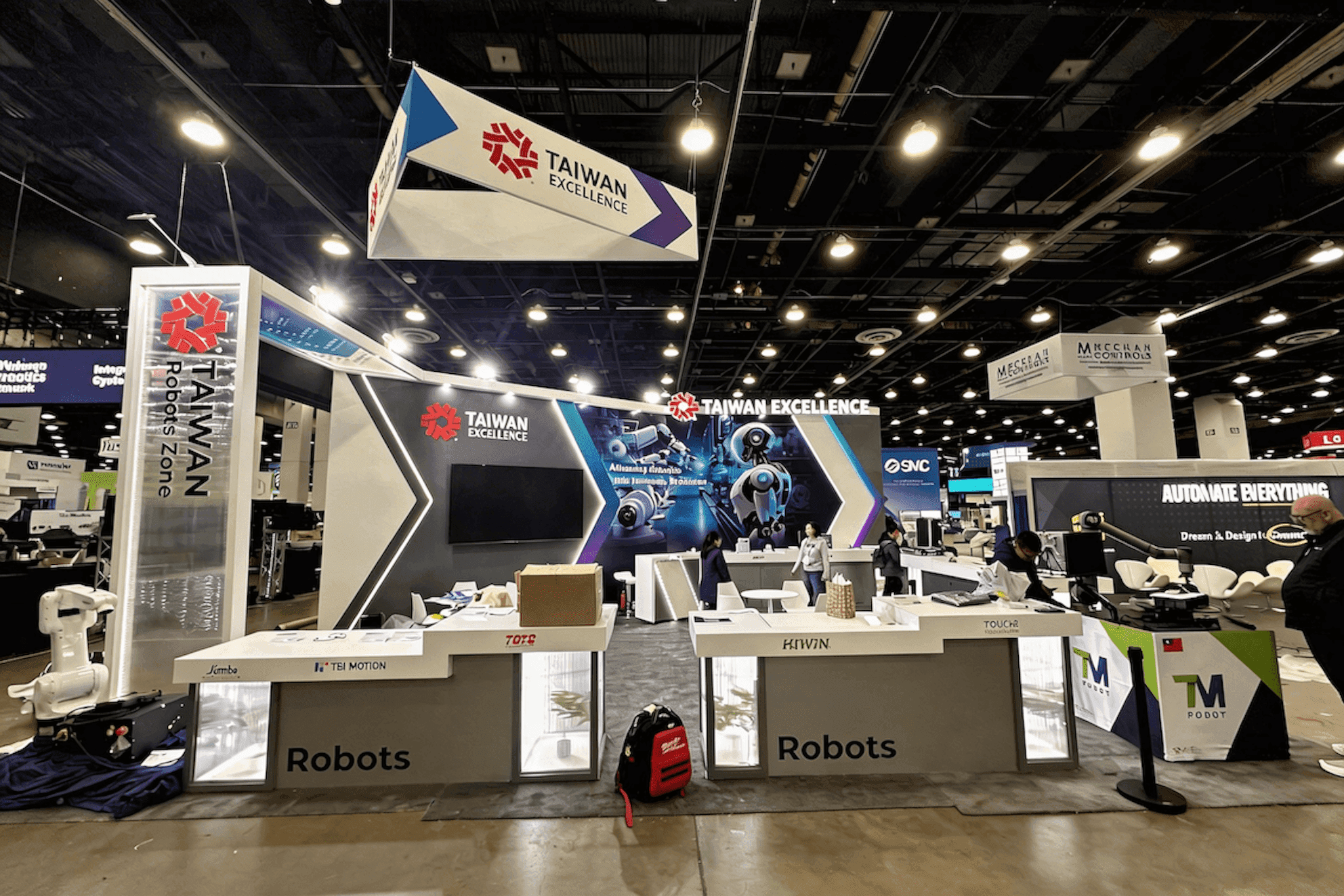
Fabrication does not start with materials

It starts with clarity.

A lot of exhibitors think fabrication begins when the shop starts cutting panels, building frames, printing graphics, or preparing hardware.

That is only the visible part.

In reality, fabrication begins earlier, at the point where the builder has enough reliable information to stop interpreting and start producing. If that information is weak, incomplete, or still moving, the project may appear to be advancing, but the production phase is already carrying risk.

That is why the builder’s most important materials at the beginning are not wood, metal, or graphics.

They are inputs.

Most production pressure starts with missing or unstable inputs

A booth project rarely becomes difficult because one single document is absent.

It usually becomes difficult because several important things are only half-clear at the same time.

That may include:

  • a layout that is approved in principle but not fully locked

  • product counts that are still shifting

  • AV requirements that are partially confirmed

  • graphics dimensions that depend on late content

  • storage needs that were mentioned but not properly planned

  • meeting or demo expectations that are still evolving

None of these problems look dramatic on their own.

Together, they make fabrication much harder to start cleanly.

Builders need decisions, not just preferences

This is one of the biggest differences between concept and production.

In the earlier phase, it is normal for the project to revolve around direction, reference, mood, and preference. That is part of the creative process.

Before fabrication starts, that is not enough anymore.

The builder needs to know what is real.

That usually means clear answers to questions like:

  • What booth size are we actually building?

  • Which zones are essential?

  • What is fixed and what is optional?

  • What equipment must be physically supported?

  • What storage or utility needs are real, not just preferred?

  • What finish level is expected in visible areas?

A builder can work with changing ideas early.
A builder cannot fabricate cleanly from changing assumptions.

The booth size must be truly settled

This sounds basic, but it affects almost everything.

A 20x20 trade show booth is not just a different dimension from a larger footprint. It changes how the booth is engineered, how storage is handled, how demo space behaves, how the graphics scale, and how labor flows during install.

That is why builders need the footprint locked before fabrication starts.

If size is still emotionally open, then production logic is not really stable yet either.

Even a small change in footprint can affect:

  • structure depth

  • counters and display placement

  • wall spans

  • storage volume

  • graphics sizing

  • packing logic

  • field sequence

That is why size confirmation is not a minor detail.
It is a production decision.

Builders need a real brief, not a loose wish list

A useful client brief does not need to be long.

But it does need to be specific enough to support action.

A strong brief usually clarifies:

What the booth must do

Demo, meeting, display, sampling, storage, lead capture, or product education.

What the booth must hold

Products, screens, hardware, literature, concealed storage, hospitality, or operator space.

What the booth must communicate

Category, positioning, use case, or launch priority.

What the booth must look like

Open, premium, technical, rugged, minimal, immersive, or product-led.

Without that level of clarity, the builder is forced to translate goals while also trying to prepare the project for fabrication.

That usually creates more revision pressure later.

Product and equipment lists matter more than many exhibitors expect

A booth builder cannot fabricate around vague content.

If the booth includes:

  • display products

  • demo hardware

  • monitors

  • touchscreens

  • shelving units

  • hanging signs

  • lighting features

  • storage requirements

then those things need to be described early enough to affect the build properly.

This is especially important when exhibitors are still speaking in general terms like:

  • “a few screens”

  • “some product shelving”

  • “a small storage area”

  • “a meeting table if possible”

Those phrases are understandable in conversation, but they are too soft for production.

The builder needs enough detail to know what the booth is physically supporting.

Drawings must describe the booth as a buildable object

This is where many projects quietly get weaker.

A drawing package can look complete and still leave fabrication exposed if it mainly describes appearance instead of construction logic.

Before the shop starts, the builder needs drawings that help answer:

  • how the booth goes together

  • where key joins happen

  • what surfaces are visible and finish-critical

  • where access must remain possible

  • what breaks down for shipping

  • how different materials meet

  • what dimensions are final

A booth can be visually approved and still not be fabrication-ready.

That is why clearer drawings protect more than the design.
They protect the build.

Graphics information cannot stay vague too long

This is where many projects begin to compress their own timeline.

Graphics usually affect:

  • panel sizing

  • lightbox dimensions

  • placement logic

  • message hierarchy

  • final finish timing

If the builder still does not know:

  • what graphics surfaces are real

  • which dimensions are locked

  • what file timing to expect

  • what content changes are still likely

then fabrication planning starts carrying uncertainty it should not have to carry.

This does not mean every final graphic file must exist immediately.
It does mean the graphic system itself must be real enough to build around.

That is part of what protects execution quality.

Builders also need logistics awareness before production starts

This is where logistics and pre-show coordination begin much earlier than many exhibitors assume.

A booth that is hard to fabricate cleanly is often also hard to pack, ship, stage, and install cleanly.

That is why builders need early clarity on things like:

  • target show and venue context

  • shipping expectations

  • access sensitivity

  • move-in priorities

  • whether the booth needs special staging logic

  • whether certain parts must stay protected until later phases

Fabrication does not happen in isolation.
It creates the conditions for everything that comes next.

If those later conditions are ignored too early, the booth becomes harder to execute even if the shop work itself looks fine.

Prebuild and fabrication planning depend on better early answers

This is where booth fabrication and prebuild checks become easier or harder before they even begin.

A strong fabrication process depends on clear exhibitor inputs because those inputs determine:

  • what gets built first

  • what needs testing in prebuild

  • what tolerances matter most

  • what finish areas need more scrutiny

  • what parts must be labeled more carefully

  • what field sequence the booth will depend on

If the exhibitor handoff is unclear, prebuild ends up spending time solving questions that should have been settled earlier.

That weakens the whole process.

Approval structure matters as much as design detail

This gets missed all the time.

A builder does not only need information.
A builder also needs to know who can finalize information.

Before fabrication starts, the project gets much safer when the builder understands:

  • who approves drawings

  • who signs off on changes

  • who decides scope tradeoffs

  • who owns graphics timing

  • who can confirm equipment and display counts

If that approval structure is vague, then even good information becomes unstable because no one is fully empowered to lock it.

That is one of the biggest hidden causes of production delay.

Better inputs protect cost as well as schedule

This is an important point.

Exhibitors often think of clearer inputs as something that mainly helps the builder.

It helps the exhibitor too.

When the project enters fabrication with cleaner inputs, it usually protects:

Schedule

The shop spends less time waiting, rechecking, or revising.

Cost

Fewer changes happen after production logic is already in motion.

Execution quality

The booth is more likely to be built the way it was meant to be built.

Install efficiency

The field receives a booth with better logic already built into it.

That is why clearer input is not just courtesy.
It is project protection.

Builder planning gets stronger when exhibitors help lock reality early

This is one reason exhibitors benefit from working with a Las Vegas trade show booth builder that actively pushes for clearer inputs before production starts.

Because a strong builder is not asking for clarity to slow the project down.

A strong builder is asking for clarity so the project can move forward without carrying avoidable confusion into fabrication.

That usually means the builder is trying to lock:

  • booth function

  • footprint

  • real equipment needs

  • draw-ready geometry

  • graphics logic

  • field-sensitive priorities

The earlier those become real, the better the project usually performs later.

The cleanest fabrication starts usually have these inputs locked

The strongest projects usually enter production with these five things clear:

1. Booth function

Everyone agrees what the booth must actually do.

2. Footprint and zone logic

The size and layout priorities are no longer drifting.

3. Product, AV, and storage requirements

The builder knows what the booth must physically support.

4. Drawings and graphics framework

The shop is not being asked to guess at major build decisions.

5. Approval ownership

The project knows who can finalize the remaining details quickly.

When those five things are in place, fabrication usually starts much cleaner.

Final thought

Before fabrication begins, the most valuable thing an exhibitor can give a booth builder is not urgency.

It is clarity.

That includes real scope, real dimensions, real equipment needs, real graphics logic, and real decision ownership. Those inputs protect schedule, cost, and execution quality because they let the builder stop translating uncertainty and start building with confidence.

That is what makes production stronger.

Not simply getting to the shop quickly.

Getting to the shop ready.

Trying to make fabrication start cleaner and with fewer revisions?
Start with a stronger Las Vegas trade show booth builder process, then connect it to better booth fabrication and prebuild checks so the project enters production with clearer inputs and better execution logic.


Message

Leave your message and we will get back to you ASAP

Send a Message

We’ll Be in Touch!

Message

Leave your message and we will get back to you ASAP

Address:

4915 Steptoe Street #300

Las Vegas, NV 89122