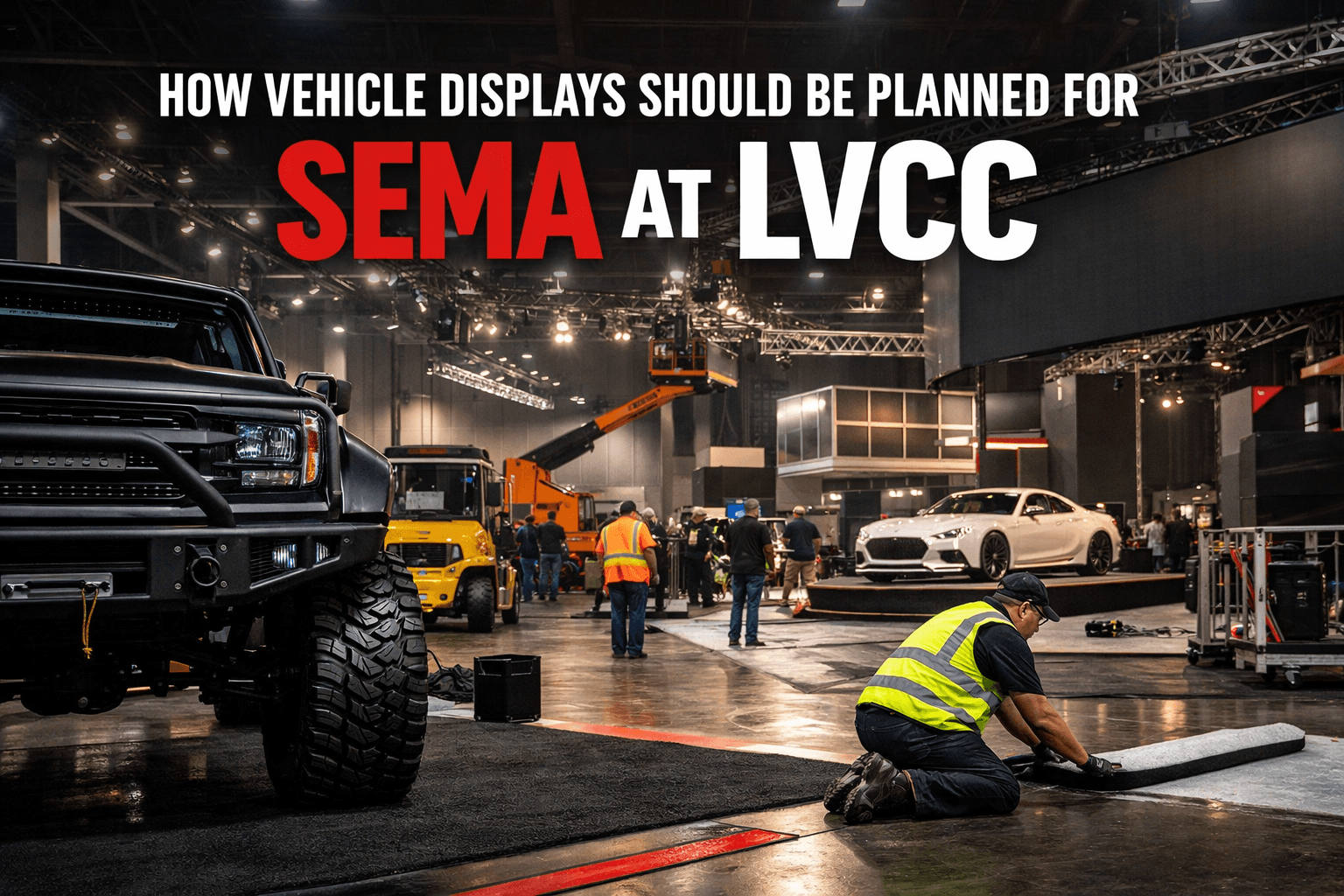
How SEMA Vehicle Displays Change Booth Layout Planning at LVCC

Circle Exhibit Team
Industry professionals
Exhibition industry professional dedicated to delivering the latest insights and curated recommendations to you.
Vehicle-focused SEMA booths need different layout logic than standard product display booths. A hero vehicle changes sightlines, aisle entry, product wall placement, staff movement, drayage planning, and install sequencing inside LVCC.
A SEMA booth with a vehicle display cannot be planned like a standard product booth.
The vehicle is not just one object inside the space. It becomes the visual anchor, traffic magnet, photo point, product context, and installation constraint. That changes how the booth should handle aisle sightlines, parts walls, staff positions, graphics, and show-site logistics at LVCC.
Quick Answer
SEMA vehicle displays change booth layout planning because the vehicle becomes the main traffic driver and visual reference point. The booth must protect sightlines from the aisle, leave enough circulation around the vehicle, connect aftermarket products to the display, and plan drayage, staging, and installation around the vehicle’s move-in requirements.
For exhibitors preparing an automotive aftermarket booth, SEMA Show booth planning should begin with the vehicle position before walls, counters, product shelves, or meeting areas are finalized.
Why Does a Vehicle Display Change the Whole Booth Layout?
A vehicle takes control of the booth before any graphics are added.
In a standard product booth, the main wall or counter often becomes the first visual anchor. In a SEMA vehicle display booth, the car, truck, build, or specialty vehicle usually becomes the first stop. Visitors see it from the aisle, move toward it, walk around it, take photos, and then look for the parts, accessories, or brand story connected to it.
That changes the layout order.
The vehicle should usually be placed before the product wall, meeting counter, reception desk, or storage area. If the booth starts with counters and walls first, the vehicle may end up blocked, squeezed, or disconnected from the traffic path.
At SEMA, the vehicle is often the reason people stop. The layout needs to respect that behavior.
How Should Hero Vehicle Sightlines Work Inside LVCC West Hall?
Hero vehicle sightlines should be protected from the aisle.
Inside LVCC West Hall, large automotive booths often compete for attention across wide aisles, tall structures, lighting, graphics, and moving crowds. A vehicle display needs a clean visual line from the aisle so visitors can understand the booth before stepping in.
The best sightline is usually not straight-on only. Many visitors approach from angles, especially near aisle intersections. That means the vehicle should be positioned so its most recognizable side, front corner, or modification feature is visible from more than one direction.
A strong SEMA layout often uses:
a front-corner vehicle angle
open aisle-facing space around the vehicle
graphics placed behind or beside the vehicle, not in front of it
product walls that support the vehicle story
lighting that frames the vehicle without creating glare
enough clearance for photos and visitor circulation
The goal is to make the vehicle easy to notice, easy to approach, and easy to connect to the brand’s aftermarket products.
What Changes When the Booth Uses a 30x40 Layout?
A 30x40 booth gives the vehicle enough room to become a full display zone, not just a parked object.
For many SEMA exhibitors, 30x40 trade show booth layouts for vehicle displays work well because the footprint can support a hero vehicle, parts wall, demo counter, product display, and a small meeting area without forcing every function into one path.
But the extra space also creates more planning responsibility.
A 30x40 vehicle booth should usually separate the layout into clear zones:
Zone | Role in a SEMA Vehicle Booth | Planning Requirement |
|---|---|---|
Hero vehicle zone | Main visual anchor and photo draw | Open sightlines, circulation clearance, lighting control |
Parts wall | Connects products to the vehicle story | Close enough to be related, not blocking the vehicle |
Demo counter | Supports product explanation or lead capture | Positioned near traffic, but away from vehicle crowding |
Meeting area | Handles buyer follow-up and dealer conversations | Side or rear placement with quieter movement |
Storage / service area | Holds staff items, samples, and install materials | Hidden from aisle and visitor photography angles |
A 30x40 booth should not simply fill the space. It should let the vehicle create attention, then guide visitors toward product details and sales conversations.
Vehicle Display Booth vs Standard Product Booth
Planning Factor | Standard Product Display Booth | SEMA Vehicle Display Booth |
|---|---|---|
Main visual anchor | Product wall, screen, counter, or graphic backdrop | Hero vehicle or modified vehicle build |
Visitor movement | Visitors often move from wall to counter | Visitors circle, pause, photograph, and inspect |
Product context | Products are usually explained on shelves or screens | Products should connect visually to the vehicle |
Aisle behavior | Visitors may stop at the counter or front message | Visitors often stop before entering fully |
Install pressure | Focused on walls, counters, graphics, AV | Adds vehicle move-in, clearance, staging, and protection |
Layout risk | Cluttered messaging or weak entry point | Blocked sightlines, tight circulation, or vehicle crowding |
How Should Parts Walls Support the Vehicle Display?
A parts wall should explain the vehicle, not compete with it.
In automotive aftermarket booths, product walls often include wheels, lighting, suspension parts, performance components, detailing products, accessories, or replacement systems. These items need to feel connected to the vehicle display. If the parts wall sits too far away, visitors may not understand the relationship. If it sits too close, it can crowd the vehicle and weaken the photo angle.
The better approach is to use the parts wall as a second layer.
The vehicle attracts attention first. The parts wall helps visitors understand what makes the vehicle relevant to the brand. The demo counter or sales area then turns interest into a real conversation.
This sequence matters at SEMA because many visitors are comparing products quickly. A clean vehicle-to-product connection helps them understand the booth without needing a long explanation from staff.
Where Should Large Graphics Go Around a Vehicle?
Large graphics should frame the vehicle, not cover it.
At SEMA, graphics often need to communicate product category, brand identity, performance message, or aftermarket application. But when the booth includes a vehicle, the graphics should support the vehicle’s visual role.
A strong graphic placement often uses the back wall, side wall, or elevated panel to create context behind the vehicle. The message should be visible from the aisle, but not so dominant that it distracts from the build itself.
For vehicle-focused booths, graphics usually work best when they answer one of these questions:
What product category is being shown?
What vehicle system or modification does the brand support?
What should visitors notice first on the vehicle?
Where should visitors move after they stop for the vehicle?
The booth should not rely on the vehicle alone. It should use graphics to turn visual attention into product understanding.
Why Does Aisle Circulation Matter More for Vehicle Displays?
Vehicle displays create stopping behavior.
Visitors often stop outside the booth before they fully enter. They may take photos, point out features, or wait for others to move around the vehicle. If the booth does not plan for this behavior, the aisle can become crowded and the booth entry can feel blocked.
The layout should leave space for three types of movement:
visitors approaching from the aisle
visitors circling the vehicle
staff moving between demo, meeting, and product areas
This is where Las Vegas booth construction team support becomes useful. The booth is not only about placing a vehicle inside a footprint. It needs construction, layout, graphics, staging, and install decisions that allow the vehicle to function as part of the show-floor experience.
At SEMA, the vehicle should create energy without trapping traffic.
How Does Vehicle Move-In Affect Booth Logistics?
Vehicle move-in adds another layer to show-site coordination.
A booth with a hero vehicle needs more than standard freight planning. The team has to consider when the vehicle enters the hall, how it moves from dock or staging area to booth space, how it is protected, and when surrounding structures can be installed.
This can affect the full installation sequence.
If walls, counters, flooring, or product displays are installed too early, they may block vehicle placement. If the vehicle arrives too late, the team may lose time adjusting graphics, lighting, or protective details around it.
For SEMA booths at LVCC, logistics and pre-show coordination should account for:
vehicle arrival timing
drayage and freight movement
dock-to-booth access
floor protection
turning clearance
surrounding booth structures
union labor coordination
final cleaning and presentation checks
A vehicle display booth needs a clear move-in order. The booth layout should be designed with that order in mind.
How Should Staff Positions Be Planned Around the Vehicle?
Staff should not block the vehicle’s strongest view.
This is a common issue in vehicle display booths. Staff naturally stand where visitor attention is strongest, but if they stand directly in front of the vehicle, product wall, or photo angle, the booth loses visual clarity.
A better layout gives staff defined working positions:
one greeter or qualifier near the aisle
one product expert near the demo counter or parts wall
one sales contact near the meeting area
one floating staff member to manage high-traffic moments
The staff path should not cut directly through the vehicle photo zone. If staff have to cross the vehicle display constantly, the booth may feel busy and disorganized.
In a SEMA booth, visitor sightlines and staff movement need to work together.
What Should Exhibitors Confirm Before Finalizing a SEMA Vehicle Booth?
The vehicle should be planned before the booth details are locked.
A strong SEMA layout starts with how the vehicle enters, where it sits, how visitors see it, and how the products connect to it.
Planning Checklist
Which vehicle is the hero object?
What side or angle should visitors see first?
Will the vehicle need room for doors, hood, trunk, or display features to open?
Where will visitors stop for photos?
How much circulation space is needed around the vehicle?
Where should the parts wall sit in relation to the vehicle?
Will graphics frame the vehicle or compete with it?
Where should staff stand during busy traffic periods?
Where should buyer conversations happen after product interest is confirmed?
How will the vehicle move into LVCC before surrounding booth elements are installed?
What drayage, staging, labor, and floor protection requirements need to be planned before move-in?
These questions help prevent the booth from becoming a vehicle parked inside a space. They turn the vehicle into the organizing center of the exhibit.
When Does a Vehicle Display Booth Need More Build Control?
A vehicle display booth needs more build control when the vehicle, structure, graphics, and product display depend on each other.
This often happens when the booth includes a hero vehicle, large parts wall, integrated lighting, custom counters, product shelving, storage, AV, and meeting space within the same footprint. A change in one area can affect sightlines, circulation, or install order.
For SEMA exhibitors, more control may be needed when:
the vehicle is large or difficult to maneuver
the booth uses a 30x40 or larger layout
the product wall must align with the vehicle story
the booth needs strong photo sightlines
the display includes heavy aftermarket parts
the installation sequence has limited flexibility
the meeting area must stay separate from high-traffic zones
In these cases, layout planning and show-site execution cannot be separated. The booth has to be designed for how it will be built, not just how it will look.
What Is the Best Layout Logic for a SEMA Vehicle Display?
The best SEMA vehicle display layout starts with the vehicle and builds outward.
First, protect the hero vehicle sightline. Then create circulation around it. Next, place the parts wall where it supports the vehicle story. After that, position demo counters, meeting areas, storage, and graphics in a way that does not interfere with visitor movement.
A strong SEMA booth should make visitors understand three things quickly:
what the vehicle is showing
what product or aftermarket category the brand supports
where to go next for a demo or sales conversation
That is what separates a planned vehicle display booth from a standard booth with a car inside it.
At LVCC, the booth also has to work during move-in, not just during show hours. The vehicle’s location, staging path, and installation sequence should be part of the layout decision from the start.
Planning a SEMA Booth Around a Hero Vehicle Display?
Start with the SEMA show context, then plan the vehicle sightline, parts wall, booth size, logistics, and Las Vegas show-site execution as one system.
A SEMA booth with a vehicle display cannot be planned like a standard product booth.
The vehicle is not just one object inside the space. It becomes the visual anchor, traffic magnet, photo point, product context, and installation constraint. That changes how the booth should handle aisle sightlines, parts walls, staff positions, graphics, and show-site logistics at LVCC.
Quick Answer
SEMA vehicle displays change booth layout planning because the vehicle becomes the main traffic driver and visual reference point. The booth must protect sightlines from the aisle, leave enough circulation around the vehicle, connect aftermarket products to the display, and plan drayage, staging, and installation around the vehicle’s move-in requirements.
For exhibitors preparing an automotive aftermarket booth, SEMA Show booth planning should begin with the vehicle position before walls, counters, product shelves, or meeting areas are finalized.
Why Does a Vehicle Display Change the Whole Booth Layout?
A vehicle takes control of the booth before any graphics are added.
In a standard product booth, the main wall or counter often becomes the first visual anchor. In a SEMA vehicle display booth, the car, truck, build, or specialty vehicle usually becomes the first stop. Visitors see it from the aisle, move toward it, walk around it, take photos, and then look for the parts, accessories, or brand story connected to it.
That changes the layout order.
The vehicle should usually be placed before the product wall, meeting counter, reception desk, or storage area. If the booth starts with counters and walls first, the vehicle may end up blocked, squeezed, or disconnected from the traffic path.
At SEMA, the vehicle is often the reason people stop. The layout needs to respect that behavior.
How Should Hero Vehicle Sightlines Work Inside LVCC West Hall?
Hero vehicle sightlines should be protected from the aisle.
Inside LVCC West Hall, large automotive booths often compete for attention across wide aisles, tall structures, lighting, graphics, and moving crowds. A vehicle display needs a clean visual line from the aisle so visitors can understand the booth before stepping in.
The best sightline is usually not straight-on only. Many visitors approach from angles, especially near aisle intersections. That means the vehicle should be positioned so its most recognizable side, front corner, or modification feature is visible from more than one direction.
A strong SEMA layout often uses:
a front-corner vehicle angle
open aisle-facing space around the vehicle
graphics placed behind or beside the vehicle, not in front of it
product walls that support the vehicle story
lighting that frames the vehicle without creating glare
enough clearance for photos and visitor circulation
The goal is to make the vehicle easy to notice, easy to approach, and easy to connect to the brand’s aftermarket products.
What Changes When the Booth Uses a 30x40 Layout?
A 30x40 booth gives the vehicle enough room to become a full display zone, not just a parked object.
For many SEMA exhibitors, 30x40 trade show booth layouts for vehicle displays work well because the footprint can support a hero vehicle, parts wall, demo counter, product display, and a small meeting area without forcing every function into one path.
But the extra space also creates more planning responsibility.
A 30x40 vehicle booth should usually separate the layout into clear zones:
Zone | Role in a SEMA Vehicle Booth | Planning Requirement |
|---|---|---|
Hero vehicle zone | Main visual anchor and photo draw | Open sightlines, circulation clearance, lighting control |
Parts wall | Connects products to the vehicle story | Close enough to be related, not blocking the vehicle |
Demo counter | Supports product explanation or lead capture | Positioned near traffic, but away from vehicle crowding |
Meeting area | Handles buyer follow-up and dealer conversations | Side or rear placement with quieter movement |
Storage / service area | Holds staff items, samples, and install materials | Hidden from aisle and visitor photography angles |
A 30x40 booth should not simply fill the space. It should let the vehicle create attention, then guide visitors toward product details and sales conversations.
Vehicle Display Booth vs Standard Product Booth
Planning Factor | Standard Product Display Booth | SEMA Vehicle Display Booth |
|---|---|---|
Main visual anchor | Product wall, screen, counter, or graphic backdrop | Hero vehicle or modified vehicle build |
Visitor movement | Visitors often move from wall to counter | Visitors circle, pause, photograph, and inspect |
Product context | Products are usually explained on shelves or screens | Products should connect visually to the vehicle |
Aisle behavior | Visitors may stop at the counter or front message | Visitors often stop before entering fully |
Install pressure | Focused on walls, counters, graphics, AV | Adds vehicle move-in, clearance, staging, and protection |
Layout risk | Cluttered messaging or weak entry point | Blocked sightlines, tight circulation, or vehicle crowding |
How Should Parts Walls Support the Vehicle Display?
A parts wall should explain the vehicle, not compete with it.
In automotive aftermarket booths, product walls often include wheels, lighting, suspension parts, performance components, detailing products, accessories, or replacement systems. These items need to feel connected to the vehicle display. If the parts wall sits too far away, visitors may not understand the relationship. If it sits too close, it can crowd the vehicle and weaken the photo angle.
The better approach is to use the parts wall as a second layer.
The vehicle attracts attention first. The parts wall helps visitors understand what makes the vehicle relevant to the brand. The demo counter or sales area then turns interest into a real conversation.
This sequence matters at SEMA because many visitors are comparing products quickly. A clean vehicle-to-product connection helps them understand the booth without needing a long explanation from staff.
Where Should Large Graphics Go Around a Vehicle?
Large graphics should frame the vehicle, not cover it.
At SEMA, graphics often need to communicate product category, brand identity, performance message, or aftermarket application. But when the booth includes a vehicle, the graphics should support the vehicle’s visual role.
A strong graphic placement often uses the back wall, side wall, or elevated panel to create context behind the vehicle. The message should be visible from the aisle, but not so dominant that it distracts from the build itself.
For vehicle-focused booths, graphics usually work best when they answer one of these questions:
What product category is being shown?
What vehicle system or modification does the brand support?
What should visitors notice first on the vehicle?
Where should visitors move after they stop for the vehicle?
The booth should not rely on the vehicle alone. It should use graphics to turn visual attention into product understanding.
Why Does Aisle Circulation Matter More for Vehicle Displays?
Vehicle displays create stopping behavior.
Visitors often stop outside the booth before they fully enter. They may take photos, point out features, or wait for others to move around the vehicle. If the booth does not plan for this behavior, the aisle can become crowded and the booth entry can feel blocked.
The layout should leave space for three types of movement:
visitors approaching from the aisle
visitors circling the vehicle
staff moving between demo, meeting, and product areas
This is where Las Vegas booth construction team support becomes useful. The booth is not only about placing a vehicle inside a footprint. It needs construction, layout, graphics, staging, and install decisions that allow the vehicle to function as part of the show-floor experience.
At SEMA, the vehicle should create energy without trapping traffic.
How Does Vehicle Move-In Affect Booth Logistics?
Vehicle move-in adds another layer to show-site coordination.
A booth with a hero vehicle needs more than standard freight planning. The team has to consider when the vehicle enters the hall, how it moves from dock or staging area to booth space, how it is protected, and when surrounding structures can be installed.
This can affect the full installation sequence.
If walls, counters, flooring, or product displays are installed too early, they may block vehicle placement. If the vehicle arrives too late, the team may lose time adjusting graphics, lighting, or protective details around it.
For SEMA booths at LVCC, logistics and pre-show coordination should account for:
vehicle arrival timing
drayage and freight movement
dock-to-booth access
floor protection
turning clearance
surrounding booth structures
union labor coordination
final cleaning and presentation checks
A vehicle display booth needs a clear move-in order. The booth layout should be designed with that order in mind.
How Should Staff Positions Be Planned Around the Vehicle?
Staff should not block the vehicle’s strongest view.
This is a common issue in vehicle display booths. Staff naturally stand where visitor attention is strongest, but if they stand directly in front of the vehicle, product wall, or photo angle, the booth loses visual clarity.
A better layout gives staff defined working positions:
one greeter or qualifier near the aisle
one product expert near the demo counter or parts wall
one sales contact near the meeting area
one floating staff member to manage high-traffic moments
The staff path should not cut directly through the vehicle photo zone. If staff have to cross the vehicle display constantly, the booth may feel busy and disorganized.
In a SEMA booth, visitor sightlines and staff movement need to work together.
What Should Exhibitors Confirm Before Finalizing a SEMA Vehicle Booth?
The vehicle should be planned before the booth details are locked.
A strong SEMA layout starts with how the vehicle enters, where it sits, how visitors see it, and how the products connect to it.
Planning Checklist
Which vehicle is the hero object?
What side or angle should visitors see first?
Will the vehicle need room for doors, hood, trunk, or display features to open?
Where will visitors stop for photos?
How much circulation space is needed around the vehicle?
Where should the parts wall sit in relation to the vehicle?
Will graphics frame the vehicle or compete with it?
Where should staff stand during busy traffic periods?
Where should buyer conversations happen after product interest is confirmed?
How will the vehicle move into LVCC before surrounding booth elements are installed?
What drayage, staging, labor, and floor protection requirements need to be planned before move-in?
These questions help prevent the booth from becoming a vehicle parked inside a space. They turn the vehicle into the organizing center of the exhibit.
When Does a Vehicle Display Booth Need More Build Control?
A vehicle display booth needs more build control when the vehicle, structure, graphics, and product display depend on each other.
This often happens when the booth includes a hero vehicle, large parts wall, integrated lighting, custom counters, product shelving, storage, AV, and meeting space within the same footprint. A change in one area can affect sightlines, circulation, or install order.
For SEMA exhibitors, more control may be needed when:
the vehicle is large or difficult to maneuver
the booth uses a 30x40 or larger layout
the product wall must align with the vehicle story
the booth needs strong photo sightlines
the display includes heavy aftermarket parts
the installation sequence has limited flexibility
the meeting area must stay separate from high-traffic zones
In these cases, layout planning and show-site execution cannot be separated. The booth has to be designed for how it will be built, not just how it will look.
What Is the Best Layout Logic for a SEMA Vehicle Display?
The best SEMA vehicle display layout starts with the vehicle and builds outward.
First, protect the hero vehicle sightline. Then create circulation around it. Next, place the parts wall where it supports the vehicle story. After that, position demo counters, meeting areas, storage, and graphics in a way that does not interfere with visitor movement.
A strong SEMA booth should make visitors understand three things quickly:
what the vehicle is showing
what product or aftermarket category the brand supports
where to go next for a demo or sales conversation
That is what separates a planned vehicle display booth from a standard booth with a car inside it.
At LVCC, the booth also has to work during move-in, not just during show hours. The vehicle’s location, staging path, and installation sequence should be part of the layout decision from the start.
Planning a SEMA Booth Around a Hero Vehicle Display?
Start with the SEMA show context, then plan the vehicle sightline, parts wall, booth size, logistics, and Las Vegas show-site execution as one system.
Exhibition Cases
Message
Leave your message and we will get back to you ASAP
Send a Message
We’ll Be in Touch!
Message
Leave your message and we will get back to you ASAP
Address:
4915 Steptoe Street #300
Las Vegas, NV 89122