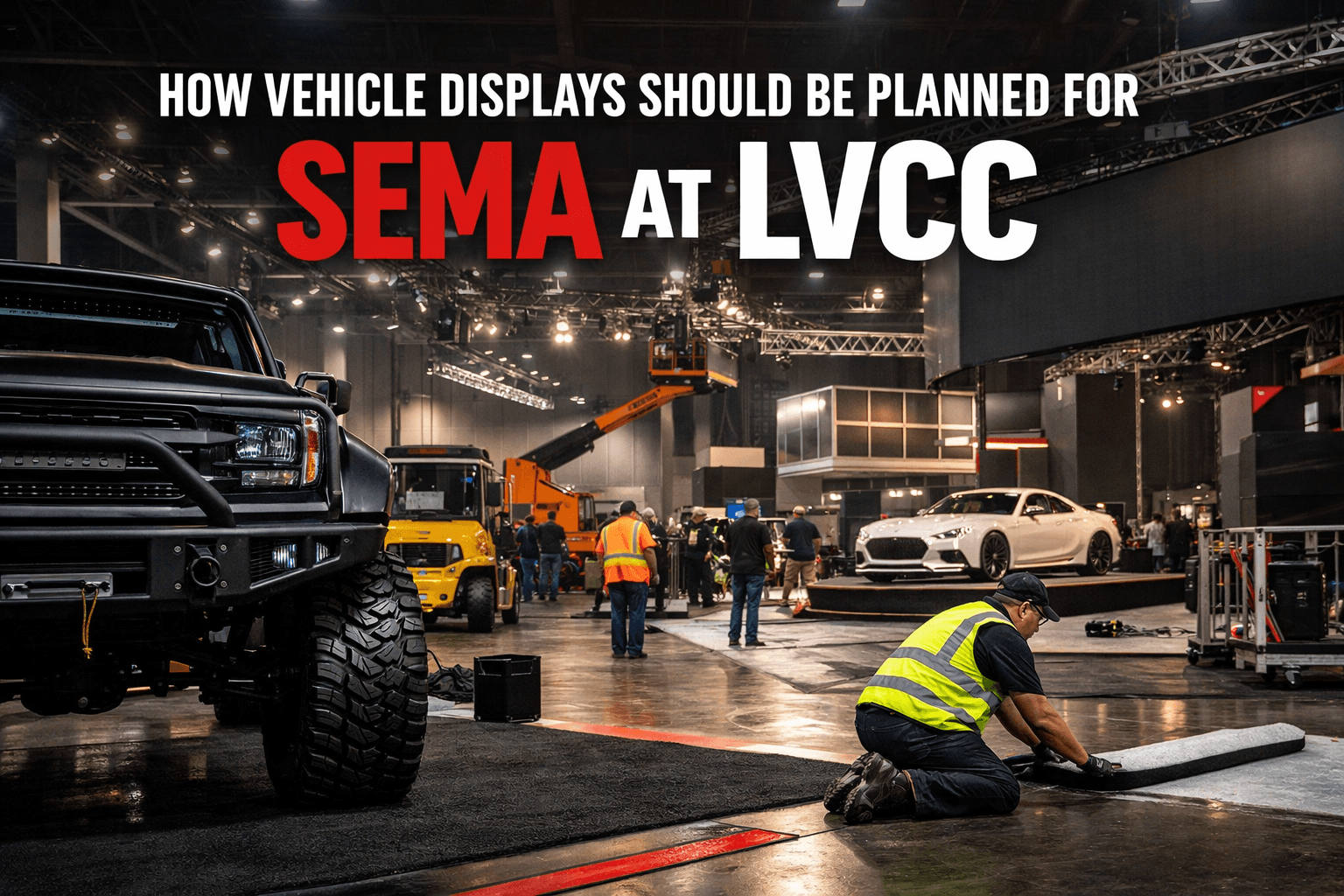
SEMA Show vehicle display booth setup planning at LVCC in Las Vegas with custom exhibit installation and automotive trade show layout

How Vehicle Displays Should Be Planned for SEMA at LVCC

How Vehicle Displays Should Be Planned for SEMA at LVCC

Circle Exhibit Team

Industry professionals

Exhibition industry professional dedicated to delivering the latest insights and curated recommendations to you.

Exhibition industry professional dedicated to delivering the latest insights and curated recommendations to you.

Planning a vehicle display for SEMA at LVCC takes more than booth design. This guide looks at layout strategy, freight timing, labor flow, safety rules, and installation sequencing for automotive exhibits in Las Vegas.

Planning a vehicle display for SEMA at LVCC takes more than booth design. This guide looks at layout strategy, freight timing, labor flow, safety rules, and installation sequencing for automotive exhibits in Las Vegas.

Planning a vehicle display for SEMA at LVCC takes more than booth design. This guide looks at layout strategy, freight timing, labor flow, safety rules, and installation sequencing for automotive exhibits in Las Vegas.

SEMA is not the kind of show where a vehicle can simply be rolled into a booth and treated like decoration. The event is built around the automotive aftermarket, and the Las Vegas Convention Center campus is large enough that booth placement, hall movement, freight timing, and install sequencing all affect how a vehicle display performs on the floor. Recent official SEMA materials also show that vehicle displays at LVCC are governed by specific operational and safety rules, not just design preference.

For exhibitors planning around the SEMA Show at LVCC, the better approach is to think of the vehicle as the center of an execution plan, not just the center of the booth. A good display has to solve three things at once: how the vehicle is seen, how people move around it, and how the install team gets it in and out without creating problems during move-in.

Start With the Vehicle Footprint, Not the Booth Graphic

A lot of SEMA booths look strong in renderings but feel cramped once the vehicle arrives. That usually happens because the display is designed from the back wall forward instead of from the vehicle outward.

At SEMA, the vehicle is not just an attraction. It changes circulation, sightlines, storage needs, lighting angles, cable routing, and even where staff can stand without blocking product views. If you are showing one featured build, one off-road truck, or one wrapped demo vehicle, the first decision should be the true working footprint of the display unit itself, including approach space, cleaning access, photography angles, and buffer space around doors, bumpers, or platform edges.

This is also where booth size matters. A compact footprint may work for a single vehicle and a simple message wall, but once you add product shelving, hospitality, meetings, or media activity, the layout can tighten quickly. That is why many exhibitors planning a serious display strategy at SEMA end up comparing a smaller layout against a more flexible 30x40 trade show booth before locking the design direction.

Visibility Is Only Part of the Job

The most effective vehicle displays are not always the ones with the biggest structure. They are usually the ones that create a clean viewing sequence.

At SEMA, attendees move fast. Buyers, distributors, media teams, and brand partners do not all stop in the same way. Some want a full frontal reveal. Some want to walk the side profile and inspect modifications. Others are looking for the parts, systems, or accessories connected to the vehicle story. If the booth only delivers one viewing angle, it wastes valuable floor attention.

That is why vehicle display planning should include at least three layers of viewing logic:

1. Distance read

What can people understand from the aisle before they stop?

2. Side circulation

Can attendees move around the vehicle without hitting furniture, counters, or staff clusters?

3. Close inspection

Is there enough room to study parts, finishes, wheel setups, interior details, or adjacent product displays?

This matters even more at LVCC because cross-hall movement is real. SEMA’s own travel guidance notes that the campus spans West, Central, and South areas, and that walking from West Hall to North/Central can take up to 25 minutes without the Loop. In other words, once someone reaches your booth, the layout has to work immediately.

Vehicle Displays Need a Real Pre-Show Logistics Plan

A strong SEMA booth can still fail operationally if the vehicle arrives at the wrong time, the carrier misses check-in, or the floor is not ready when the unit is called in.

Recent SEMA logistics documents show that commercial carriers delivering to the show site must first check in at the Freeman Marshalling Yard, where weight tickets may be required and unloading order is assigned by driver check-in time. Those are not minor details. They affect when a vehicle or booth freight actually reaches LVCC and how calmly the install can proceed.

That is why vehicle display planning should always start before show week. The right process usually includes:

  • confirming the vehicle arrival method

  • aligning booth readiness with freight target timing

  • deciding whether the vehicle enters before or after key structure elements are set

  • protecting the vehicle path from blocked aisles or unfinished flooring

  • coordinating who is responsible for escort, spotters, staging, and final placement

This is exactly where experienced logistics and pre-show coordination becomes part of the display strategy, not just a support service in the background. At SEMA, the booth, the freight schedule, and the vehicle placement sequence should be treated as one plan.

Safety Rules Shape the Layout More Than Most Exhibitors Expect

Vehicle displays at SEMA are subject to recent show-management and LVCC fire rules that affect how the booth can actually be used. Official exhibitor materials say display vehicles must have battery cables disconnected and taped, alarms disconnected, and fuel tanks limited to one-quarter tank or five gallons, whichever is less. They also note that display vehicles may occupy no more than 80% of the contracted exhibit space, must be set back 10 inches from the aisle, and may not be started during show hours. EV displays require additional notification paperwork.

Those requirements have design consequences.

They influence whether a platform is worth building. They affect whether you should use a raised deck or keep the vehicle at grade. They change how much open floor you need for traffic and compliance. They also shape where product stands, demo counters, barriers, or low walls can go.

Put simply, a booth that looks dramatic in concept can become difficult in execution if the display vehicle is treated as a styling feature instead of a regulated object on a live show floor.

Labor, Install Sequence, and On-Site Control Need to Be Planned Together

SEMA install work is not just about who builds the booth. It is about how labor, access, and timing are controlled across the venue.

Recent SEMA contractor guidance says exhibitor-appointed contractors must comply with LVCC and SEMA rules, including check-in procedures and worker identification requirements. That matters because vehicle staging, structure assembly, flooring, electrical prep, and final detailing do not happen in isolation. They are tied to venue access, approved labor flow, and the order in which the booth becomes ready for the display unit.

For vehicle-centered booths, the install sequence usually needs to answer these questions early:

  • Does the vehicle go in before overhead elements are finalized?

  • When does finished flooring need to be protected?

  • Where do crew members stand during guided placement?

  • When do detailing, lighting focus, and final content dressing happen?

  • Who owns the last-hour adjustments if the booth is show-ready but the vehicle still is not?

This is why exhibitors with serious vehicle displays often work with a Las Vegas trade show booth builder that understands design, install, logistics, and venue execution as one connected job. At SEMA, that connection is where a lot of booth performance is won or lost.

Good SEMA Vehicle Displays Feel Controlled, Not Crowded

The best vehicle booths at LVCC usually share the same quality: they feel deliberate.

They do not try to fill every inch. They give the vehicle room to read. They create a natural route for attendees. They keep support elements where staff can use them without breaking the presentation. And they make the install process easier because the execution logic was already built into the layout.

That is especially important for SEMA, where the difference between a booth that photographs well and a booth that actually works is often decided during planning, not during show week.

A vehicle display should help the brand look prepared, technically credible, and easy to approach. That result usually comes from smart booth design, clean logistics, and disciplined install planning working together from the beginning.

Final Thoughts

If you are planning to exhibit at SEMA with a featured vehicle, the real question is not just how to make the booth look impressive. The real question is how to make the vehicle, the booth, the freight plan, and the install sequence work together inside LVCC.

That is the difference between a display that feels rushed and one that feels built for the show.
SEMA is not the kind of show where a vehicle can simply be rolled into a booth and treated like decoration. The event is built around the automotive aftermarket, and the Las Vegas Convention Center campus is large enough that booth placement, hall movement, freight timing, and install sequencing all affect how a vehicle display performs on the floor. Recent official SEMA materials also show that vehicle displays at LVCC are governed by specific operational and safety rules, not just design preference.

For exhibitors planning around the SEMA Show at LVCC, the better approach is to think of the vehicle as the center of an execution plan, not just the center of the booth. A good display has to solve three things at once: how the vehicle is seen, how people move around it, and how the install team gets it in and out without creating problems during move-in.

Start With the Vehicle Footprint, Not the Booth Graphic

A lot of SEMA booths look strong in renderings but feel cramped once the vehicle arrives. That usually happens because the display is designed from the back wall forward instead of from the vehicle outward.

At SEMA, the vehicle is not just an attraction. It changes circulation, sightlines, storage needs, lighting angles, cable routing, and even where staff can stand without blocking product views. If you are showing one featured build, one off-road truck, or one wrapped demo vehicle, the first decision should be the true working footprint of the display unit itself, including approach space, cleaning access, photography angles, and buffer space around doors, bumpers, or platform edges.

This is also where booth size matters. A compact footprint may work for a single vehicle and a simple message wall, but once you add product shelving, hospitality, meetings, or media activity, the layout can tighten quickly. That is why many exhibitors planning a serious display strategy at SEMA end up comparing a smaller layout against a more flexible 30x40 trade show booth before locking the design direction.

Visibility Is Only Part of the Job

The most effective vehicle displays are not always the ones with the biggest structure. They are usually the ones that create a clean viewing sequence.

At SEMA, attendees move fast. Buyers, distributors, media teams, and brand partners do not all stop in the same way. Some want a full frontal reveal. Some want to walk the side profile and inspect modifications. Others are looking for the parts, systems, or accessories connected to the vehicle story. If the booth only delivers one viewing angle, it wastes valuable floor attention.

That is why vehicle display planning should include at least three layers of viewing logic:

1. Distance read

What can people understand from the aisle before they stop?

2. Side circulation

Can attendees move around the vehicle without hitting furniture, counters, or staff clusters?

3. Close inspection

Is there enough room to study parts, finishes, wheel setups, interior details, or adjacent product displays?

This matters even more at LVCC because cross-hall movement is real. SEMA’s own travel guidance notes that the campus spans West, Central, and South areas, and that walking from West Hall to North/Central can take up to 25 minutes without the Loop. In other words, once someone reaches your booth, the layout has to work immediately.

Vehicle Displays Need a Real Pre-Show Logistics Plan

A strong SEMA booth can still fail operationally if the vehicle arrives at the wrong time, the carrier misses check-in, or the floor is not ready when the unit is called in.

Recent SEMA logistics documents show that commercial carriers delivering to the show site must first check in at the Freeman Marshalling Yard, where weight tickets may be required and unloading order is assigned by driver check-in time. Those are not minor details. They affect when a vehicle or booth freight actually reaches LVCC and how calmly the install can proceed.

That is why vehicle display planning should always start before show week. The right process usually includes:

  • confirming the vehicle arrival method

  • aligning booth readiness with freight target timing

  • deciding whether the vehicle enters before or after key structure elements are set

  • protecting the vehicle path from blocked aisles or unfinished flooring

  • coordinating who is responsible for escort, spotters, staging, and final placement

This is exactly where experienced logistics and pre-show coordination becomes part of the display strategy, not just a support service in the background. At SEMA, the booth, the freight schedule, and the vehicle placement sequence should be treated as one plan.

Safety Rules Shape the Layout More Than Most Exhibitors Expect

Vehicle displays at SEMA are subject to recent show-management and LVCC fire rules that affect how the booth can actually be used. Official exhibitor materials say display vehicles must have battery cables disconnected and taped, alarms disconnected, and fuel tanks limited to one-quarter tank or five gallons, whichever is less. They also note that display vehicles may occupy no more than 80% of the contracted exhibit space, must be set back 10 inches from the aisle, and may not be started during show hours. EV displays require additional notification paperwork.

Those requirements have design consequences.

They influence whether a platform is worth building. They affect whether you should use a raised deck or keep the vehicle at grade. They change how much open floor you need for traffic and compliance. They also shape where product stands, demo counters, barriers, or low walls can go.

Put simply, a booth that looks dramatic in concept can become difficult in execution if the display vehicle is treated as a styling feature instead of a regulated object on a live show floor.

Labor, Install Sequence, and On-Site Control Need to Be Planned Together

SEMA install work is not just about who builds the booth. It is about how labor, access, and timing are controlled across the venue.

Recent SEMA contractor guidance says exhibitor-appointed contractors must comply with LVCC and SEMA rules, including check-in procedures and worker identification requirements. That matters because vehicle staging, structure assembly, flooring, electrical prep, and final detailing do not happen in isolation. They are tied to venue access, approved labor flow, and the order in which the booth becomes ready for the display unit.

For vehicle-centered booths, the install sequence usually needs to answer these questions early:

  • Does the vehicle go in before overhead elements are finalized?

  • When does finished flooring need to be protected?

  • Where do crew members stand during guided placement?

  • When do detailing, lighting focus, and final content dressing happen?

  • Who owns the last-hour adjustments if the booth is show-ready but the vehicle still is not?

This is why exhibitors with serious vehicle displays often work with a Las Vegas trade show booth builder that understands design, install, logistics, and venue execution as one connected job. At SEMA, that connection is where a lot of booth performance is won or lost.

Good SEMA Vehicle Displays Feel Controlled, Not Crowded

The best vehicle booths at LVCC usually share the same quality: they feel deliberate.

They do not try to fill every inch. They give the vehicle room to read. They create a natural route for attendees. They keep support elements where staff can use them without breaking the presentation. And they make the install process easier because the execution logic was already built into the layout.

That is especially important for SEMA, where the difference between a booth that photographs well and a booth that actually works is often decided during planning, not during show week.

A vehicle display should help the brand look prepared, technically credible, and easy to approach. That result usually comes from smart booth design, clean logistics, and disciplined install planning working together from the beginning.

Final Thoughts

If you are planning to exhibit at SEMA with a featured vehicle, the real question is not just how to make the booth look impressive. The real question is how to make the vehicle, the booth, the freight plan, and the install sequence work together inside LVCC.

That is the difference between a display that feels rushed and one that feels built for the show.
Message

Leave your message and we will get back to you ASAP

Send a Message

We’ll Be in Touch!

Message

Leave your message and we will get back to you ASAP

If you’re ready to shape the future with us, your journey could start here.

If you’re ready to shape the future with us, your journey could start here.

Address:

4915 Steptoe Street #300

Las Vegas, NV 89122