How Trade Show Booth Builders Speed Up Install Without Shrinking the Design

Circle Exhibit Team
Industry professionals
Exhibition industry professional dedicated to delivering the latest insights and curated recommendations to you.
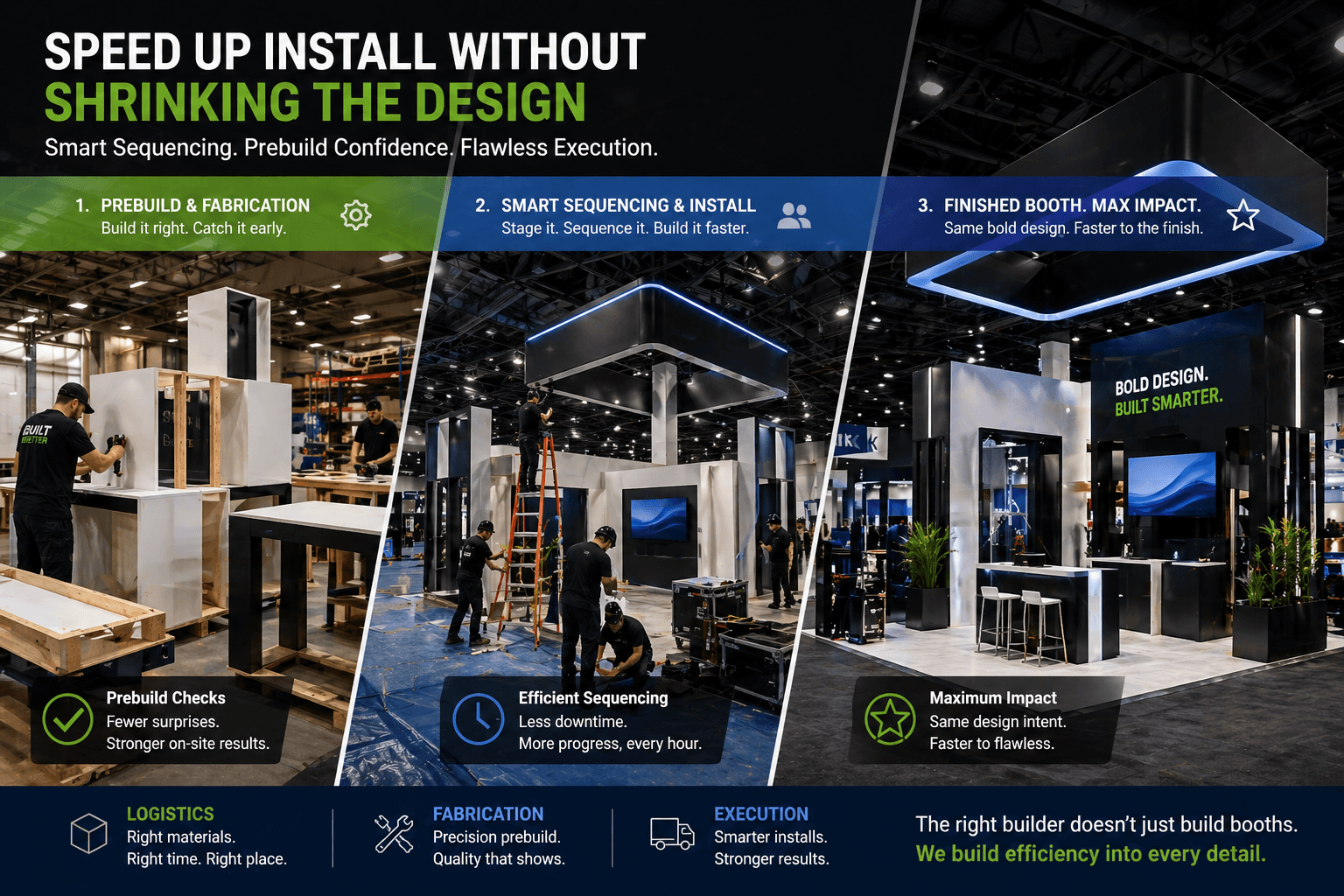
Install speed usually comes from sequencing and prebuild, not from simplifying the booth too much. The strongest builders make the design easier to execute without stripping away the parts that make it worth building.
Faster install does not have to mean a smaller idea
A lot of exhibitors assume there are only two choices.
Either the booth stays ambitious and the install gets harder.
Or the booth gets simplified and the install gets faster.
That sounds logical, but it is usually too blunt.
In real projects, the best builders speed up install in a different way. They do not automatically shrink the design. They make the design easier to execute.
That is a very different thing.
A booth can stay custom, premium, and visually strong while still becoming faster to install if the project is planned with field logic in mind.
Speed usually comes from better logic, not less design
This is the core idea.
A booth gets faster when the team improves things like:
sequence
prebuild clarity
packing logic
access planning
component grouping
staging discipline
transition control between phases
Those changes do not necessarily make the booth simpler to look at.
They make it simpler to build correctly.
That is why install speed is often a planning advantage, not a design sacrifice.
The real goal is to remove friction, not remove value
This is where strong builder thinking starts.
A booth builder trying to improve install speed should be asking:
What slows the crew down unnecessarily?
What part of the booth keeps reopening itself?
What needs early protection?
What could be grouped more intelligently?
What looks complex but does not actually create value?
What creates value and should absolutely stay?
Those are not “cut the design” questions.
They are “protect the important parts better” questions.
That is why better builders often speed up installs by editing friction, not by flattening the concept.
Prebuild is one of the biggest speed advantages
This is where booth fabrication and prebuild checks matter so much.
A booth that has been checked properly before show-floor install usually arrives with much less uncertainty.
That helps the crew because they already know more about:
fit
sequence
packing order
hardware logic
sensitive finish conditions
what needs extra care versus what can move quickly
That does not make the booth visually smaller.
It makes the booth operationally clearer.
And that clarity saves time.
A builder who uses prebuild as a real field rehearsal often gains speed without giving up the booth’s strongest design moments.
Modular thinking helps when it protects sequence, not when it cheapens the booth
A lot of people hear “modular” and assume the booth will start looking generic.
That is not always true.
A builder can use modular sequencing intelligently by grouping components in ways that help the install move faster without making the booth feel ordinary.
That often means:
building repeatable structural logic behind custom-looking surfaces
grouping finish-ready sections for cleaner handoff
reducing unnecessary field assembly steps
making critical parts easier to stage and identify
protecting custom elements by simplifying the way they arrive and connect
This is not about making everything look standard.
It is about making the install more predictable while keeping the booth’s visible identity strong.
The fastest booths usually do not look rushed on the floor
This is worth noticing.
A builder who is really speeding up an install well is not just making the crew move faster.
They are making the booth feel calmer sooner.
That usually looks like:
structure settling earlier
fewer unnecessary materials open on the floor
clearer task handoff between trades
better protection of finish areas
less visible rework
fewer stalls at the exact moment the booth should be tightening up
That kind of speed is not chaotic.
It usually looks more organized, not more aggressive.
Logistics is what makes install speed usable
This is where logistics and pre-show coordination become part of the builder’s speed strategy.
A booth may be designed intelligently, but if freight arrives in the wrong order, or staging is weak, or the active phase cannot access the materials it needs, the install still slows down.
That is why real speed depends on more than structure.
It depends on whether the booth receives:
the right materials first
usable access paths
protected zones that stay protected
a staging plan that matches field sequence
fewer situations where the crew has to sort before it can build
A fast install is not just a labor story.
It is a logistics story too.
Fabrication speed improves when the design is translated honestly
A lot of booths lose time because the production logic is still trying to catch up to the concept logic.
That is where strong fabrication planning makes the difference.
A booth builder can speed up install when the fabrication phase has already translated the design into something field-ready:
labeled clearly
grouped by install phase
packed with access in mind
prebuilt where needed
broken down in ways that support real movement on site
That is why fabrication is not only about building parts.
It is about building the right kind of readiness into the project.
When that happens, the booth can stay visually strong and still arrive with less install friction attached to it.
SEMA-type booths show this clearly
This becomes especially obvious on SEMA Show projects.
SEMA booths often carry a lot of visual intensity:
vehicles
parts walls
hero objects
stronger product layering
more dramatic display logic
That can make teams assume the install must naturally be slower because the booth is more visual.
Not always.
A strong builder can still speed up a SEMA install by protecting things like:
vehicle entry sequence
center-zone discipline
staging around hero displays
pre-grouped product-wall logic
finish timing that does not expose sensitive areas too early
The booth can remain bold.
It just stops asking the field to solve too many problems live.
That is the real gain.
Builder speed usually comes from earlier decisions, not faster reactions
This is one reason exhibitors benefit from working with a Las Vegas trade show booth builder that plans install speed before the booth ever hits the floor.
Because by the time the crew is reacting on site, it is often too late to create the cleanest version of speed.
The strongest builder decisions usually happen earlier:
what gets grouped
what gets prebuilt
what gets packed together
what gets protected until later
what field moments need tolerance
what part of the booth should remain flexible
what absolutely must land perfectly the first time
Those choices are where install speed is really created.
Not just in how quickly people carry tools once move-in begins.
A booth gets faster when the sequence gets cleaner
This is the simplest way to say it.
If the install sequence is cleaner, the booth usually gets faster without becoming weaker.
That means:
Structure enters clearly
The footprint stabilizes without trapping the next phase.
Materials arrive with purpose
The floor carries what the active phase can use.
Finish surfaces arrive into stable conditions
The booth gets refined instead of reopened.
Custom moments stay protected
The important visual features survive with less field stress.
That is usually what separates fast professional installs from fast messy installs.
What builders usually improve when they speed up a booth well
The strongest builders often accelerate install by improving these areas:
Prebuild confidence
Problems are found before the show floor, not during it.
Component grouping
The booth arrives in a way that matches install logic.
Staging control
The floor stays usable longer.
Labor overlap
Crews do not collide unnecessarily.
Transition timing
The booth knows when to move from structure into finish.
None of these require the booth to lose its identity.
They just require the builder to respect execution as part of design quality.
The wrong way to speed up a booth
This is worth saying clearly.
A builder does not really improve a project by simply removing everything difficult.
That often leads to:
flatter visual hierarchy
weaker differentiation
fewer memorable moments
a booth that is easier to build but less valuable once it is finished
That is not the goal.
The goal is to keep what matters and remove what only creates friction.
That is a much more skillful kind of speed.
Final thought
Trade show booth builders speed up install without shrinking the design when they focus on sequence, prebuild, grouping, and field logic instead of just cutting features.
That is why speed does not have to come at the expense of impact.
A strong booth can still feel custom, premium, and worth noticing. It just arrives on the floor with better operational discipline built into it. And once that happens, the crew works cleaner, the finish holds better, and the design has a much better chance to look the way it was meant to look.
That is usually the better version of speed.
Not a smaller booth.
A smarter one.
Trying to speed up booth installation without watering down the design?
Start with a stronger Las Vegas trade show booth builder approach, then connect it to better booth fabrication and prebuild checks so the install gets faster because the sequence is cleaner, not because the idea got smaller.
Faster install does not have to mean a smaller idea
A lot of exhibitors assume there are only two choices.
Either the booth stays ambitious and the install gets harder.
Or the booth gets simplified and the install gets faster.
That sounds logical, but it is usually too blunt.
In real projects, the best builders speed up install in a different way. They do not automatically shrink the design. They make the design easier to execute.
That is a very different thing.
A booth can stay custom, premium, and visually strong while still becoming faster to install if the project is planned with field logic in mind.
Speed usually comes from better logic, not less design
This is the core idea.
A booth gets faster when the team improves things like:
sequence
prebuild clarity
packing logic
access planning
component grouping
staging discipline
transition control between phases
Those changes do not necessarily make the booth simpler to look at.
They make it simpler to build correctly.
That is why install speed is often a planning advantage, not a design sacrifice.
The real goal is to remove friction, not remove value
This is where strong builder thinking starts.
A booth builder trying to improve install speed should be asking:
What slows the crew down unnecessarily?
What part of the booth keeps reopening itself?
What needs early protection?
What could be grouped more intelligently?
What looks complex but does not actually create value?
What creates value and should absolutely stay?
Those are not “cut the design” questions.
They are “protect the important parts better” questions.
That is why better builders often speed up installs by editing friction, not by flattening the concept.
Prebuild is one of the biggest speed advantages
This is where booth fabrication and prebuild checks matter so much.
A booth that has been checked properly before show-floor install usually arrives with much less uncertainty.
That helps the crew because they already know more about:
fit
sequence
packing order
hardware logic
sensitive finish conditions
what needs extra care versus what can move quickly
That does not make the booth visually smaller.
It makes the booth operationally clearer.
And that clarity saves time.
A builder who uses prebuild as a real field rehearsal often gains speed without giving up the booth’s strongest design moments.
Modular thinking helps when it protects sequence, not when it cheapens the booth
A lot of people hear “modular” and assume the booth will start looking generic.
That is not always true.
A builder can use modular sequencing intelligently by grouping components in ways that help the install move faster without making the booth feel ordinary.
That often means:
building repeatable structural logic behind custom-looking surfaces
grouping finish-ready sections for cleaner handoff
reducing unnecessary field assembly steps
making critical parts easier to stage and identify
protecting custom elements by simplifying the way they arrive and connect
This is not about making everything look standard.
It is about making the install more predictable while keeping the booth’s visible identity strong.
The fastest booths usually do not look rushed on the floor
This is worth noticing.
A builder who is really speeding up an install well is not just making the crew move faster.
They are making the booth feel calmer sooner.
That usually looks like:
structure settling earlier
fewer unnecessary materials open on the floor
clearer task handoff between trades
better protection of finish areas
less visible rework
fewer stalls at the exact moment the booth should be tightening up
That kind of speed is not chaotic.
It usually looks more organized, not more aggressive.
Logistics is what makes install speed usable
This is where logistics and pre-show coordination become part of the builder’s speed strategy.
A booth may be designed intelligently, but if freight arrives in the wrong order, or staging is weak, or the active phase cannot access the materials it needs, the install still slows down.
That is why real speed depends on more than structure.
It depends on whether the booth receives:
the right materials first
usable access paths
protected zones that stay protected
a staging plan that matches field sequence
fewer situations where the crew has to sort before it can build
A fast install is not just a labor story.
It is a logistics story too.
Fabrication speed improves when the design is translated honestly
A lot of booths lose time because the production logic is still trying to catch up to the concept logic.
That is where strong fabrication planning makes the difference.
A booth builder can speed up install when the fabrication phase has already translated the design into something field-ready:
labeled clearly
grouped by install phase
packed with access in mind
prebuilt where needed
broken down in ways that support real movement on site
That is why fabrication is not only about building parts.
It is about building the right kind of readiness into the project.
When that happens, the booth can stay visually strong and still arrive with less install friction attached to it.
SEMA-type booths show this clearly
This becomes especially obvious on SEMA Show projects.
SEMA booths often carry a lot of visual intensity:
vehicles
parts walls
hero objects
stronger product layering
more dramatic display logic
That can make teams assume the install must naturally be slower because the booth is more visual.
Not always.
A strong builder can still speed up a SEMA install by protecting things like:
vehicle entry sequence
center-zone discipline
staging around hero displays
pre-grouped product-wall logic
finish timing that does not expose sensitive areas too early
The booth can remain bold.
It just stops asking the field to solve too many problems live.
That is the real gain.
Builder speed usually comes from earlier decisions, not faster reactions
This is one reason exhibitors benefit from working with a Las Vegas trade show booth builder that plans install speed before the booth ever hits the floor.
Because by the time the crew is reacting on site, it is often too late to create the cleanest version of speed.
The strongest builder decisions usually happen earlier:
what gets grouped
what gets prebuilt
what gets packed together
what gets protected until later
what field moments need tolerance
what part of the booth should remain flexible
what absolutely must land perfectly the first time
Those choices are where install speed is really created.
Not just in how quickly people carry tools once move-in begins.
A booth gets faster when the sequence gets cleaner
This is the simplest way to say it.
If the install sequence is cleaner, the booth usually gets faster without becoming weaker.
That means:
Structure enters clearly
The footprint stabilizes without trapping the next phase.
Materials arrive with purpose
The floor carries what the active phase can use.
Finish surfaces arrive into stable conditions
The booth gets refined instead of reopened.
Custom moments stay protected
The important visual features survive with less field stress.
That is usually what separates fast professional installs from fast messy installs.
What builders usually improve when they speed up a booth well
The strongest builders often accelerate install by improving these areas:
Prebuild confidence
Problems are found before the show floor, not during it.
Component grouping
The booth arrives in a way that matches install logic.
Staging control
The floor stays usable longer.
Labor overlap
Crews do not collide unnecessarily.
Transition timing
The booth knows when to move from structure into finish.
None of these require the booth to lose its identity.
They just require the builder to respect execution as part of design quality.
The wrong way to speed up a booth
This is worth saying clearly.
A builder does not really improve a project by simply removing everything difficult.
That often leads to:
flatter visual hierarchy
weaker differentiation
fewer memorable moments
a booth that is easier to build but less valuable once it is finished
That is not the goal.
The goal is to keep what matters and remove what only creates friction.
That is a much more skillful kind of speed.
Final thought
Trade show booth builders speed up install without shrinking the design when they focus on sequence, prebuild, grouping, and field logic instead of just cutting features.
That is why speed does not have to come at the expense of impact.
A strong booth can still feel custom, premium, and worth noticing. It just arrives on the floor with better operational discipline built into it. And once that happens, the crew works cleaner, the finish holds better, and the design has a much better chance to look the way it was meant to look.
That is usually the better version of speed.
Not a smaller booth.
A smarter one.
Trying to speed up booth installation without watering down the design?
Start with a stronger Las Vegas trade show booth builder approach, then connect it to better booth fabrication and prebuild checks so the install gets faster because the sequence is cleaner, not because the idea got smaller.
Exhibition Cases
Message
Leave your message and we will get back to you ASAP
Send a Message
We’ll Be in Touch!
Message
Leave your message and we will get back to you ASAP
Address:
4915 Steptoe Street #300
Las Vegas, NV 89122