How Broadcast Demo Areas Should Be Planned for NAB Show Exhibitors

Circle Exhibit Team
Industry professionals
Exhibition industry professional dedicated to delivering the latest insights and curated recommendations to you.
NAB Show remains one of the clearest commercial stages for companies selling broadcast, production, streaming and media technology. The 2026 show is scheduled at the Las Vegas Convention Center, with exhibits running April 19–22, and NAB continues to position the event as the meeting point for media, entertainment and storytelling professionals. Official exhibitor resources also point teams toward floor plans, Freeman services, labor guidelines and the LVCC Builder’s User Manual before they arrive on site.
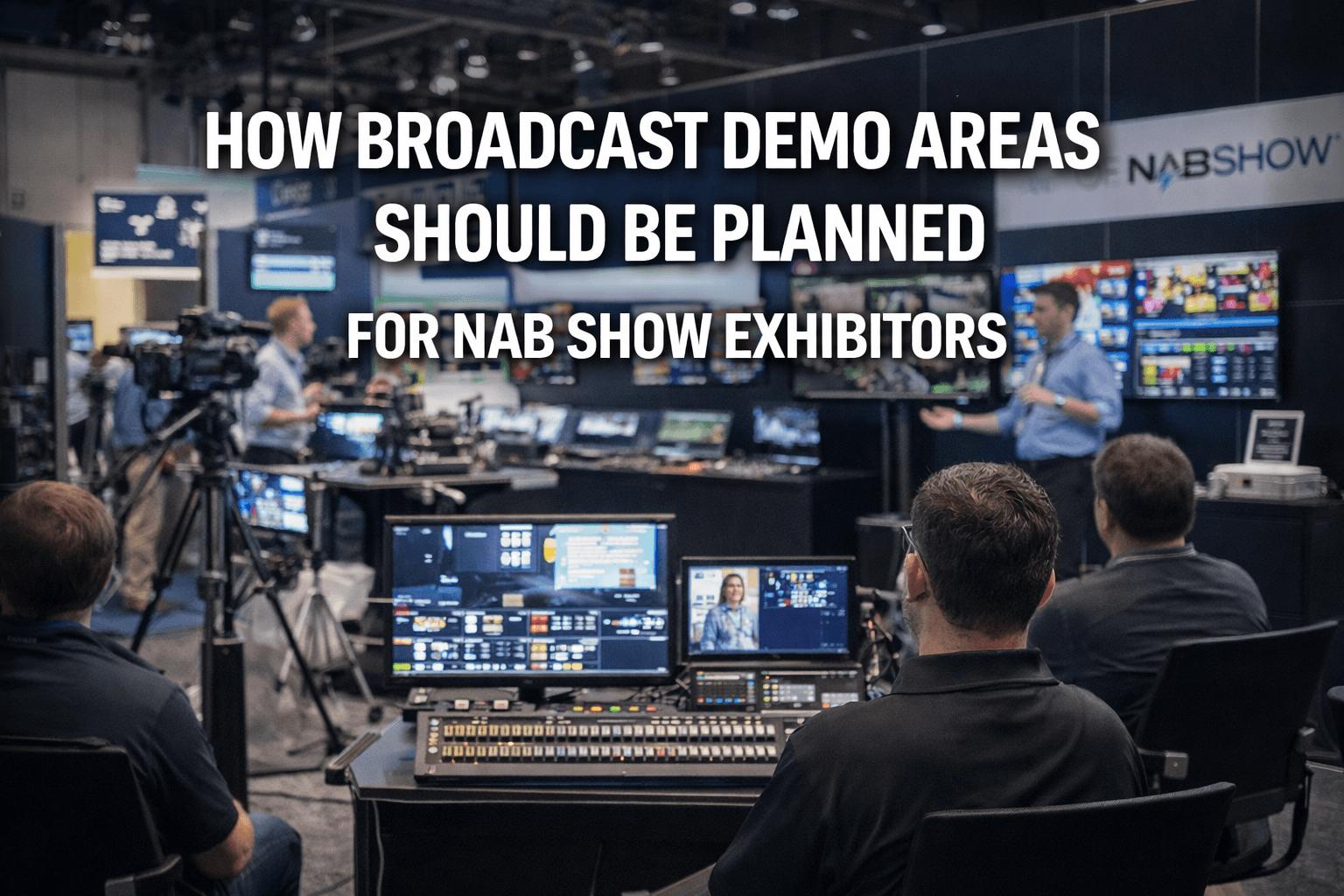
For exhibitors planning around the NAB Show, the broadcast demo area should not be treated as a screen wall with a few stools in front of it. At this show, the demo zone is usually the place where product claims get tested in real time. Visitors are not only looking at branding. They are watching switching, latency, picture quality, interface behavior, workflow logic and operator confidence. That means the booth has to do more than look polished. It has to help the product make sense quickly.
Start With the Workflow, Not the Display Count
A lot of NAB booth concepts begin with the most visible hardware: LED walls, monitors, camera rigs or control surfaces. That is understandable, but it often leads to a demo area that looks impressive before it starts working properly.
A better approach is to plan the zone around the workflow being demonstrated. If the product is about live production, the layout should make the live chain easy to follow. If the product is about remote contribution, cloud playout or signal transport, the visitor should understand the sequence without needing a long verbal explanation. In practice, that usually means deciding what the attendee should notice first, what the operator should control second, and where the deeper technical conversation should happen after the demo lands.
That sequence matters more at NAB than at many other shows because the audience is often technically literate. They are not just asking whether a product exists. They are asking how it behaves under real use.
Broadcast Demo Areas Need Clean Sightlines and Controlled Noise
Broadcast demos fail when too many things demand attention at once.
If the screen content is doing one thing, the presenter is explaining another, and the graphics are introducing a third message, the booth starts feeling busy instead of convincing. The strongest NAB demo areas usually reduce the scene to one main technical story. That could be a live switching chain, a camera-to-cloud path, an IP workflow, an audio monitoring solution or a virtual production toolset. Once that main story is clear, the supporting elements can sit around it instead of fighting for attention.
This is also why open circulation matters. A demo zone should let visitors stop, watch, and move deeper without forcing the operator area and the audience area to overlap. At NAB, the product often needs room to be seen from a short distance and then understood up close. That is very different from a booth where the main goal is just handing out brochures or taking quick sales meetings.
Graphics Should Explain the Demo Before the Presenter Does
Graphics do more work at NAB than people think.
In a broadcast booth, the wall graphics are not just there to make the structure feel complete. They help translate technical value into something readable. If the visitor can understand the platform category, the signal path or the production outcome before the staff member starts speaking, the demo is already ahead.
That is why a strong graphics and brand presentation strategy matters so much in this category. NAB exhibitors often sell systems, workflows and infrastructure, not impulse products. The graphics should shorten the distance between “interesting screen” and “I understand what this does.” The best demo areas usually do that with clear hierarchy: one headline idea, one visible workflow cue, and one supporting layer for deeper technical proof.
Why a 20x20 Booth Often Works Well for Broadcast Demo Planning
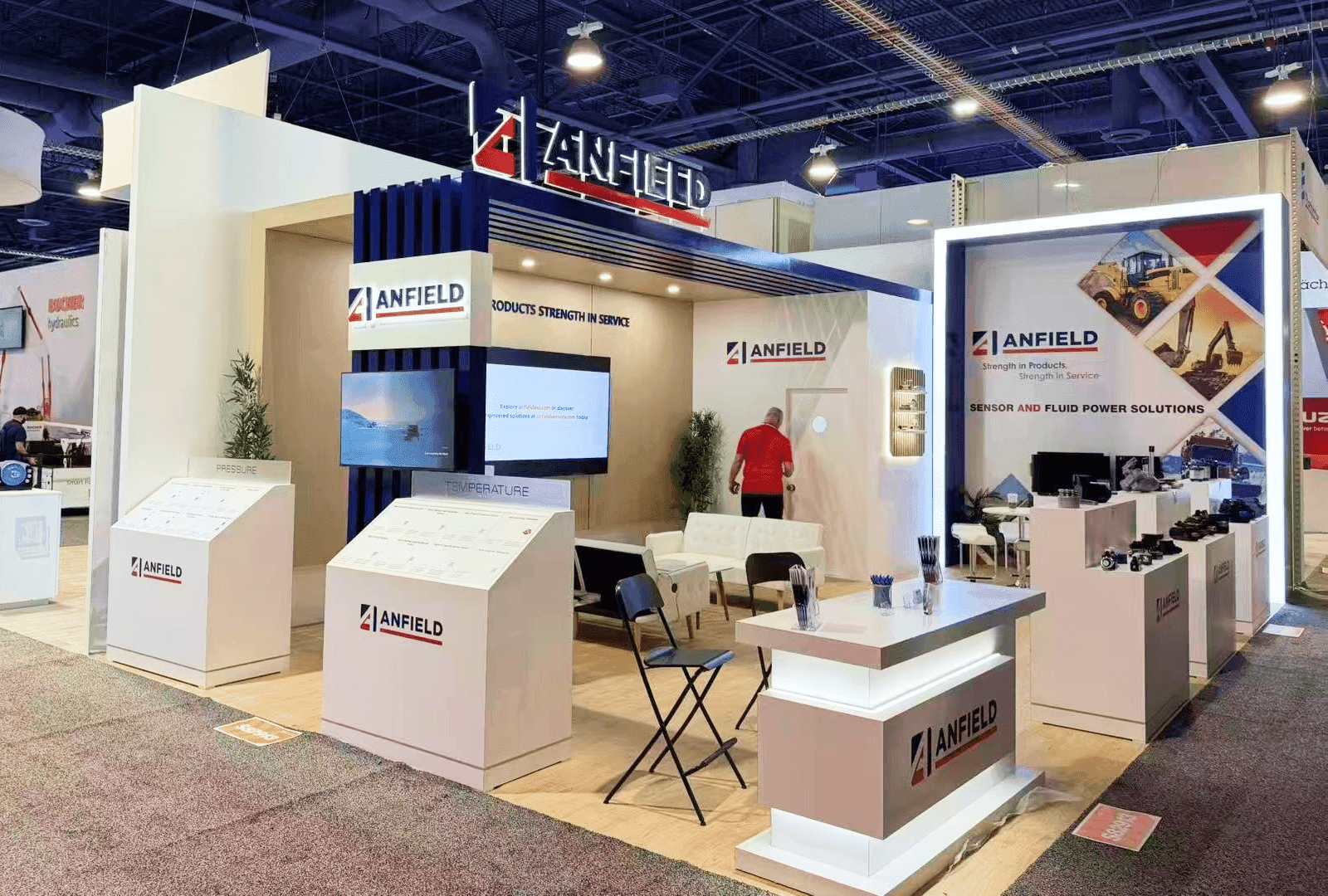
For a lot of NAB exhibitors, a 20x20 trade show booth is a practical footprint because it gives enough room to separate three things that should not be stacked on top of each other: the audience edge, the operator/demo position and the follow-up conversation point.
That size is often large enough to let a monitor wall or demo counter breathe without forcing every visitor to stand directly in the aisle. It also makes it easier to create one clean viewing direction instead of scattering hardware across too many small surfaces. Broadcast technology tends to look more credible when the booth feels structured and intentional. Even a strong product can lose impact if the surrounding layout feels cramped or improvised.
The point is not that every NAB exhibitor needs a 20x20. The point is that broadcast demo areas usually perform better when there is enough room to separate viewing, operation and discussion.
Installation Planning Changes the Quality of the Demo
This is where a lot of booths quietly win or lose.
Official NAB Show labor guidance for Las Vegas says there are tasks exhibitors may perform themselves and other tasks that belong to the official service contractor or registered Exhibitor Appointed Contractors. The same guidance notes that material handling beyond simple hand-carry conditions is treated as drayage, and that EACs must be registered with show management and the building. NAB’s 2026 contract also says exhibitors must observe labor jurisdictions outlined in the exhibit manual. Separately, NAB’s 2026 LVCVA webinar told exhibitors to plan connectivity early and submit floor plans for internet installations.
For a broadcast demo area, that has real design consequences. It affects where equipment is staged, when operator stations can be tested, how early signal paths can be verified, and whether the booth is ready for reliable demos before the floor opens. In this category, installation is not just about getting the booth assembled. It is about getting the system ready to behave consistently in front of a technical audience.
That is why many exhibitors end up relying on a Las Vegas trade show booth builder that understands structure, graphics, staging and show-floor execution as one connected process rather than four separate jobs.
NAB Demo Areas Should Feel Legible, Not Overloaded
One of the easiest mistakes at NAB is trying to show everything.
The show attracts a large, commercially active audience, and NAB’s own 2026 exhibitor marketing webinar said exhibitors should expect more than 60,000 attendees, including many buyers and first-time visitors. That kind of traffic rewards clarity. Visitors do not need every feature at once. They need a reason to stop, a clear demo to watch and a natural path to continue the conversation.
A strong broadcast demo area usually feels easy to read from outside the booth and easy to trust once you step in. The message is clear. The hardware has room. The graphics support the workflow. The operator is not trapped in the same space as the crowd. And the conversation area sits close enough to the demo to carry momentum without blocking the next viewer.
That kind of booth rarely happens by accident. It comes from deciding early what the demo is supposed to prove and then letting the layout serve that goal.
Final Thoughts
For NAB Show exhibitors, the broadcast demo area should be treated as the center of booth performance, not as an accessory added after the design is finished.
At a show built around media, broadcast and technical workflows, the best booths are usually the ones that make complex tools easier to understand in a live environment. That takes more than big screens. It takes the right footprint, clear graphics, disciplined layout and installation planning that respects how the booth will actually operate once the doors open.
NAB Show remains one of the clearest commercial stages for companies selling broadcast, production, streaming and media technology. The 2026 show is scheduled at the Las Vegas Convention Center, with exhibits running April 19–22, and NAB continues to position the event as the meeting point for media, entertainment and storytelling professionals. Official exhibitor resources also point teams toward floor plans, Freeman services, labor guidelines and the LVCC Builder’s User Manual before they arrive on site.
For exhibitors planning around the NAB Show, the broadcast demo area should not be treated as a screen wall with a few stools in front of it. At this show, the demo zone is usually the place where product claims get tested in real time. Visitors are not only looking at branding. They are watching switching, latency, picture quality, interface behavior, workflow logic and operator confidence. That means the booth has to do more than look polished. It has to help the product make sense quickly.
Start With the Workflow, Not the Display Count
A lot of NAB booth concepts begin with the most visible hardware: LED walls, monitors, camera rigs or control surfaces. That is understandable, but it often leads to a demo area that looks impressive before it starts working properly.
A better approach is to plan the zone around the workflow being demonstrated. If the product is about live production, the layout should make the live chain easy to follow. If the product is about remote contribution, cloud playout or signal transport, the visitor should understand the sequence without needing a long verbal explanation. In practice, that usually means deciding what the attendee should notice first, what the operator should control second, and where the deeper technical conversation should happen after the demo lands.
That sequence matters more at NAB than at many other shows because the audience is often technically literate. They are not just asking whether a product exists. They are asking how it behaves under real use.
Broadcast Demo Areas Need Clean Sightlines and Controlled Noise
Broadcast demos fail when too many things demand attention at once.
If the screen content is doing one thing, the presenter is explaining another, and the graphics are introducing a third message, the booth starts feeling busy instead of convincing. The strongest NAB demo areas usually reduce the scene to one main technical story. That could be a live switching chain, a camera-to-cloud path, an IP workflow, an audio monitoring solution or a virtual production toolset. Once that main story is clear, the supporting elements can sit around it instead of fighting for attention.
This is also why open circulation matters. A demo zone should let visitors stop, watch, and move deeper without forcing the operator area and the audience area to overlap. At NAB, the product often needs room to be seen from a short distance and then understood up close. That is very different from a booth where the main goal is just handing out brochures or taking quick sales meetings.
Graphics Should Explain the Demo Before the Presenter Does
Graphics do more work at NAB than people think.
In a broadcast booth, the wall graphics are not just there to make the structure feel complete. They help translate technical value into something readable. If the visitor can understand the platform category, the signal path or the production outcome before the staff member starts speaking, the demo is already ahead.
That is why a strong graphics and brand presentation strategy matters so much in this category. NAB exhibitors often sell systems, workflows and infrastructure, not impulse products. The graphics should shorten the distance between “interesting screen” and “I understand what this does.” The best demo areas usually do that with clear hierarchy: one headline idea, one visible workflow cue, and one supporting layer for deeper technical proof.
Why a 20x20 Booth Often Works Well for Broadcast Demo Planning
For a lot of NAB exhibitors, a 20x20 trade show booth is a practical footprint because it gives enough room to separate three things that should not be stacked on top of each other: the audience edge, the operator/demo position and the follow-up conversation point.
That size is often large enough to let a monitor wall or demo counter breathe without forcing every visitor to stand directly in the aisle. It also makes it easier to create one clean viewing direction instead of scattering hardware across too many small surfaces. Broadcast technology tends to look more credible when the booth feels structured and intentional. Even a strong product can lose impact if the surrounding layout feels cramped or improvised.
The point is not that every NAB exhibitor needs a 20x20. The point is that broadcast demo areas usually perform better when there is enough room to separate viewing, operation and discussion.
Installation Planning Changes the Quality of the Demo
This is where a lot of booths quietly win or lose.
Official NAB Show labor guidance for Las Vegas says there are tasks exhibitors may perform themselves and other tasks that belong to the official service contractor or registered Exhibitor Appointed Contractors. The same guidance notes that material handling beyond simple hand-carry conditions is treated as drayage, and that EACs must be registered with show management and the building. NAB’s 2026 contract also says exhibitors must observe labor jurisdictions outlined in the exhibit manual. Separately, NAB’s 2026 LVCVA webinar told exhibitors to plan connectivity early and submit floor plans for internet installations.
For a broadcast demo area, that has real design consequences. It affects where equipment is staged, when operator stations can be tested, how early signal paths can be verified, and whether the booth is ready for reliable demos before the floor opens. In this category, installation is not just about getting the booth assembled. It is about getting the system ready to behave consistently in front of a technical audience.
That is why many exhibitors end up relying on a Las Vegas trade show booth builder that understands structure, graphics, staging and show-floor execution as one connected process rather than four separate jobs.
NAB Demo Areas Should Feel Legible, Not Overloaded
One of the easiest mistakes at NAB is trying to show everything.
The show attracts a large, commercially active audience, and NAB’s own 2026 exhibitor marketing webinar said exhibitors should expect more than 60,000 attendees, including many buyers and first-time visitors. That kind of traffic rewards clarity. Visitors do not need every feature at once. They need a reason to stop, a clear demo to watch and a natural path to continue the conversation.
A strong broadcast demo area usually feels easy to read from outside the booth and easy to trust once you step in. The message is clear. The hardware has room. The graphics support the workflow. The operator is not trapped in the same space as the crowd. And the conversation area sits close enough to the demo to carry momentum without blocking the next viewer.
That kind of booth rarely happens by accident. It comes from deciding early what the demo is supposed to prove and then letting the layout serve that goal.
Final Thoughts
For NAB Show exhibitors, the broadcast demo area should be treated as the center of booth performance, not as an accessory added after the design is finished.
At a show built around media, broadcast and technical workflows, the best booths are usually the ones that make complex tools easier to understand in a live environment. That takes more than big screens. It takes the right footprint, clear graphics, disciplined layout and installation planning that respects how the booth will actually operate once the doors open.
Exhibition Cases
Message
Leave your message and we will get back to you ASAP
Send a Message
We’ll Be in Touch!
Message
Leave your message and we will get back to you ASAP
Address:
4915 Steptoe Street #300
Las Vegas, NV 89122