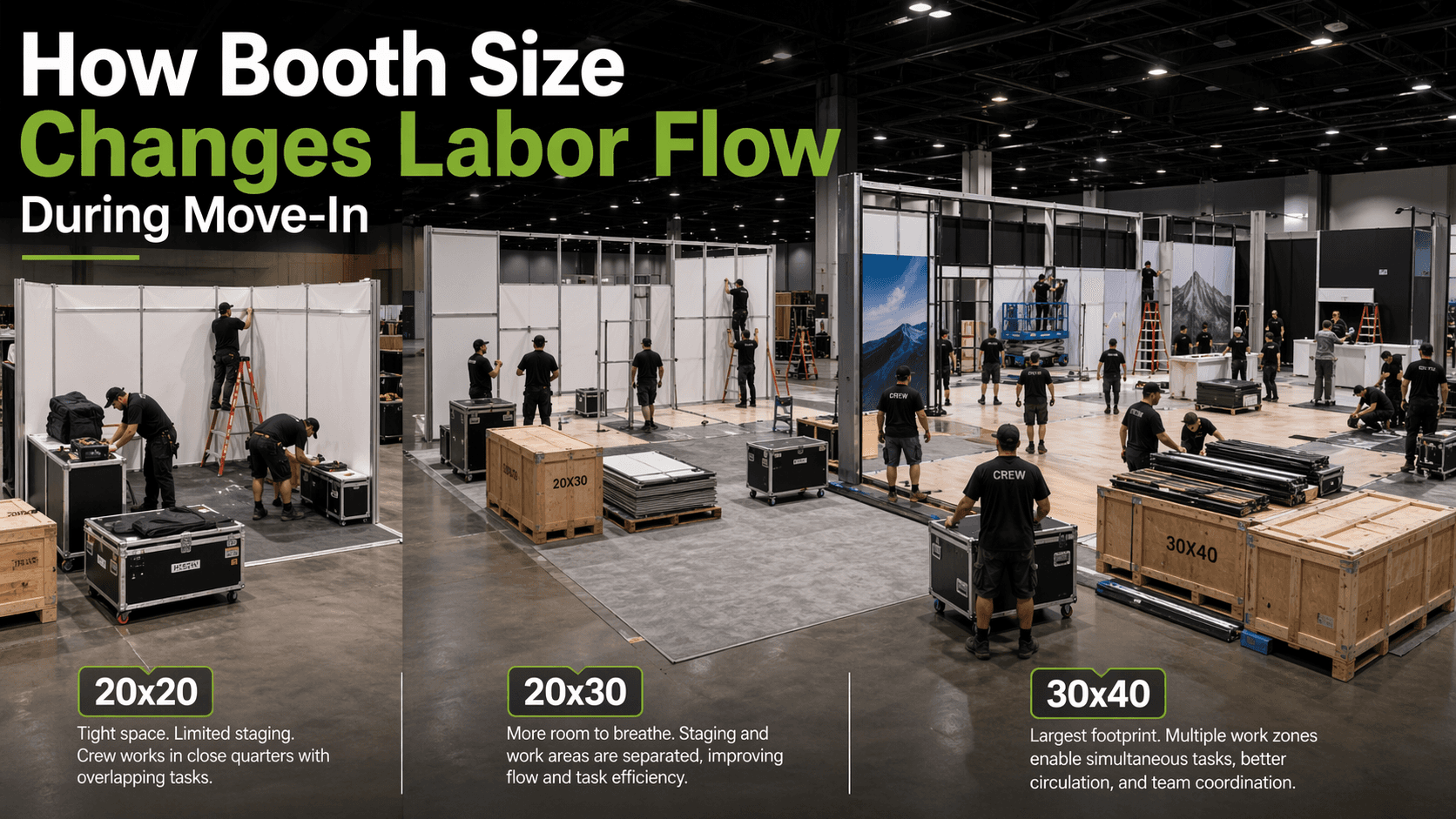
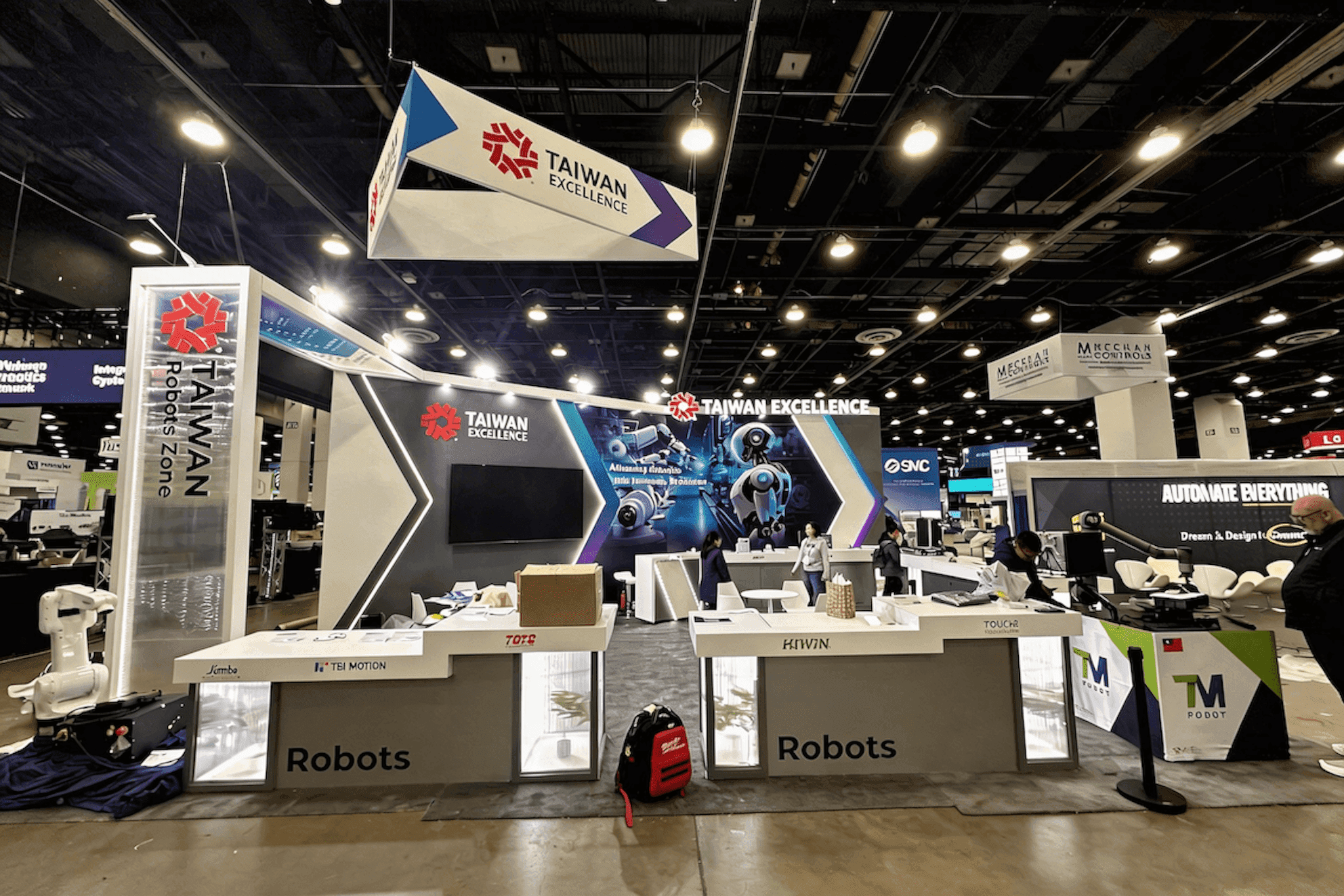
How booth size changes labor flow during move-in cover image showing three booth sizes compared by crew spacing, staging, and install activity

How Booth Size Changes Labor Flow During Move-In

How Booth Size Changes Labor Flow During Move-In

Circle Exhibit Team

Industry professionals

Exhibition industry professional dedicated to delivering the latest insights and curated recommendations to you.

Exhibition industry professional dedicated to delivering the latest insights and curated recommendations to you.

Booth size changes labor flow in practical ways during move-in. It affects how crews share space, where materials can stage, and how easily structure, graphics, and finishing work can happen without getting in each other’s way.

Booth size changes labor flow in practical ways during move-in. It affects how crews share space, where materials can stage, and how easily structure, graphics, and finishing work can happen without getting in each other’s way.

Booth size changes labor flow in practical ways during move-in. It affects how crews share space, where materials can stage, and how easily structure, graphics, and finishing work can happen without getting in each other’s way.

Booth size changes more than layout

Most exhibitors think about booth size in terms of design.

That makes sense.

A bigger footprint gives you more room for product display, meetings, demos, or storage. A smaller booth forces tighter choices. But on move-in day, booth size also changes something less visible and just as important:

how labor actually moves through the space.

That includes:

  • where crews can stand

  • how many trades can work at once

  • how staging affects access

  • whether tasks happen in sequence or start colliding

This is why booth size is not only a design decision.
It is also a labor-flow decision.

Labor flow is really a space-management problem

Move-in rarely slows down because people stop working.

It slows down because the work starts competing for space.

A booth may have enough labor on site, but if the footprint cannot support:

  • staging

  • structure assembly

  • graphics prep

  • electrical access

  • finishing work

at the same time, then the install begins to bottleneck.

That is where booth size starts making a real difference.

The question is not just how much booth do you want.

It is also how much booth the crew needs in order to build cleanly.

A 20x20 booth usually requires tighter sequencing

A 20x20 trade show booth can absolutely install well.

But it usually demands more discipline during move-in.

That is because the footprint fills up quickly. Once you add crates, tools, structural parts, and active labor, there is less room for tasks to overlap comfortably. The booth often needs a cleaner install order because there is not much spare space for recovery.

In a 20x20, crews usually feel the pressure in these ways:

  • staging has to stay compact

  • open floor disappears quickly

  • access paths are easier to block

  • one active task can delay the next one

  • finish work often needs to wait for structure to stabilize

That does not make 20x20 booths harder by default.
It just means move-in depends more on sequence discipline.

Smaller booths punish clutter faster

This is one reason 20x20 booths can feel busy very early.

A few open cases may not look like a problem at first. Then suddenly the crew is stepping around materials, the working edge gets tighter, and the booth begins to feel full before the main structure is even complete.

That is why smaller footprints usually benefit from:

  • opening fewer materials at once

  • staging outside the most sensitive work zone

  • tighter control over what stays on the floor

  • clearer handoff between structure and finishing

In a 20x20, labor flow gets worse fast when the floor becomes temporary storage.

A 20x30 booth often gives the crew more breathing room

A 20x30 trade show booth usually creates a more forgiving move-in environment.

Not because it is huge.
Because it gives the work more room to separate.

That extra depth or width often helps the install in practical ways:

  • one crew can keep moving while another zone stays protected

  • staging has more options

  • structure and finish work overlap more safely

  • access to the center is easier to preserve

  • the booth can absorb small timing shifts without tightening immediately

That is why 20x30 often feels like a more stable operating footprint. It gives the booth enough room to function without immediately turning every move-in decision into a spacing problem.

Mid-size booths often improve task overlap

This is one of the biggest labor advantages of 20x30.

In a tight booth, tasks usually need to wait on each other.
In a mid-size booth, tasks can often coexist better.

For example:

  • structure can continue on one side while another team starts light finishing

  • one zone can stay protected while another zone remains active

  • materials can stage nearer to where they are needed without overwhelming the whole booth

That does not eliminate sequencing.
It just reduces the amount of forced stop-and-start behavior.

That is a major reason 20x30 booths often feel smoother during move-in than smaller footprints.

A 30x40 booth changes labor flow again

A 30x40 trade show booth creates a different move-in profile.

At this size, the issue is usually not just crowding.
It is coordination.

A larger booth gives more room for:

  • more staging

  • more labor

  • more active trades

  • more simultaneous tasks

That sounds easier, and in some ways it is. But it also means the booth can become more complex operationally. More space allows more movement, but it also requires better control so different workstreams do not drift too far apart or begin interfering in less obvious ways.

In a 30x40, labor flow depends on keeping the booth organized across multiple active zones rather than simply protecting one tight work area.

Bigger booths can handle more overlap, but only with stronger control

This is where people sometimes get fooled.

A bigger booth looks easier because it feels less cramped.

But more square footage can also create:

  • looser staging discipline

  • too many materials opened at once

  • crews working in parallel without enough coordination

  • more distance between related tasks

  • more chances for one zone to fall out of sync with another

That is why bigger booths do not automatically install better.

They install better when the space is used to create order, not looseness.

A 30x40 gives the team more options.
It also asks the team to manage those options properly.

Staging pressure changes with booth size

This is one of the clearest practical differences across footprints.

In a 20x20

Staging is highly sensitive.
A few misplaced materials can change the whole working condition of the booth.

In a 20x30

Staging becomes more flexible.
The booth can usually support clearer separation between active work zones and support materials.

In a 30x40

Staging can be more strategic.
The booth may allow perimeter staging, zone-specific access, and better material distribution, but only if that plan is decided early.

In other words, booth size changes not just how much staging is possible, but how carefully staging has to be managed.

Crew spacing changes the install rhythm

Labor flow is not only about crates and materials.

It is also about how close crews are forced to work to each other.

That affects:

  • comfort

  • safety

  • efficiency

  • the amount of backtracking

  • how quickly one task blocks another

In a 20x20, labor spacing is tight and highly reactive.
In a 20x30, labor spacing becomes more workable.
In a 30x40, labor spacing may improve physically, but coordination becomes more important than raw space.

That is the key shift.

Smaller booths are usually limited by crowding.
Larger booths are often limited by coordination.

The real issue is task overlap

This is where the move-in story usually becomes clear.

Every booth install is managing some version of these overlapping tasks:

  • structure

  • electrical access

  • graphics

  • flooring

  • product placement

  • finish detailing

The size of the booth changes how these tasks interact.

In a 20x20

Tasks often need to happen more one-after-another.

In a 20x30

Tasks can overlap more safely if the zones are clear.

In a 30x40

Tasks can overlap at a much higher level, but only if sequencing and communication are strong enough to keep the booth organized.

That is why booth size changes labor flow so much.
It changes how much overlap the booth can absorb.

Builder planning matters because labor flow starts before move-in

This is one reason exhibitors benefit from working with a Las Vegas trade show booth builder that treats booth size as an install condition, not just a design dimension.

Because size affects:

  • crew density

  • staging options

  • access protection

  • sequence control

  • how quickly different trades start colliding

  • how forgiving the booth is when timing shifts

A booth may look excellent in plan view and still create move-in friction if no one thought through how labor would actually share the space.

That is where stronger builder planning makes a real difference.

The best booth size decision is usually an operations decision too

When exhibitors compare booth sizes, the conversation often centers on marketing goals:

  • Do we need more visibility?

  • Do we need demo space?

  • Do we need more meeting room?

  • Do we need product display capacity?

Those are all valid questions.

But there is another one worth asking:

What booth size gives the install enough room to work the way the project needs it to work?

That answer may not always push you to the biggest footprint.

Sometimes a 20x20 is enough with disciplined sequencing.
Sometimes a 20x30 is the best balance of function and control.
Sometimes a 30x40 is the right choice because the project truly needs more parallel work capacity and clearer zone separation.

The right size is not only about what the booth will show.
It is also about how the booth will get built.

A simple way to think about it

Here is the practical shortcut:

20x20 = tighter sequence control

Best when the project can stay disciplined and the booth does not need too many overlapping work zones.

20x30 = more forgiving labor flow

Often the strongest middle ground when the booth needs better separation without becoming operationally heavy.

30x40 = more capacity, more coordination

Great when the project needs more space and more simultaneous work, but only if move-in planning stays organized.

That is usually the clearest way to compare labor flow across common booth sizes.

Final thought

Booth size changes much more than the final layout.

It changes how people build.

It affects how closely crews work together, how materials stage, how tasks overlap, and how quickly the booth starts feeling controlled or congested during move-in.

That is why size should not be chosen only by what the booth needs to look like when it is finished.

It should also be chosen by what the booth needs to behave like while it is being built.

That is often where the real difference shows up.

Choosing between common booth sizes for an upcoming project?
Start with a Las Vegas trade show booth builder approach that plans labor flow early, then compare whether a 20x20, 20x30, or 30x40 booth gives your move-in the right level of working room.
Booth size changes more than layout

Most exhibitors think about booth size in terms of design.

That makes sense.

A bigger footprint gives you more room for product display, meetings, demos, or storage. A smaller booth forces tighter choices. But on move-in day, booth size also changes something less visible and just as important:

how labor actually moves through the space.

That includes:

  • where crews can stand

  • how many trades can work at once

  • how staging affects access

  • whether tasks happen in sequence or start colliding

This is why booth size is not only a design decision.
It is also a labor-flow decision.

Labor flow is really a space-management problem

Move-in rarely slows down because people stop working.

It slows down because the work starts competing for space.

A booth may have enough labor on site, but if the footprint cannot support:

  • staging

  • structure assembly

  • graphics prep

  • electrical access

  • finishing work

at the same time, then the install begins to bottleneck.

That is where booth size starts making a real difference.

The question is not just how much booth do you want.

It is also how much booth the crew needs in order to build cleanly.

A 20x20 booth usually requires tighter sequencing

A 20x20 trade show booth can absolutely install well.

But it usually demands more discipline during move-in.

That is because the footprint fills up quickly. Once you add crates, tools, structural parts, and active labor, there is less room for tasks to overlap comfortably. The booth often needs a cleaner install order because there is not much spare space for recovery.

In a 20x20, crews usually feel the pressure in these ways:

  • staging has to stay compact

  • open floor disappears quickly

  • access paths are easier to block

  • one active task can delay the next one

  • finish work often needs to wait for structure to stabilize

That does not make 20x20 booths harder by default.
It just means move-in depends more on sequence discipline.

Smaller booths punish clutter faster

This is one reason 20x20 booths can feel busy very early.

A few open cases may not look like a problem at first. Then suddenly the crew is stepping around materials, the working edge gets tighter, and the booth begins to feel full before the main structure is even complete.

That is why smaller footprints usually benefit from:

  • opening fewer materials at once

  • staging outside the most sensitive work zone

  • tighter control over what stays on the floor

  • clearer handoff between structure and finishing

In a 20x20, labor flow gets worse fast when the floor becomes temporary storage.

A 20x30 booth often gives the crew more breathing room

A 20x30 trade show booth usually creates a more forgiving move-in environment.

Not because it is huge.
Because it gives the work more room to separate.

That extra depth or width often helps the install in practical ways:

  • one crew can keep moving while another zone stays protected

  • staging has more options

  • structure and finish work overlap more safely

  • access to the center is easier to preserve

  • the booth can absorb small timing shifts without tightening immediately

That is why 20x30 often feels like a more stable operating footprint. It gives the booth enough room to function without immediately turning every move-in decision into a spacing problem.

Mid-size booths often improve task overlap

This is one of the biggest labor advantages of 20x30.

In a tight booth, tasks usually need to wait on each other.
In a mid-size booth, tasks can often coexist better.

For example:

  • structure can continue on one side while another team starts light finishing

  • one zone can stay protected while another zone remains active

  • materials can stage nearer to where they are needed without overwhelming the whole booth

That does not eliminate sequencing.
It just reduces the amount of forced stop-and-start behavior.

That is a major reason 20x30 booths often feel smoother during move-in than smaller footprints.

A 30x40 booth changes labor flow again

A 30x40 trade show booth creates a different move-in profile.

At this size, the issue is usually not just crowding.
It is coordination.

A larger booth gives more room for:

  • more staging

  • more labor

  • more active trades

  • more simultaneous tasks

That sounds easier, and in some ways it is. But it also means the booth can become more complex operationally. More space allows more movement, but it also requires better control so different workstreams do not drift too far apart or begin interfering in less obvious ways.

In a 30x40, labor flow depends on keeping the booth organized across multiple active zones rather than simply protecting one tight work area.

Bigger booths can handle more overlap, but only with stronger control

This is where people sometimes get fooled.

A bigger booth looks easier because it feels less cramped.

But more square footage can also create:

  • looser staging discipline

  • too many materials opened at once

  • crews working in parallel without enough coordination

  • more distance between related tasks

  • more chances for one zone to fall out of sync with another

That is why bigger booths do not automatically install better.

They install better when the space is used to create order, not looseness.

A 30x40 gives the team more options.
It also asks the team to manage those options properly.

Staging pressure changes with booth size

This is one of the clearest practical differences across footprints.

In a 20x20

Staging is highly sensitive.
A few misplaced materials can change the whole working condition of the booth.

In a 20x30

Staging becomes more flexible.
The booth can usually support clearer separation between active work zones and support materials.

In a 30x40

Staging can be more strategic.
The booth may allow perimeter staging, zone-specific access, and better material distribution, but only if that plan is decided early.

In other words, booth size changes not just how much staging is possible, but how carefully staging has to be managed.

Crew spacing changes the install rhythm

Labor flow is not only about crates and materials.

It is also about how close crews are forced to work to each other.

That affects:

  • comfort

  • safety

  • efficiency

  • the amount of backtracking

  • how quickly one task blocks another

In a 20x20, labor spacing is tight and highly reactive.
In a 20x30, labor spacing becomes more workable.
In a 30x40, labor spacing may improve physically, but coordination becomes more important than raw space.

That is the key shift.

Smaller booths are usually limited by crowding.
Larger booths are often limited by coordination.

The real issue is task overlap

This is where the move-in story usually becomes clear.

Every booth install is managing some version of these overlapping tasks:

  • structure

  • electrical access

  • graphics

  • flooring

  • product placement

  • finish detailing

The size of the booth changes how these tasks interact.

In a 20x20

Tasks often need to happen more one-after-another.

In a 20x30

Tasks can overlap more safely if the zones are clear.

In a 30x40

Tasks can overlap at a much higher level, but only if sequencing and communication are strong enough to keep the booth organized.

That is why booth size changes labor flow so much.
It changes how much overlap the booth can absorb.

Builder planning matters because labor flow starts before move-in

This is one reason exhibitors benefit from working with a Las Vegas trade show booth builder that treats booth size as an install condition, not just a design dimension.

Because size affects:

  • crew density

  • staging options

  • access protection

  • sequence control

  • how quickly different trades start colliding

  • how forgiving the booth is when timing shifts

A booth may look excellent in plan view and still create move-in friction if no one thought through how labor would actually share the space.

That is where stronger builder planning makes a real difference.

The best booth size decision is usually an operations decision too

When exhibitors compare booth sizes, the conversation often centers on marketing goals:

  • Do we need more visibility?

  • Do we need demo space?

  • Do we need more meeting room?

  • Do we need product display capacity?

Those are all valid questions.

But there is another one worth asking:

What booth size gives the install enough room to work the way the project needs it to work?

That answer may not always push you to the biggest footprint.

Sometimes a 20x20 is enough with disciplined sequencing.
Sometimes a 20x30 is the best balance of function and control.
Sometimes a 30x40 is the right choice because the project truly needs more parallel work capacity and clearer zone separation.

The right size is not only about what the booth will show.
It is also about how the booth will get built.

A simple way to think about it

Here is the practical shortcut:

20x20 = tighter sequence control

Best when the project can stay disciplined and the booth does not need too many overlapping work zones.

20x30 = more forgiving labor flow

Often the strongest middle ground when the booth needs better separation without becoming operationally heavy.

30x40 = more capacity, more coordination

Great when the project needs more space and more simultaneous work, but only if move-in planning stays organized.

That is usually the clearest way to compare labor flow across common booth sizes.

Final thought

Booth size changes much more than the final layout.

It changes how people build.

It affects how closely crews work together, how materials stage, how tasks overlap, and how quickly the booth starts feeling controlled or congested during move-in.

That is why size should not be chosen only by what the booth needs to look like when it is finished.

It should also be chosen by what the booth needs to behave like while it is being built.

That is often where the real difference shows up.

Choosing between common booth sizes for an upcoming project?
Start with a Las Vegas trade show booth builder approach that plans labor flow early, then compare whether a 20x20, 20x30, or 30x40 booth gives your move-in the right level of working room.
Message

Leave your message and we will get back to you ASAP

Send a Message

We’ll Be in Touch!

Message

Leave your message and we will get back to you ASAP

Address:

4915 Steptoe Street #300

Las Vegas, NV 89122