How 30x40 Booths Support Vehicle, Equipment, and Large Product Displays
Published:
Jan 6, 2026
Updated:
Jan 6, 2026

Circle Exhibit Team
Industry professionals
Exhibition industry professional dedicated to delivering the latest insights and curated recommendations to you.
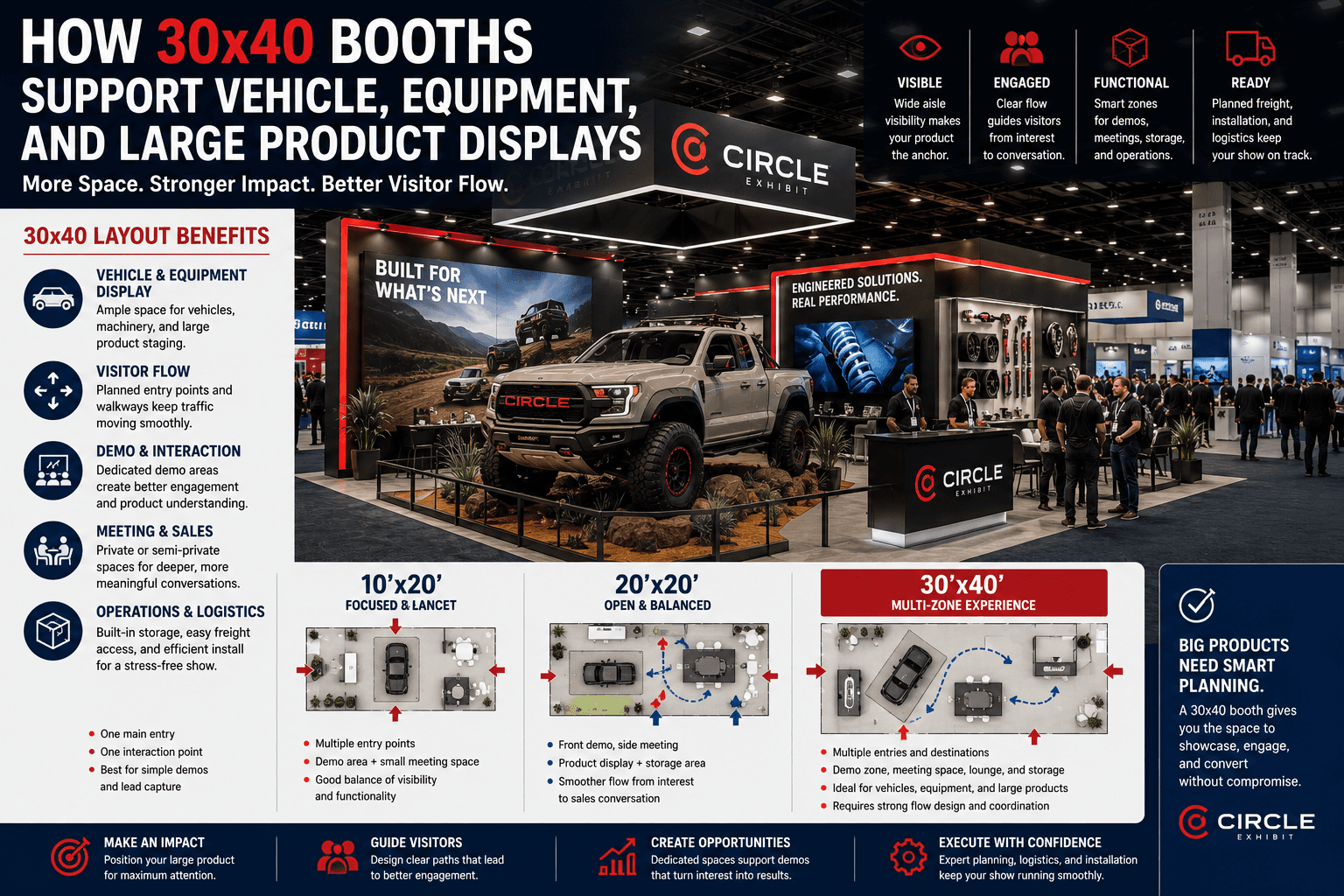
A 30x40 booth gives large products enough space to become the visual anchor without blocking visitor movement. This footprint works well for vehicle displays, equipment demos, large product staging, meeting counters, and show-site installation planning.
Quick Answer: What is a 30x40 booth best used for?
A 30x40 booth works well for vehicle displays, equipment displays, large product staging, multi-zone demos, and meeting areas. The larger footprint gives exhibitors room to make the product a visual anchor while still planning visitor movement, aisle visibility, freight access, and installation sequence.
Quick Answer: What is a 30x40 booth best used for?
A 30x40 booth works well for vehicle displays, equipment displays, large product staging, multi-zone demos, and meeting areas. The larger footprint gives exhibitors room to make the product a visual anchor while still planning visitor movement, aisle visibility, freight access, and installation sequence.
Large products change how a booth needs to work. A vehicle, machine, equipment unit, or oversized display cannot be placed into a booth like a small sample or screen. It affects sightlines, visitor entry, demo space, freight movement, drayage timing, and installation order. That is why a 30x40 booth should be planned around the product first, then around the visitor path that supports it.
A 30x40 Booth Should Start With the Large Product
A 30x40 booth works best when the large product becomes the planning anchor.
That product may be a vehicle, machinery unit, equipment system, large component, technology cabinet, tool display, or physical product setup that needs space around it. The booth layout should not place the product as an afterthought. It should decide how visitors see it, walk around it, ask questions about it, and move into the next conversation.
For exhibitors reviewing 30x40 trade show booth layouts, the first question should be practical:
Where does the large product need to sit so visitors can see it clearly without blocking the booth?
A strong 30x40 layout usually plans around:
product sightlines
aisle-facing visibility
entry and exit flow
demo space
staff position
meeting counter placement
storage and service access
freight and installation sequence
The size gives room, but the product still needs control.
Vehicle Displays Need Clear Sightlines and Walkaround Space
Vehicle displays need more than floor space.
At shows like SEMA, the vehicle is often the first visual reason visitors stop. But if the vehicle is placed too close to the aisle, it may block entry. If it is buried too far inside the booth, visitors may not see it early enough. If there is no walkaround space, the display becomes hard to inspect.
For SEMA Show booth planning, a vehicle display may need:
front or angled visibility from the aisle
enough clearance for visitors to view key sides
lighting that supports paint, finish, or parts details
product wall or parts display nearby
staff positions that do not block photos or viewing
a meeting counter away from the main viewing crowd
The vehicle should pull visitors into the booth.
It should not become a wall that stops movement.
Equipment Displays Need Room for Explanation
Equipment displays usually need more explanation than a static product wall.
A machine, component, tool system, industrial unit, or large technical product may require staff to explain how it works, where it is used, what parts matter, or how it fits into the buyer’s operation. That means the booth needs space for both viewing and conversation.
A strong equipment display should include:
one clear viewing angle from the aisle
enough space for visitors to stop and ask questions
staff access on the working side
simple graphic labels or product callouts
a nearby demo or explanation counter
a meeting zone for deeper buyer discussion
The equipment should not be surrounded by furniture.
It needs breathing room so visitors can understand its scale, features, and application.
Large Product Staging Changes the Booth Layout
Large product staging affects the whole booth.
Once a large object enters the layout, every other zone has to adjust around it. Reception, storage, meeting counters, graphics, demos, and staff positions should support the product rather than compete with it.
Booth Area | Planning Question |
|---|---|
Product display zone | Can visitors see the large product from the main aisle? |
Walkaround space | Can visitors inspect without blocking other traffic? |
Demo zone | Is there room to explain the product without crowding? |
Meeting counter | Can qualified buyers move away from the product crowd? |
Graphics | Do visuals support the product instead of repeating too much? |
Storage | Are tools, cases, and staff items hidden from the display area? |
Freight path | Can the large product reach the booth during move-in? |
A 30x40 booth can support these zones, but only when the large product is placed first in the planning process.
Wide Aisle Visibility Helps the Product Become the Anchor
Wide aisle visibility is one of the main reasons to use a 30x40 booth.
Large products often work best when visitors can understand them before entering the booth. A strong 30x40 layout should use the product, screen wall, graphic backdrop, or overhead structure to create a clear visual anchor from the aisle.
That anchor should answer:
What is being displayed?
Why does it matter?
Where should visitors enter?
Where should they stop first?
Where does the product explanation begin?
If the booth has a vehicle or equipment display, aisle visibility should not depend only on the product’s size. The surrounding booth structure, graphics, lighting, and staff placement should help the display read clearly.
A large product can attract attention.
A planned visual anchor turns that attention into booth traffic.
Demo Zones Should Not Fight the Large Product
The demo zone should support the large product, not compete with it.
For vehicle displays, the demo may involve parts, accessories, interior features, screen-based product explanation, or performance components. For equipment displays, the demo may involve a control panel, sample part, workflow screen, or staff-led explanation.
The demo zone should sit close enough to the product to feel connected, but not so close that it blocks viewing.
A practical demo zone may include:
a side counter
product samples
a monitor or touchscreen
a parts wall
a staff-led explanation point
a compact standing area for two to four visitors
The product creates the stop.
The demo zone explains the value.
Meeting Counters Should Sit Away From the Viewing Crowd
A 30x40 booth gives exhibitors room to separate product viewing from buyer conversations.
This matters because large product displays often attract casual attention. Visitors may take photos, inspect details, or gather near the product. Serious buyer conversations should not happen directly inside that crowd.
A meeting counter should usually sit to the side or rear of the display path.
It can support:
distributor conversations
technical fit discussions
dealer or partner meetings
specification review
pricing or next-step conversations
post-demo follow-up
The meeting zone should feel connected to the product, but not trapped by it.
A good 30x40 booth lets visitors move from product interest to a quieter conversation without crossing through the busiest display zone.
Freight Access Must Be Planned Before the Booth Is Built
Large products make freight access more important.
A 30x40 booth with a vehicle, machine, or heavy product display needs early planning around how the product reaches the booth space. The layout should consider how freight moves from dock to booth, how crates are staged, and which items need to arrive before structure, graphics, or furniture.
This is where logistics and pre-show coordination becomes part of the booth layout, not just a shipping task.
Large product freight planning should clarify:
product dimensions and handling needs
crate size and staging location
move-in timing
dock-to-booth movement
drayage and material handling sequence
whether the product enters before walls or counters
how the product is protected during setup
how it exits during dismantle
The product may be the hero of the booth, but it also has to move through the venue safely and on time.
Drayage and Crate Staging Can Affect the Display Sequence
Drayage timing can decide when the booth can actually start coming together.
If the large product arrives late, the crew may not be able to place surrounding elements correctly. If the product arrives too early but has nowhere to stage, it can block the crew. If the display crate is removed too soon or too late, the install sequence may slow down.
A 30x40 booth needs a staging plan that answers:
What arrives first?
Where does the large product wait before final placement?
Which structure must be installed before the product is positioned?
Which structure must wait until after the product is placed?
Where do empty crates go during setup?
How does the product leave after the show?
These questions are not separate from design.
They shape whether the booth can be installed efficiently.
Installation Planning Should Protect the Product and the Booth
Large product installation planning should begin before move-in.
A 30x40 booth may have enough space for a vehicle or equipment display, but space alone does not solve the install sequence. The team needs to know what is placed first, what needs protection, and what cannot be moved once the product is positioned.
This is where Las Vegas exhibit build support becomes important.
The installation plan should account for:
floor protection
product entry path
product placement
booth structure sequence
graphic wall installation
lighting placement
power access
demo counter setup
final product cleaning or detailing
punch-list review before opening
A large product display should not create last-minute install pressure.
It should be part of the installation plan from the start.
30x40 Booth Zone Planning for Large Products
Zone | Main Role | Planning Focus |
|---|---|---|
Large product zone | Make the vehicle, equipment, or product the visual anchor | Place for aisle visibility and safe viewing distance |
Walkaround path | Let visitors inspect without blocking traffic | Keep clear around key viewing sides |
Demo counter | Explain features, parts, or use cases | Position near the product but outside the main viewing crowd |
Meeting counter | Support serious buyer conversations | Move to side or rear zone |
Graphics wall | Explain product category, benefit, or technical context | Keep message simple and readable from the aisle |
Storage / service area | Hold tools, literature, staff items, or support materials | Keep hidden and away from product viewing |
Freight / install path | Support product movement during setup and dismantle | Plan before finalizing structure placement |
A 30x40 booth works well when these zones support each other.
It works poorly when the large product is placed without a movement plan.
SEMA Shows Why Large Product Displays Need Routing
SEMA is a strong example because vehicle displays can dominate the booth.
A vehicle can stop traffic quickly, but that does not mean the booth is working well. Visitors need to see the vehicle, understand the product story, inspect the relevant details, and move into the right conversation without crowding the aisle.
For SEMA exhibitors, a 30x40 booth may need:
a hero vehicle angle
parts wall or accessory display
staff-led explanation counter
wide aisle visibility
photo-friendly sightlines
product detail lighting
meeting counter for buyers or distributors
freight and move-in planning for vehicle placement
The vehicle should not consume all the booth logic.
It should organize the booth logic.
Common Problems in Large Product Booths
Most 30x40 booth problems come from treating the large product as a display object only.
Common issues include:
product placed too close to the aisle
visitors blocking entry while viewing
no clear path around the vehicle or equipment
demo counter placed in the wrong traffic lane
meeting area too close to casual viewing traffic
graphics hidden behind the product
freight access considered too late
product placement interfering with structure install
storage visible from the main viewing angle
These problems are avoidable when the booth is planned around movement, not only appearance.
The product should be easy to see, easy to explain, and possible to install without disrupting the rest of the booth.
30x40 Large Product Display Checklist
A strong 30x40 booth should be checked through both visitor flow and installation logic.
Checklist
What is the main large product or vehicle?
What angle should visitors see first from the aisle?
Does the product need walkaround space?
Where should staff explain the product?
Does the booth need a demo counter, parts wall, or screen?
Where should serious buyer conversations happen?
Will the product block entry, graphics, or meeting areas?
How will the product reach the booth space during move-in?
What drayage or freight timing affects product placement?
Which booth structures install before or after the product?
Does the product need floor protection or detailing?
How will the product be removed during dismantle?
This checklist keeps the booth from becoming a large product sitting in a large space.
It helps the display become part of a working exhibit plan.
Final Takeaway
A 30x40 booth supports vehicle, equipment, and large product displays because it gives the product enough space to become the anchor without stopping visitor movement.
But the larger footprint only works when sightlines, walkaround space, demo zones, meeting counters, freight access, drayage timing, and installation sequence are planned together.
For SEMA-style vehicle displays and other large product exhibits, the product should not just sit inside the booth.
It should shape the booth.
That is how a 30x40 layout turns a large display into a usable visitor experience.
A 30x40 Booth Should Start With the Large Product
A 30x40 booth works best when the large product becomes the planning anchor.
That product may be a vehicle, machinery unit, equipment system, large component, technology cabinet, tool display, or physical product setup that needs space around it. The booth layout should not place the product as an afterthought. It should decide how visitors see it, walk around it, ask questions about it, and move into the next conversation.
For exhibitors reviewing 30x40 trade show booth layouts, the first question should be practical:
Where does the large product need to sit so visitors can see it clearly without blocking the booth?
A strong 30x40 layout usually plans around:
product sightlines
aisle-facing visibility
entry and exit flow
demo space
staff position
meeting counter placement
storage and service access
freight and installation sequence
The size gives room, but the product still needs control.
Vehicle Displays Need Clear Sightlines and Walkaround Space
Vehicle displays need more than floor space.
At shows like SEMA, the vehicle is often the first visual reason visitors stop. But if the vehicle is placed too close to the aisle, it may block entry. If it is buried too far inside the booth, visitors may not see it early enough. If there is no walkaround space, the display becomes hard to inspect.
For SEMA Show booth planning, a vehicle display may need:
front or angled visibility from the aisle
enough clearance for visitors to view key sides
lighting that supports paint, finish, or parts details
product wall or parts display nearby
staff positions that do not block photos or viewing
a meeting counter away from the main viewing crowd
The vehicle should pull visitors into the booth.
It should not become a wall that stops movement.
Equipment Displays Need Room for Explanation
Equipment displays usually need more explanation than a static product wall.
A machine, component, tool system, industrial unit, or large technical product may require staff to explain how it works, where it is used, what parts matter, or how it fits into the buyer’s operation. That means the booth needs space for both viewing and conversation.
A strong equipment display should include:
one clear viewing angle from the aisle
enough space for visitors to stop and ask questions
staff access on the working side
simple graphic labels or product callouts
a nearby demo or explanation counter
a meeting zone for deeper buyer discussion
The equipment should not be surrounded by furniture.
It needs breathing room so visitors can understand its scale, features, and application.
Large Product Staging Changes the Booth Layout
Large product staging affects the whole booth.
Once a large object enters the layout, every other zone has to adjust around it. Reception, storage, meeting counters, graphics, demos, and staff positions should support the product rather than compete with it.
Booth Area | Planning Question |
|---|---|
Product display zone | Can visitors see the large product from the main aisle? |
Walkaround space | Can visitors inspect without blocking other traffic? |
Demo zone | Is there room to explain the product without crowding? |
Meeting counter | Can qualified buyers move away from the product crowd? |
Graphics | Do visuals support the product instead of repeating too much? |
Storage | Are tools, cases, and staff items hidden from the display area? |
Freight path | Can the large product reach the booth during move-in? |
A 30x40 booth can support these zones, but only when the large product is placed first in the planning process.
Wide Aisle Visibility Helps the Product Become the Anchor
Wide aisle visibility is one of the main reasons to use a 30x40 booth.
Large products often work best when visitors can understand them before entering the booth. A strong 30x40 layout should use the product, screen wall, graphic backdrop, or overhead structure to create a clear visual anchor from the aisle.
That anchor should answer:
What is being displayed?
Why does it matter?
Where should visitors enter?
Where should they stop first?
Where does the product explanation begin?
If the booth has a vehicle or equipment display, aisle visibility should not depend only on the product’s size. The surrounding booth structure, graphics, lighting, and staff placement should help the display read clearly.
A large product can attract attention.
A planned visual anchor turns that attention into booth traffic.
Demo Zones Should Not Fight the Large Product
The demo zone should support the large product, not compete with it.
For vehicle displays, the demo may involve parts, accessories, interior features, screen-based product explanation, or performance components. For equipment displays, the demo may involve a control panel, sample part, workflow screen, or staff-led explanation.
The demo zone should sit close enough to the product to feel connected, but not so close that it blocks viewing.
A practical demo zone may include:
a side counter
product samples
a monitor or touchscreen
a parts wall
a staff-led explanation point
a compact standing area for two to four visitors
The product creates the stop.
The demo zone explains the value.
Meeting Counters Should Sit Away From the Viewing Crowd
A 30x40 booth gives exhibitors room to separate product viewing from buyer conversations.
This matters because large product displays often attract casual attention. Visitors may take photos, inspect details, or gather near the product. Serious buyer conversations should not happen directly inside that crowd.
A meeting counter should usually sit to the side or rear of the display path.
It can support:
distributor conversations
technical fit discussions
dealer or partner meetings
specification review
pricing or next-step conversations
post-demo follow-up
The meeting zone should feel connected to the product, but not trapped by it.
A good 30x40 booth lets visitors move from product interest to a quieter conversation without crossing through the busiest display zone.
Freight Access Must Be Planned Before the Booth Is Built
Large products make freight access more important.
A 30x40 booth with a vehicle, machine, or heavy product display needs early planning around how the product reaches the booth space. The layout should consider how freight moves from dock to booth, how crates are staged, and which items need to arrive before structure, graphics, or furniture.
This is where logistics and pre-show coordination becomes part of the booth layout, not just a shipping task.
Large product freight planning should clarify:
product dimensions and handling needs
crate size and staging location
move-in timing
dock-to-booth movement
drayage and material handling sequence
whether the product enters before walls or counters
how the product is protected during setup
how it exits during dismantle
The product may be the hero of the booth, but it also has to move through the venue safely and on time.
Drayage and Crate Staging Can Affect the Display Sequence
Drayage timing can decide when the booth can actually start coming together.
If the large product arrives late, the crew may not be able to place surrounding elements correctly. If the product arrives too early but has nowhere to stage, it can block the crew. If the display crate is removed too soon or too late, the install sequence may slow down.
A 30x40 booth needs a staging plan that answers:
What arrives first?
Where does the large product wait before final placement?
Which structure must be installed before the product is positioned?
Which structure must wait until after the product is placed?
Where do empty crates go during setup?
How does the product leave after the show?
These questions are not separate from design.
They shape whether the booth can be installed efficiently.
Installation Planning Should Protect the Product and the Booth
Large product installation planning should begin before move-in.
A 30x40 booth may have enough space for a vehicle or equipment display, but space alone does not solve the install sequence. The team needs to know what is placed first, what needs protection, and what cannot be moved once the product is positioned.
This is where Las Vegas exhibit build support becomes important.
The installation plan should account for:
floor protection
product entry path
product placement
booth structure sequence
graphic wall installation
lighting placement
power access
demo counter setup
final product cleaning or detailing
punch-list review before opening
A large product display should not create last-minute install pressure.
It should be part of the installation plan from the start.
30x40 Booth Zone Planning for Large Products
Zone | Main Role | Planning Focus |
|---|---|---|
Large product zone | Make the vehicle, equipment, or product the visual anchor | Place for aisle visibility and safe viewing distance |
Walkaround path | Let visitors inspect without blocking traffic | Keep clear around key viewing sides |
Demo counter | Explain features, parts, or use cases | Position near the product but outside the main viewing crowd |
Meeting counter | Support serious buyer conversations | Move to side or rear zone |
Graphics wall | Explain product category, benefit, or technical context | Keep message simple and readable from the aisle |
Storage / service area | Hold tools, literature, staff items, or support materials | Keep hidden and away from product viewing |
Freight / install path | Support product movement during setup and dismantle | Plan before finalizing structure placement |
A 30x40 booth works well when these zones support each other.
It works poorly when the large product is placed without a movement plan.
SEMA Shows Why Large Product Displays Need Routing
SEMA is a strong example because vehicle displays can dominate the booth.
A vehicle can stop traffic quickly, but that does not mean the booth is working well. Visitors need to see the vehicle, understand the product story, inspect the relevant details, and move into the right conversation without crowding the aisle.
For SEMA exhibitors, a 30x40 booth may need:
a hero vehicle angle
parts wall or accessory display
staff-led explanation counter
wide aisle visibility
photo-friendly sightlines
product detail lighting
meeting counter for buyers or distributors
freight and move-in planning for vehicle placement
The vehicle should not consume all the booth logic.
It should organize the booth logic.
Common Problems in Large Product Booths
Most 30x40 booth problems come from treating the large product as a display object only.
Common issues include:
product placed too close to the aisle
visitors blocking entry while viewing
no clear path around the vehicle or equipment
demo counter placed in the wrong traffic lane
meeting area too close to casual viewing traffic
graphics hidden behind the product
freight access considered too late
product placement interfering with structure install
storage visible from the main viewing angle
These problems are avoidable when the booth is planned around movement, not only appearance.
The product should be easy to see, easy to explain, and possible to install without disrupting the rest of the booth.
30x40 Large Product Display Checklist
A strong 30x40 booth should be checked through both visitor flow and installation logic.
Checklist
What is the main large product or vehicle?
What angle should visitors see first from the aisle?
Does the product need walkaround space?
Where should staff explain the product?
Does the booth need a demo counter, parts wall, or screen?
Where should serious buyer conversations happen?
Will the product block entry, graphics, or meeting areas?
How will the product reach the booth space during move-in?
What drayage or freight timing affects product placement?
Which booth structures install before or after the product?
Does the product need floor protection or detailing?
How will the product be removed during dismantle?
This checklist keeps the booth from becoming a large product sitting in a large space.
It helps the display become part of a working exhibit plan.
Final Takeaway
A 30x40 booth supports vehicle, equipment, and large product displays because it gives the product enough space to become the anchor without stopping visitor movement.
But the larger footprint only works when sightlines, walkaround space, demo zones, meeting counters, freight access, drayage timing, and installation sequence are planned together.
For SEMA-style vehicle displays and other large product exhibits, the product should not just sit inside the booth.
It should shape the booth.
That is how a 30x40 layout turns a large display into a usable visitor experience.
Planning a 30x40 Booth for a Vehicle or Large Product Display?
Start with the product placement, then plan aisle visibility, walkaround space, demo zones, meeting counters, freight access, logistics, and installation sequence as one connected layout.
The first two hours of setup can affect floor marking, crate access, structure staging, graphics checks, power confirmation, and final closeout. Circle Exhibit teams help exhibitors plan on-site installation and dismantle support so booth components move into place with a clear crew sequence.