Why Product Category Clarity Matters More Than Feature Density at CES

Circle Exhibit Team
Industry professionals
Exhibition industry professional dedicated to delivering the latest insights and curated recommendations to you.
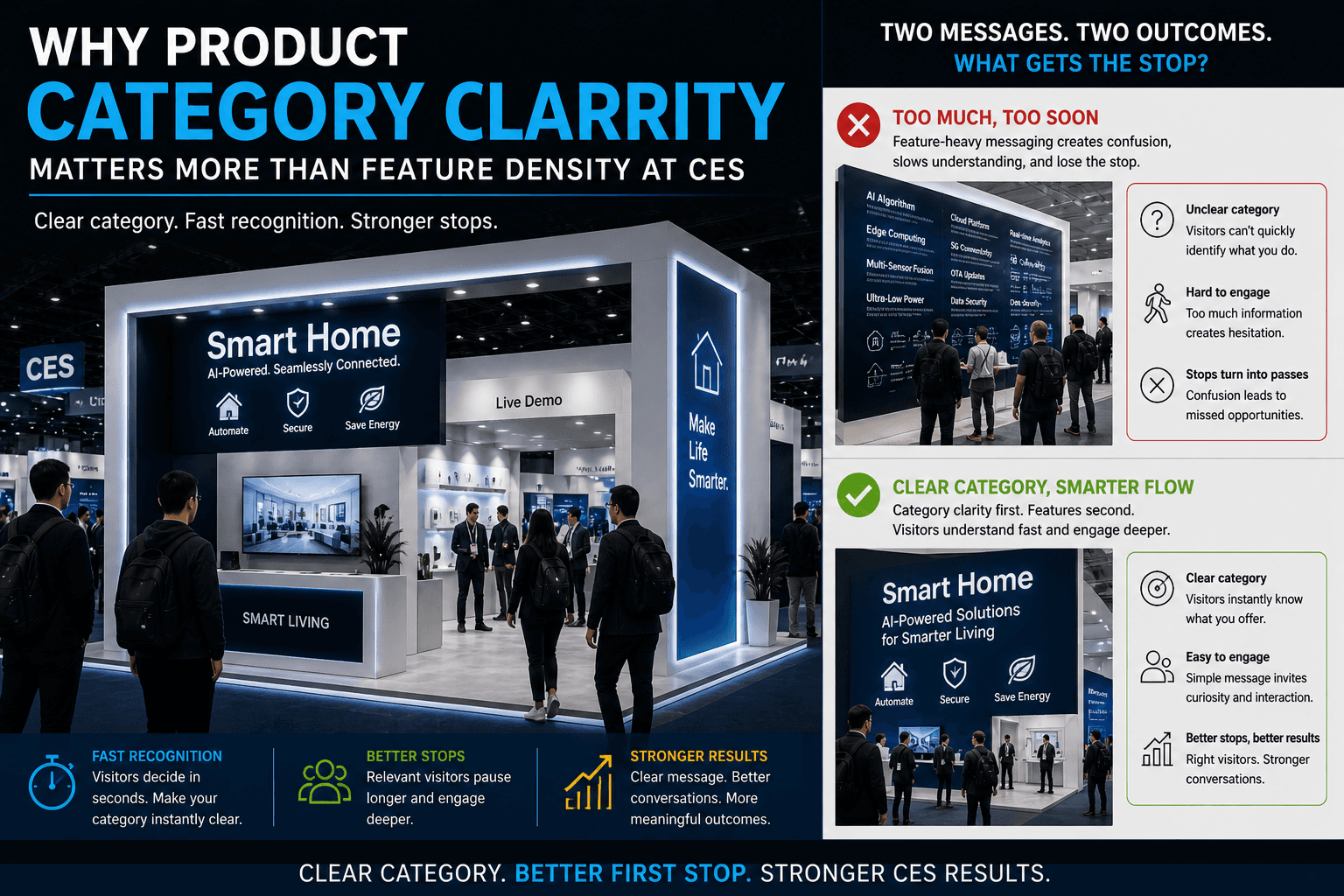
At CES, category clarity usually matters more than feature density in the first few seconds. If visitors cannot quickly tell what kind of product they are looking at, they often keep walking before the booth gets a real chance.
CES usually rewards recognition before detail
A lot of exhibitors want the booth to prove everything at once.
They want visitors to see the innovation, the product depth, the technical advantage, the ecosystem, the integrations, the specs, and the reasons the company is different.
That instinct is understandable.
But at CES, the booth usually does not earn that level of attention immediately.
It earns something smaller first:
a quick recognition moment.
The visitor needs to know what kind of product or solution this is before they are willing to process the rest.
That is why product category clarity often matters more than feature density.
Feature-rich messaging often loses the first stop
This is one of the most common CES mistakes.
A booth tries to look advanced by showing too much too early:
too many product claims
too many feature callouts
too many interface references
too many equal-value headlines
too many technical details packed into the first read
The result is not usually stronger communication.
It is slower communication.
At CES in Las Vegas, slower first-read messaging is dangerous because people are already moving when they see the booth. They are deciding in motion whether the category feels relevant enough to stop for.
If the booth has not made that clear yet, the feature depth often never gets a chance to matter.
Visitors do not compare features before they understand the category
This is the core issue.
A CES attendee usually does not stop and think:
Which of these ten features is most compelling?
They think something much simpler first:
What is this?
Then, if the answer feels relevant:
Why should I look closer?
Feature density belongs after that point, not before it.
That is why category clarity is so important. It gives the visitor a clean entry point into the booth. Without it, even strong features can feel like disconnected information instead of a reason to stay.
CES is a fast-scan environment
That changes everything.
At CES, people often approach booths while:
walking past quickly
comparing multiple brands in the same category
scanning from a diagonal angle
looking across aisles instead of straight ahead
deciding whether a booth is worth slowing down for
This means the first message layer has to work under imperfect conditions.
The booth should not assume a patient reader.
It should assume a moving reader.
That is why category clarity often wins.
A category message is easier to process quickly than a dense feature list.
The first layer should explain the type of solution, not the whole argument
A lot of CES booths become stronger when the first-read layer stays focused on one simple job:
help the visitor identify the product class fast.
That might mean clarifying:
smart home device
wearable health tech
EV charging solution
robotics platform
enterprise AI tool
mobility sensor system
consumer audio product
industrial monitoring technology
Once that foundation is clear, the booth can start introducing the next layer:
what makes the solution different
what problem it solves
what the live demo is proving
what feature set deserves deeper conversation
But if those deeper layers arrive too early, they often compete with the category signal instead of supporting it.
The strongest CES graphics often behave like filters
This is where graphics and brand presentation matter so much.
A strong CES graphic system does not try to dump every selling point onto the booth edge. It filters the message so the visitor receives the right information in the right order.
That usually means:
First layer
Category clarity
Second layer
Use case or value
Third layer
Feature depth or technical proof
When that order is reversed, the booth may feel sophisticated internally, but it becomes harder to enter from the aisle.
That is not a graphics problem alone.
It is a message-priority problem.
Feature density becomes more useful after the stop
This is the part many exhibitors get backward.
Features do matter.
They often matter a lot.
But at CES, they usually perform better once the visitor has already decided the booth is relevant.
That means the best place for richer feature content is often:
just inside the booth
near the demo zone
beside the product interaction point
in supporting screen content
in the conversation layer after the first stop
That way, the booth is not forcing the entire story into the aisle-facing layer.
The aisle-facing layer should open the door.
It should not try to finish the meeting.
A 20x20 booth feels this problem even more
This is especially true in a 20x20 trade show booth.
A 20x20 does not have much spare room for messaging mistakes. If the first-read surfaces are overloaded, the booth can start feeling crowded before anyone even steps in. The visitor sees too many priorities at once, and the booth becomes harder to understand quickly.
That is why smaller CES footprints usually benefit from:
fewer competing headlines
clearer category cues
one strong first-read surface
feature content pushed slightly deeper into the booth
A 20x20 does not need less intelligence.
It needs better message sequencing.
Category clarity also helps traffic quality
This is not only about getting more stops.
It is also about getting better stops.
If the booth clearly signals the right category, the people who pause are more likely to be relevant. They have a better chance of understanding the demo, asking the right questions, and moving deeper into the booth for the right reason.
When the category signal is weak, the booth often attracts the wrong kind of curiosity:
people who are unsure what they are looking at
passersby who slow down but do not commit
visitors who need too much explanation before relevance is established
That can make traffic look active while still weakening the real quality of engagement.
Booth design should support the category signal
This is one reason exhibitors benefit from working with a Las Vegas trade show booth builder that understands the relationship between layout and message.
Because category clarity is not just a wording issue.
It depends on:
what wall is seen first
where the booth opens
where the first stop happens
how the demo relates to the first-read message
whether the edge feels clean or overloaded
A booth can have the right category message and still underperform if the physical hierarchy does not support it.
That is why builder logic and graphics logic need to work together.
CES first-read hierarchy usually gets stronger when it stays simple
A practical CES message structure often looks like this:
1. Category first
What is this product family or solution type?
2. Relevance second
Why should someone in this category care?
3. Feature proof third
What makes this offering stronger or different?
That order usually works better than trying to lead with a cluster of product features and hoping the visitor will infer the category on their own.
At CES, people are too busy for that.
The booth needs to reduce cognitive work, not increase it.
What exhibitors often get wrong
The most common mistakes usually sound reasonable in planning:
“We need to show the full feature set”
Not at the aisle edge.
“The product is complex, so the message should be detailed”
Not in the first three seconds.
“The category is obvious from the visuals”
Often not as obvious as the team assumes.
“More information makes the booth feel more advanced”
Sometimes it only makes the booth feel slower.
That is why category clarity is not a simplistic strategy.
At CES, it is often the more intelligent one.
A practical test for CES booths
Before locking the first message layer, it helps to ask:
Can a moving visitor identify the category in a few seconds?
If not, the booth may already be too dense.
Does the first surface explain the product class before the feature depth?
That usually improves stop quality.
Could someone understand what the demo is about before hearing the pitch?
That is often a good sign.
Are features helping the booth after the stop, or cluttering it before the stop?
That question usually reveals the real problem.
These are simple tests, but they often separate stronger CES booths from weaker ones.
Final thought
At CES, product category clarity matters more than feature density because the booth has to earn relevance before it can earn attention depth.
Visitors move quickly.
They compare quickly.
They stop only when the booth answers the first question clearly enough:
What is this?
Once that answer is clear, features can start doing real work.
Before that, too much feature density often just slows the booth down.
That is why the smarter CES booth is not always the one saying more.
It is usually the one saying the right thing first.
Planning a booth for CES in Las Vegas?
Start with CES booth planning, then shape the message with a Las Vegas trade show booth builder approach that makes the category clear before the features start competing for attention.
CES usually rewards recognition before detail
A lot of exhibitors want the booth to prove everything at once.
They want visitors to see the innovation, the product depth, the technical advantage, the ecosystem, the integrations, the specs, and the reasons the company is different.
That instinct is understandable.
But at CES, the booth usually does not earn that level of attention immediately.
It earns something smaller first:
a quick recognition moment.
The visitor needs to know what kind of product or solution this is before they are willing to process the rest.
That is why product category clarity often matters more than feature density.
Feature-rich messaging often loses the first stop
This is one of the most common CES mistakes.
A booth tries to look advanced by showing too much too early:
too many product claims
too many feature callouts
too many interface references
too many equal-value headlines
too many technical details packed into the first read
The result is not usually stronger communication.
It is slower communication.
At CES in Las Vegas, slower first-read messaging is dangerous because people are already moving when they see the booth. They are deciding in motion whether the category feels relevant enough to stop for.
If the booth has not made that clear yet, the feature depth often never gets a chance to matter.
Visitors do not compare features before they understand the category
This is the core issue.
A CES attendee usually does not stop and think:
Which of these ten features is most compelling?
They think something much simpler first:
What is this?
Then, if the answer feels relevant:
Why should I look closer?
Feature density belongs after that point, not before it.
That is why category clarity is so important. It gives the visitor a clean entry point into the booth. Without it, even strong features can feel like disconnected information instead of a reason to stay.
CES is a fast-scan environment
That changes everything.
At CES, people often approach booths while:
walking past quickly
comparing multiple brands in the same category
scanning from a diagonal angle
looking across aisles instead of straight ahead
deciding whether a booth is worth slowing down for
This means the first message layer has to work under imperfect conditions.
The booth should not assume a patient reader.
It should assume a moving reader.
That is why category clarity often wins.
A category message is easier to process quickly than a dense feature list.
The first layer should explain the type of solution, not the whole argument
A lot of CES booths become stronger when the first-read layer stays focused on one simple job:
help the visitor identify the product class fast.
That might mean clarifying:
smart home device
wearable health tech
EV charging solution
robotics platform
enterprise AI tool
mobility sensor system
consumer audio product
industrial monitoring technology
Once that foundation is clear, the booth can start introducing the next layer:
what makes the solution different
what problem it solves
what the live demo is proving
what feature set deserves deeper conversation
But if those deeper layers arrive too early, they often compete with the category signal instead of supporting it.
The strongest CES graphics often behave like filters
This is where graphics and brand presentation matter so much.
A strong CES graphic system does not try to dump every selling point onto the booth edge. It filters the message so the visitor receives the right information in the right order.
That usually means:
First layer
Category clarity
Second layer
Use case or value
Third layer
Feature depth or technical proof
When that order is reversed, the booth may feel sophisticated internally, but it becomes harder to enter from the aisle.
That is not a graphics problem alone.
It is a message-priority problem.
Feature density becomes more useful after the stop
This is the part many exhibitors get backward.
Features do matter.
They often matter a lot.
But at CES, they usually perform better once the visitor has already decided the booth is relevant.
That means the best place for richer feature content is often:
just inside the booth
near the demo zone
beside the product interaction point
in supporting screen content
in the conversation layer after the first stop
That way, the booth is not forcing the entire story into the aisle-facing layer.
The aisle-facing layer should open the door.
It should not try to finish the meeting.
A 20x20 booth feels this problem even more
This is especially true in a 20x20 trade show booth.
A 20x20 does not have much spare room for messaging mistakes. If the first-read surfaces are overloaded, the booth can start feeling crowded before anyone even steps in. The visitor sees too many priorities at once, and the booth becomes harder to understand quickly.
That is why smaller CES footprints usually benefit from:
fewer competing headlines
clearer category cues
one strong first-read surface
feature content pushed slightly deeper into the booth
A 20x20 does not need less intelligence.
It needs better message sequencing.
Category clarity also helps traffic quality
This is not only about getting more stops.
It is also about getting better stops.
If the booth clearly signals the right category, the people who pause are more likely to be relevant. They have a better chance of understanding the demo, asking the right questions, and moving deeper into the booth for the right reason.
When the category signal is weak, the booth often attracts the wrong kind of curiosity:
people who are unsure what they are looking at
passersby who slow down but do not commit
visitors who need too much explanation before relevance is established
That can make traffic look active while still weakening the real quality of engagement.
Booth design should support the category signal
This is one reason exhibitors benefit from working with a Las Vegas trade show booth builder that understands the relationship between layout and message.
Because category clarity is not just a wording issue.
It depends on:
what wall is seen first
where the booth opens
where the first stop happens
how the demo relates to the first-read message
whether the edge feels clean or overloaded
A booth can have the right category message and still underperform if the physical hierarchy does not support it.
That is why builder logic and graphics logic need to work together.
CES first-read hierarchy usually gets stronger when it stays simple
A practical CES message structure often looks like this:
1. Category first
What is this product family or solution type?
2. Relevance second
Why should someone in this category care?
3. Feature proof third
What makes this offering stronger or different?
That order usually works better than trying to lead with a cluster of product features and hoping the visitor will infer the category on their own.
At CES, people are too busy for that.
The booth needs to reduce cognitive work, not increase it.
What exhibitors often get wrong
The most common mistakes usually sound reasonable in planning:
“We need to show the full feature set”
Not at the aisle edge.
“The product is complex, so the message should be detailed”
Not in the first three seconds.
“The category is obvious from the visuals”
Often not as obvious as the team assumes.
“More information makes the booth feel more advanced”
Sometimes it only makes the booth feel slower.
That is why category clarity is not a simplistic strategy.
At CES, it is often the more intelligent one.
A practical test for CES booths
Before locking the first message layer, it helps to ask:
Can a moving visitor identify the category in a few seconds?
If not, the booth may already be too dense.
Does the first surface explain the product class before the feature depth?
That usually improves stop quality.
Could someone understand what the demo is about before hearing the pitch?
That is often a good sign.
Are features helping the booth after the stop, or cluttering it before the stop?
That question usually reveals the real problem.
These are simple tests, but they often separate stronger CES booths from weaker ones.
Final thought
At CES, product category clarity matters more than feature density because the booth has to earn relevance before it can earn attention depth.
Visitors move quickly.
They compare quickly.
They stop only when the booth answers the first question clearly enough:
What is this?
Once that answer is clear, features can start doing real work.
Before that, too much feature density often just slows the booth down.
That is why the smarter CES booth is not always the one saying more.
It is usually the one saying the right thing first.
Planning a booth for CES in Las Vegas?
Start with CES booth planning, then shape the message with a Las Vegas trade show booth builder approach that makes the category clear before the features start competing for attention.
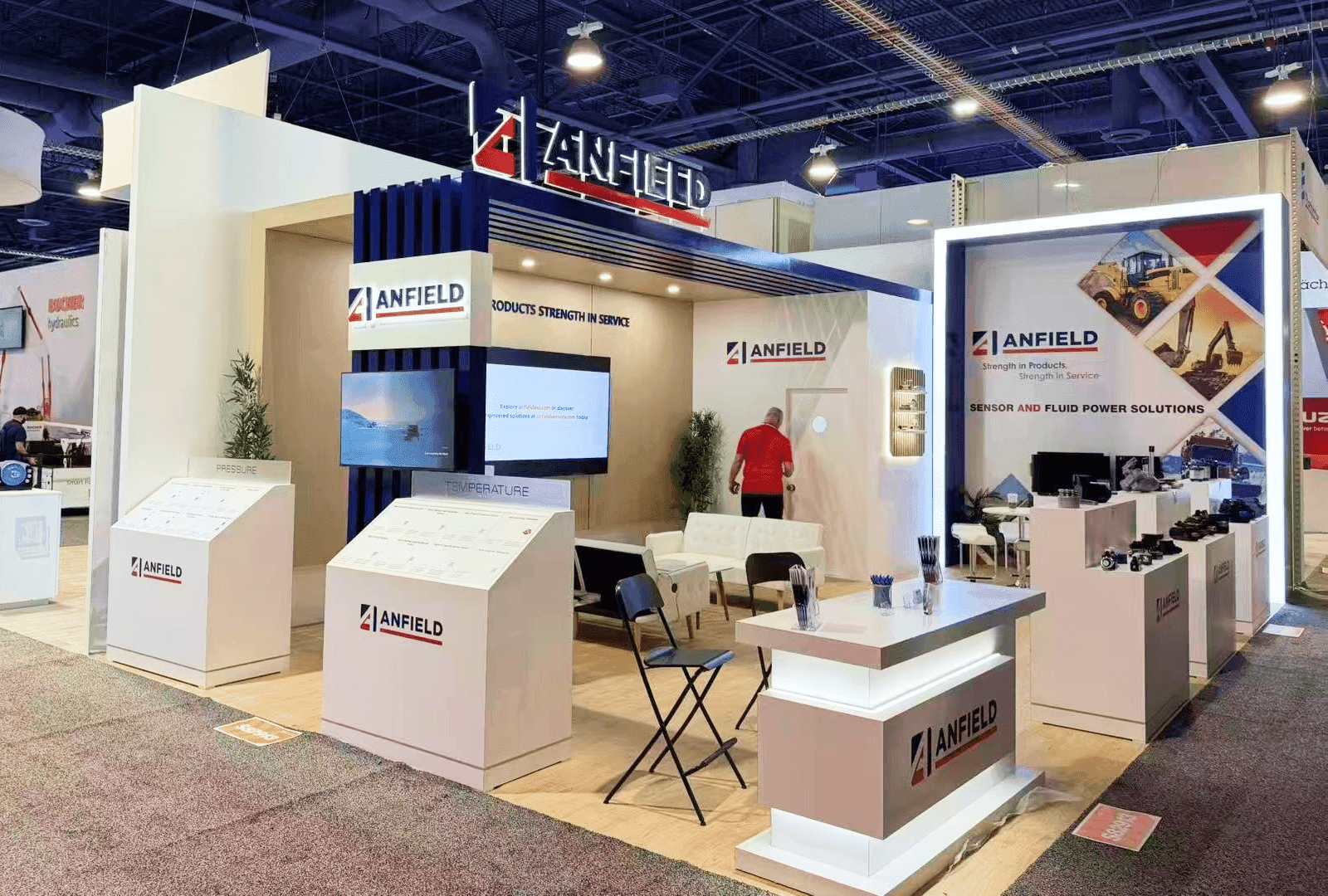
Exhibition Cases
Message
Leave your message and we will get back to you ASAP
Send a Message
We’ll Be in Touch!
Message
Leave your message and we will get back to you ASAP
Address:
4915 Steptoe Street #300
Las Vegas, NV 89122