Why Booth Graphics Need Different Priorities at CES, SEMA, and NAB

Circle Exhibit Team
Industry professionals
Exhibition industry professional dedicated to delivering the latest insights and curated recommendations to you.
Different industries need different first-read messaging. A booth graphic system that works at CES may feel weak at SEMA or too broad at NAB because the visitor is looking for a different kind of first answer.
The same booth-graphics logic does not travel well across every show
A lot of exhibitors treat graphics like a fixed brand layer.
The booth gets a logo, a headline, a few supporting visuals, and the message system is expected to work the same way across different events.
That is usually where performance starts dropping.
Because CES, SEMA, and NAB do not ask visitors to notice the same things first.
The brand may be the same.
The products may even overlap.
But the first-read job of the booth is different.
That is why graphics need different priorities at each show.
Graphics are not just decoration, they are first-read strategy
At major trade shows, the booth graphic layer does more than make the environment look finished.
It helps answer the first question a visitor asks from the aisle:
What am I looking at, and why should I stop here?
That answer changes depending on the event.
At one show, the visitor may need category clarity first.
At another, they may need product fit or application first.
At another, they may need workflow context before they can even understand what the screens are showing.
That is why booth graphics should respond to industry behavior, not just brand consistency.
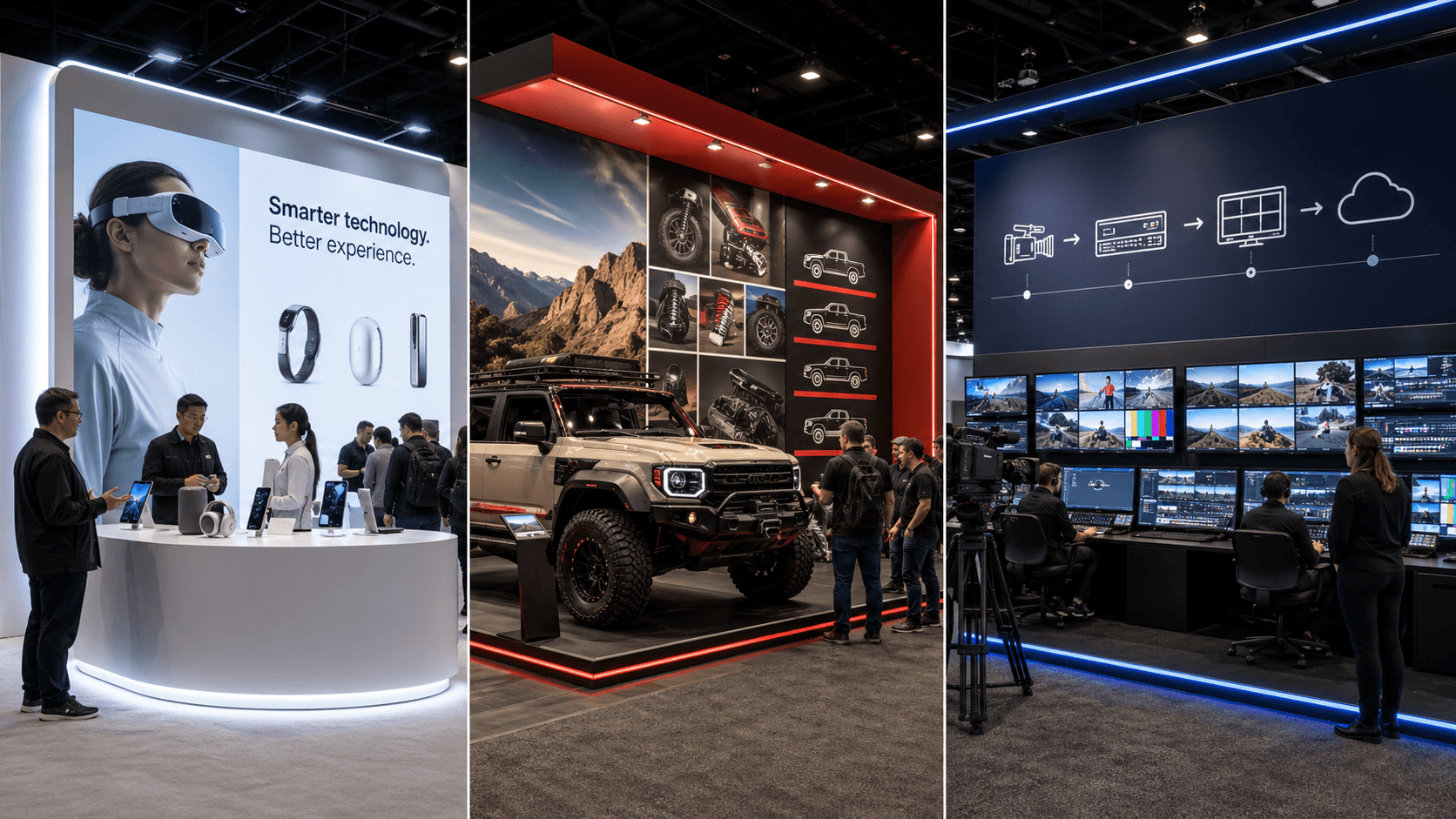
CES usually rewards speed and clarity first
At CES in Las Vegas, people move fast.
They scan quickly, compare quickly, and decide quickly whether a booth deserves a stop. That means the first-read message usually has to work almost immediately.
At CES, the strongest graphics often prioritize:
what the product category is
what problem it solves
what the visitor should look at next
why the demo matters before the conversation begins
This is why CES graphics often need to be:
shorter
cleaner
easier to read from movement
less dependent on long explanation
If the message is too layered too early, the booth starts slowing the visitor down before the booth has earned the stop.
That is usually a weak trade at CES.
SEMA usually rewards visual category fit and product context
At SEMA Show, the booth often begins with a stronger visual stop.
Vehicles, wheels, parts walls, and category displays naturally pull attention. That means the first-read job of the graphics changes.
At SEMA, the graphics often do not need to create attention from zero.
They need to make the attention more useful.
That usually means helping the visitor understand:
what product category the booth really belongs to
how the product display relates to the vehicle
what kind of build, system, or application is being shown
where to go after the first visual stop
This is why SEMA graphics often work better when they support the display instead of trying to overpower it.
The booth already has something strong to look at.
The graphics need to make that strength easier to decode.
NAB usually rewards simpler workflow framing
At NAB Show, the challenge is different again.
A NAB booth often contains technical systems, multiple screens, operator zones, workflow logic, and product categories that are not always self-explanatory from a distance.
That means the booth graphics usually need to do something very specific:
they need to simplify the workflow entry point.
At NAB, visitors often need to know:
what kind of workflow this is
what output or result they are supposed to notice
where the main proof point is
why the setup matters before they start decoding all the technical layers
That is why NAB graphics usually get stronger when they get shorter.
Not weaker.
Stronger.
Because the more technical the environment is, the more important it becomes to reduce the first-read burden.
The wrong graphics priority usually sounds reasonable in theory
This is why teams make the mistake so often.
For example:
A CES booth may over-explain
The message becomes too dense before the visitor has decided to stop.
A SEMA booth may over-brand
The graphics repeat the logo loudly but do not help the vehicle or product categories tell a clearer story.
A NAB booth may over-technicalize
The booth tries to explain too much workflow detail too early, so the visitor never gets a clean entry point.
None of these choices sound obviously wrong during planning.
But on the floor, they weaken booth performance quickly.
First-read messaging should match the way attention starts
This is the real comparison point.
At CES
Attention often starts with curiosity and speed.
At SEMA
Attention often starts with visual impact and product context.
At NAB
Attention often starts with technical activity but requires message simplification to become meaningful.
That means the first headline, first graphic layer, and first supporting visual should not be built from the same formula every time.
A booth can stay on-brand and still change its message hierarchy based on the event.
That is usually the smarter move.
The same booth can need three different graphic priorities
Here is a simple way to think about it.
If the same company exhibited at all three shows, the first-read priorities might look like this:
CES
Start with category + outcome.
What is this, and why should I care fast?
SEMA
Start with vehicle/product relationship.
What kind of build or product family am I actually seeing?
NAB
Start with workflow clarity.
What kind of system is this, and what should I focus on first?
Those are not small wording changes.
They change how the entire booth gets read.
Graphics should work with the dominant booth behavior
This matters more than people think.
A booth message does not live by itself.
It is part of the physical booth behavior.
That means the graphic priorities should support things like:
how people approach
where they stop
what they see first
how the display is structured
what the next step after the stop should be
At CES, that may mean making the message easier to grasp before the demo.
At SEMA, that may mean supporting the hero vehicle with category clarity.
At NAB, that may mean helping a complex screen wall feel easier to enter.
That is why graphics hierarchy is never just a wording problem.
It is a booth behavior problem too.
Builder logic still matters, even on a graphics-led question
This is one reason exhibitors benefit from working with a Las Vegas trade show booth builder that understands graphics as part of layout and traffic logic, not as a last decorative layer.
Because graphics affect:
where the booth feels open
where the first stop happens
which zone feels primary
whether a demo is easy to approach
how a display reads from the aisle
If the graphics hierarchy is right but the booth placement is wrong, the message still underperforms. If the booth is strong but the graphics are using the wrong first-read logic for the event, the same thing happens.
The best result usually comes from aligning both.
A better comparison framework
When deciding booth graphics across CES, SEMA, and NAB, the best teams usually ask:
What does the visitor need to understand first?
Not eventually. First.
What is already doing the visual work?
Vehicle, screen wall, product display, or demo activity.
What should graphics clarify instead of compete with?
This is different at every show.
What happens after the stop?
The message should help the next step feel natural.
Those questions usually produce better priorities than simply reusing the same headline structure everywhere.
A practical shorthand
If you want the shortest version:
CES graphics
Fast category clarity.
SEMA graphics
Display support and product context.
NAB graphics
Workflow simplification.
That is usually the cleanest way to separate the first-read priority across the three shows.
Final thought
Booth graphics need different priorities at CES, SEMA, and NAB because the visitor is not looking for the same first answer in each environment.
At CES, the message has to work fast.
At SEMA, it has to support the display logic.
At NAB, it has to simplify complexity.
That is why one graphics system should not be copied across all three without adjustment.
The booth may stay on-brand.
But the first-read job should still change.
That is usually what makes the graphics start working harder, not just looking consistent.
The same booth-graphics logic does not travel well across every show
A lot of exhibitors treat graphics like a fixed brand layer.
The booth gets a logo, a headline, a few supporting visuals, and the message system is expected to work the same way across different events.
That is usually where performance starts dropping.
Because CES, SEMA, and NAB do not ask visitors to notice the same things first.
The brand may be the same.
The products may even overlap.
But the first-read job of the booth is different.
That is why graphics need different priorities at each show.
Graphics are not just decoration, they are first-read strategy
At major trade shows, the booth graphic layer does more than make the environment look finished.
It helps answer the first question a visitor asks from the aisle:
What am I looking at, and why should I stop here?
That answer changes depending on the event.
At one show, the visitor may need category clarity first.
At another, they may need product fit or application first.
At another, they may need workflow context before they can even understand what the screens are showing.
That is why booth graphics should respond to industry behavior, not just brand consistency.
CES usually rewards speed and clarity first
At CES in Las Vegas, people move fast.
They scan quickly, compare quickly, and decide quickly whether a booth deserves a stop. That means the first-read message usually has to work almost immediately.
At CES, the strongest graphics often prioritize:
what the product category is
what problem it solves
what the visitor should look at next
why the demo matters before the conversation begins
This is why CES graphics often need to be:
shorter
cleaner
easier to read from movement
less dependent on long explanation
If the message is too layered too early, the booth starts slowing the visitor down before the booth has earned the stop.
That is usually a weak trade at CES.
SEMA usually rewards visual category fit and product context
At SEMA Show, the booth often begins with a stronger visual stop.
Vehicles, wheels, parts walls, and category displays naturally pull attention. That means the first-read job of the graphics changes.
At SEMA, the graphics often do not need to create attention from zero.
They need to make the attention more useful.
That usually means helping the visitor understand:
what product category the booth really belongs to
how the product display relates to the vehicle
what kind of build, system, or application is being shown
where to go after the first visual stop
This is why SEMA graphics often work better when they support the display instead of trying to overpower it.
The booth already has something strong to look at.
The graphics need to make that strength easier to decode.
NAB usually rewards simpler workflow framing
At NAB Show, the challenge is different again.
A NAB booth often contains technical systems, multiple screens, operator zones, workflow logic, and product categories that are not always self-explanatory from a distance.
That means the booth graphics usually need to do something very specific:
they need to simplify the workflow entry point.
At NAB, visitors often need to know:
what kind of workflow this is
what output or result they are supposed to notice
where the main proof point is
why the setup matters before they start decoding all the technical layers
That is why NAB graphics usually get stronger when they get shorter.
Not weaker.
Stronger.
Because the more technical the environment is, the more important it becomes to reduce the first-read burden.
The wrong graphics priority usually sounds reasonable in theory
This is why teams make the mistake so often.
For example:
A CES booth may over-explain
The message becomes too dense before the visitor has decided to stop.
A SEMA booth may over-brand
The graphics repeat the logo loudly but do not help the vehicle or product categories tell a clearer story.
A NAB booth may over-technicalize
The booth tries to explain too much workflow detail too early, so the visitor never gets a clean entry point.
None of these choices sound obviously wrong during planning.
But on the floor, they weaken booth performance quickly.
First-read messaging should match the way attention starts
This is the real comparison point.
At CES
Attention often starts with curiosity and speed.
At SEMA
Attention often starts with visual impact and product context.
At NAB
Attention often starts with technical activity but requires message simplification to become meaningful.
That means the first headline, first graphic layer, and first supporting visual should not be built from the same formula every time.
A booth can stay on-brand and still change its message hierarchy based on the event.
That is usually the smarter move.
The same booth can need three different graphic priorities
Here is a simple way to think about it.
If the same company exhibited at all three shows, the first-read priorities might look like this:
CES
Start with category + outcome.
What is this, and why should I care fast?
SEMA
Start with vehicle/product relationship.
What kind of build or product family am I actually seeing?
NAB
Start with workflow clarity.
What kind of system is this, and what should I focus on first?
Those are not small wording changes.
They change how the entire booth gets read.
Graphics should work with the dominant booth behavior
This matters more than people think.
A booth message does not live by itself.
It is part of the physical booth behavior.
That means the graphic priorities should support things like:
how people approach
where they stop
what they see first
how the display is structured
what the next step after the stop should be
At CES, that may mean making the message easier to grasp before the demo.
At SEMA, that may mean supporting the hero vehicle with category clarity.
At NAB, that may mean helping a complex screen wall feel easier to enter.
That is why graphics hierarchy is never just a wording problem.
It is a booth behavior problem too.
Builder logic still matters, even on a graphics-led question
This is one reason exhibitors benefit from working with a Las Vegas trade show booth builder that understands graphics as part of layout and traffic logic, not as a last decorative layer.
Because graphics affect:
where the booth feels open
where the first stop happens
which zone feels primary
whether a demo is easy to approach
how a display reads from the aisle
If the graphics hierarchy is right but the booth placement is wrong, the message still underperforms. If the booth is strong but the graphics are using the wrong first-read logic for the event, the same thing happens.
The best result usually comes from aligning both.
A better comparison framework
When deciding booth graphics across CES, SEMA, and NAB, the best teams usually ask:
What does the visitor need to understand first?
Not eventually. First.
What is already doing the visual work?
Vehicle, screen wall, product display, or demo activity.
What should graphics clarify instead of compete with?
This is different at every show.
What happens after the stop?
The message should help the next step feel natural.
Those questions usually produce better priorities than simply reusing the same headline structure everywhere.
A practical shorthand
If you want the shortest version:
CES graphics
Fast category clarity.
SEMA graphics
Display support and product context.
NAB graphics
Workflow simplification.
That is usually the cleanest way to separate the first-read priority across the three shows.
Final thought
Booth graphics need different priorities at CES, SEMA, and NAB because the visitor is not looking for the same first answer in each environment.
At CES, the message has to work fast.
At SEMA, it has to support the display logic.
At NAB, it has to simplify complexity.
That is why one graphics system should not be copied across all three without adjustment.
The booth may stay on-brand.
But the first-read job should still change.
That is usually what makes the graphics start working harder, not just looking consistent.
Exhibition Cases
Message
Leave your message and we will get back to you ASAP
Send a Message
We’ll Be in Touch!
Message
Leave your message and we will get back to you ASAP
Address:
4915 Steptoe Street #300
Las Vegas, NV 89122