What Freight Sequencing Actually Changes During Trade Show Installation

Circle Exhibit Team
Industry professionals
Exhibition industry professional dedicated to delivering the latest insights and curated recommendations to you.
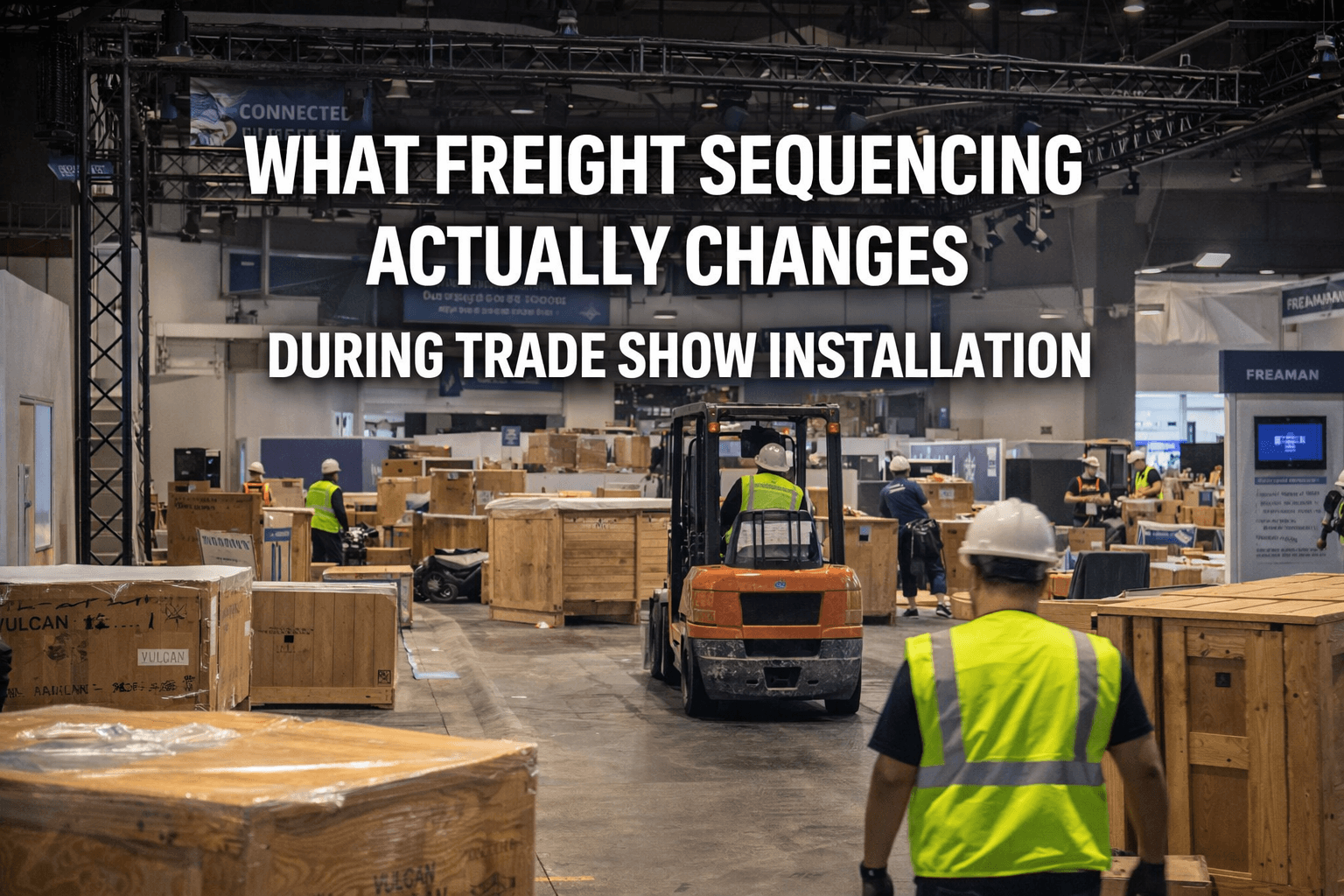
Most exhibitors think freight sequencing is just a delivery issue. It is not. During trade show installation, freight sequencing changes how the booth gets built, when labor can start working efficiently, how safely materials move through the hall, and whether the final setup feels controlled or rushed.
That matters even more in Las Vegas, where major shows often run on targeted freight systems instead of simple first-come unloading. Official exhibitor materials for SEMA, CES, and AAPEX all show the same pattern in different ways: exhibitors are assigned target times, direct shipments often have to pass through a Freeman marshalling yard, and outbound freight must be packed, labeled, and cleared within tightly managed deadlines. In other words, the order in which freight arrives affects the order in which installation can actually happen.
Freight Sequencing Changes When Labor Becomes Productive
On paper, a booth install may be scheduled for a certain morning or afternoon. In practice, labor is only fully productive when the right materials are on site in the right order.
If flooring arrives late but the structure arrives first, crews may have to stop, wait, or work around unfinished surfaces. If backlit graphics show up after walls are already assembled, the team may have to reopen finished areas. If product displays arrive before the booth is cleared of crates, there is nowhere clean or safe to stage them. That is why freight sequencing is not separate from installation planning. It is installation planning.
A good booth build does not just need freight to arrive. It needs freight to arrive in a usable sequence. Base structure, flooring, electrical coordination, graphics, demo hardware, and final styling do not carry the same urgency. Once that is understood early, the install feels faster even when the overall schedule is tight.
It Changes the Order of Work Inside the Booth
A booth is rarely built as one smooth, uninterrupted process. It is built in layers.
Freight sequencing determines whether those layers can happen in the right order. The typical sequence is not complicated, but it is easy to disrupt:
Booth freight gets unloaded and staged
Core structure is positioned
Flooring and underfloor adjustments are completed
Electrical and rigging access stays open where needed
Graphics and branded elements are installed
Product, furniture, and demo equipment move in last
When freight is sequenced poorly, teams end up doing finished work twice. Walls get moved. Carpet protection gets damaged. Cases block access to power. Graphics wait in the aisle because the frame is not ready. The booth may still get built, but the job costs more effort and usually looks less controlled by the final day.
That is one reason exhibitors often lean on both a Las Vegas trade show booth builder and a dedicated logistics and pre-show coordination team rather than treating freight as a separate vendor issue.
It Changes Aisle Access and On-Site Safety
Freight sequencing also changes how the hall behaves around your booth.
Large cases, pallets, carts, forklifts, and empty crates do not just take up space. They affect who can enter the booth, which side can be worked on, and whether installers can safely move from one task to the next. A booth that looks simple in a rendering can become difficult on-site if materials arrive in the wrong order and the aisle edge becomes the holding area for everything at once.
This is where experienced teams think differently. They do not just ask when freight arrives. They ask what should be on the floor first, what should stay in staging, what should remain protected until the structure is stable, and what should not enter the booth until the final install pass.
That logic becomes even more important at large Las Vegas shows, because the official operating rules are built to control congestion, labor flow, and dock pressure. SEMA assigns Freight Target Times, requires commercially delivered freight to report to the Freeman Marshalling Yard, and notes that missing the assigned target time may trigger additional fees. Its official delivery materials also state that carriers are called over to LVCC according to check-in order, not simply by arrival at the venue.
It Changes Cost More Than Most Exhibitors Expect
Freight sequencing affects cost in ways that are easy to miss when a project is still on paper.
The obvious cost is material handling. The less obvious costs show up later:
labor waiting on missing components
overtime caused by rework
rushed installs after late delivery
extra crew time to re-stage materials
avoidable damage to finished surfaces
inefficient use of electricians, riggers, or detail crews
This is why “the freight arrived” is not the same as “the install is on schedule.” A booth can have all materials somewhere in the hall and still be behind if the wrong items landed first.
Shows themselves reinforce this point operationally. SEMA’s exhibitor guidance says material handling includes unloading, delivery to the booth, empty storage, empty return, and delivery back to the outbound carrier, and that this service is handled exclusively by Freeman. AAPEX’s Venetian freight instructions similarly direct common carriers, van lines, and company trucks through the Freeman Marshalling Yard at assigned target times, while its advance warehouse option is described as the best choice for exhibitors who want to begin setup at their assigned target time.
It Changes How Early the Booth Starts to Look Finished
One of the biggest differences between a calm install and a stressful one is visual progress.
When freight sequencing is right, the booth begins to look finished early. Structure goes up cleanly. Flooring is protected instead of reworked. Graphics appear at the right moment. Product placement happens after heavy traffic is gone. The space starts looking like a booth, not a loading zone.
When freight sequencing is wrong, the booth stays messy for too long. That does not just affect the crew. It affects client confidence, final detailing time, photography windows, and the ability to catch small finish issues before show opening.
This is especially true for product-heavy and vehicle-heavy booths. AAPEX’s official vehicle entry form is a good example. For display vehicles at the Venetian Expo, Freeman assigns the freight door and a worker directs the vehicle along the correct aisles to the exhibit location. The show also specifically recommends bringing the vehicle in on Sunday afternoon, when most crates have been removed and fewer forklifts are moving through the aisles. That is freight sequencing in real operational terms: the vehicle is easier and safer to place once the freight environment has changed.
It Changes Move-Out Too, Not Just Move-In
A lot of teams only talk about sequencing during move-in. In reality, bad move-out sequencing can undo a lot of good work.
When outbound labels are late, carriers are not checked in on time, or dismantle begins before materials are properly packed, the result is confusion, delays, and extra charges. CES is very explicit about this in its official move-out guidance: it uses a targeted freight move-out system, requires booths to be packed and labeled at target time, requires the Material Handling Agreement to be turned in, and requires the carrier to be checked in at the marshalling yard prior to the target time. Freight left too late can be rerouted or handled at the exhibitor’s expense.
AAPEX’s dismantling notice says exhibits must remain intact until official close, and for certain halls all freight must be packed, labeled, and ready by noon on the designated move-out day, with outside carriers checked in by 10:00 a.m., after which Freeman may reroute the shipment by the most convenient method available. That is not just a paperwork issue. It changes how dismantle crews should pack, stage, and release materials.
The Real Issue Is Not Freight. It Is Sequence Control.
That is the part many exhibitors miss.
Freight sequencing is really about sequence control across the whole installation:
what enters first
what stays protected
what labor can do immediately
what has to wait
what should never be blocked
what needs to land last for the booth to finish cleanly
At shows like AAPEX, SEMA Show, and CES, official exhibitor rules keep reinforcing the same operational truth: target times, managed yards, controlled unloading, labor jurisdiction, and outbound deadlines are all there to prevent floor chaos. Exhibitors that plan around that system usually get smoother installs. Exhibitors that treat freight as a last-mile issue usually feel the pressure on-site.
Final Thoughts
Freight sequencing does not just decide when your materials arrive. It decides how your booth gets built.
It changes labor productivity, staging logic, aisle access, installation order, finish quality, and move-out control. That is why strong trade show execution is rarely just about design or just about shipping. The booths that go in cleanly are usually the ones where freight, labor, and installation were planned as one system from the beginning.
Most exhibitors think freight sequencing is just a delivery issue. It is not. During trade show installation, freight sequencing changes how the booth gets built, when labor can start working efficiently, how safely materials move through the hall, and whether the final setup feels controlled or rushed.
That matters even more in Las Vegas, where major shows often run on targeted freight systems instead of simple first-come unloading. Official exhibitor materials for SEMA, CES, and AAPEX all show the same pattern in different ways: exhibitors are assigned target times, direct shipments often have to pass through a Freeman marshalling yard, and outbound freight must be packed, labeled, and cleared within tightly managed deadlines. In other words, the order in which freight arrives affects the order in which installation can actually happen.
Freight Sequencing Changes When Labor Becomes Productive
On paper, a booth install may be scheduled for a certain morning or afternoon. In practice, labor is only fully productive when the right materials are on site in the right order.
If flooring arrives late but the structure arrives first, crews may have to stop, wait, or work around unfinished surfaces. If backlit graphics show up after walls are already assembled, the team may have to reopen finished areas. If product displays arrive before the booth is cleared of crates, there is nowhere clean or safe to stage them. That is why freight sequencing is not separate from installation planning. It is installation planning.
A good booth build does not just need freight to arrive. It needs freight to arrive in a usable sequence. Base structure, flooring, electrical coordination, graphics, demo hardware, and final styling do not carry the same urgency. Once that is understood early, the install feels faster even when the overall schedule is tight.
It Changes the Order of Work Inside the Booth
A booth is rarely built as one smooth, uninterrupted process. It is built in layers.
Freight sequencing determines whether those layers can happen in the right order. The typical sequence is not complicated, but it is easy to disrupt:
Booth freight gets unloaded and staged
Core structure is positioned
Flooring and underfloor adjustments are completed
Electrical and rigging access stays open where needed
Graphics and branded elements are installed
Product, furniture, and demo equipment move in last
When freight is sequenced poorly, teams end up doing finished work twice. Walls get moved. Carpet protection gets damaged. Cases block access to power. Graphics wait in the aisle because the frame is not ready. The booth may still get built, but the job costs more effort and usually looks less controlled by the final day.
That is one reason exhibitors often lean on both a Las Vegas trade show booth builder and a dedicated logistics and pre-show coordination team rather than treating freight as a separate vendor issue.
It Changes Aisle Access and On-Site Safety
Freight sequencing also changes how the hall behaves around your booth.
Large cases, pallets, carts, forklifts, and empty crates do not just take up space. They affect who can enter the booth, which side can be worked on, and whether installers can safely move from one task to the next. A booth that looks simple in a rendering can become difficult on-site if materials arrive in the wrong order and the aisle edge becomes the holding area for everything at once.
This is where experienced teams think differently. They do not just ask when freight arrives. They ask what should be on the floor first, what should stay in staging, what should remain protected until the structure is stable, and what should not enter the booth until the final install pass.
That logic becomes even more important at large Las Vegas shows, because the official operating rules are built to control congestion, labor flow, and dock pressure. SEMA assigns Freight Target Times, requires commercially delivered freight to report to the Freeman Marshalling Yard, and notes that missing the assigned target time may trigger additional fees. Its official delivery materials also state that carriers are called over to LVCC according to check-in order, not simply by arrival at the venue.
It Changes Cost More Than Most Exhibitors Expect
Freight sequencing affects cost in ways that are easy to miss when a project is still on paper.
The obvious cost is material handling. The less obvious costs show up later:
labor waiting on missing components
overtime caused by rework
rushed installs after late delivery
extra crew time to re-stage materials
avoidable damage to finished surfaces
inefficient use of electricians, riggers, or detail crews
This is why “the freight arrived” is not the same as “the install is on schedule.” A booth can have all materials somewhere in the hall and still be behind if the wrong items landed first.
Shows themselves reinforce this point operationally. SEMA’s exhibitor guidance says material handling includes unloading, delivery to the booth, empty storage, empty return, and delivery back to the outbound carrier, and that this service is handled exclusively by Freeman. AAPEX’s Venetian freight instructions similarly direct common carriers, van lines, and company trucks through the Freeman Marshalling Yard at assigned target times, while its advance warehouse option is described as the best choice for exhibitors who want to begin setup at their assigned target time.
It Changes How Early the Booth Starts to Look Finished
One of the biggest differences between a calm install and a stressful one is visual progress.
When freight sequencing is right, the booth begins to look finished early. Structure goes up cleanly. Flooring is protected instead of reworked. Graphics appear at the right moment. Product placement happens after heavy traffic is gone. The space starts looking like a booth, not a loading zone.
When freight sequencing is wrong, the booth stays messy for too long. That does not just affect the crew. It affects client confidence, final detailing time, photography windows, and the ability to catch small finish issues before show opening.
This is especially true for product-heavy and vehicle-heavy booths. AAPEX’s official vehicle entry form is a good example. For display vehicles at the Venetian Expo, Freeman assigns the freight door and a worker directs the vehicle along the correct aisles to the exhibit location. The show also specifically recommends bringing the vehicle in on Sunday afternoon, when most crates have been removed and fewer forklifts are moving through the aisles. That is freight sequencing in real operational terms: the vehicle is easier and safer to place once the freight environment has changed.
It Changes Move-Out Too, Not Just Move-In
A lot of teams only talk about sequencing during move-in. In reality, bad move-out sequencing can undo a lot of good work.
When outbound labels are late, carriers are not checked in on time, or dismantle begins before materials are properly packed, the result is confusion, delays, and extra charges. CES is very explicit about this in its official move-out guidance: it uses a targeted freight move-out system, requires booths to be packed and labeled at target time, requires the Material Handling Agreement to be turned in, and requires the carrier to be checked in at the marshalling yard prior to the target time. Freight left too late can be rerouted or handled at the exhibitor’s expense.
AAPEX’s dismantling notice says exhibits must remain intact until official close, and for certain halls all freight must be packed, labeled, and ready by noon on the designated move-out day, with outside carriers checked in by 10:00 a.m., after which Freeman may reroute the shipment by the most convenient method available. That is not just a paperwork issue. It changes how dismantle crews should pack, stage, and release materials.
The Real Issue Is Not Freight. It Is Sequence Control.
That is the part many exhibitors miss.
Freight sequencing is really about sequence control across the whole installation:
what enters first
what stays protected
what labor can do immediately
what has to wait
what should never be blocked
what needs to land last for the booth to finish cleanly
At shows like AAPEX, SEMA Show, and CES, official exhibitor rules keep reinforcing the same operational truth: target times, managed yards, controlled unloading, labor jurisdiction, and outbound deadlines are all there to prevent floor chaos. Exhibitors that plan around that system usually get smoother installs. Exhibitors that treat freight as a last-mile issue usually feel the pressure on-site.
Final Thoughts
Freight sequencing does not just decide when your materials arrive. It decides how your booth gets built.
It changes labor productivity, staging logic, aisle access, installation order, finish quality, and move-out control. That is why strong trade show execution is rarely just about design or just about shipping. The booths that go in cleanly are usually the ones where freight, labor, and installation were planned as one system from the beginning.
Exhibition Cases
Message
Leave your message and we will get back to you ASAP
Send a Message
We’ll Be in Touch!
Message
Leave your message and we will get back to you ASAP
Address:
4915 Steptoe Street #300
Las Vegas, NV 89122