What AAPEX Exhibitors Should Know About The Venetian Expo and Caesars Forum

Circle Exhibit Team
Industry professionals
Exhibition industry professional dedicated to delivering the latest insights and curated recommendations to you.
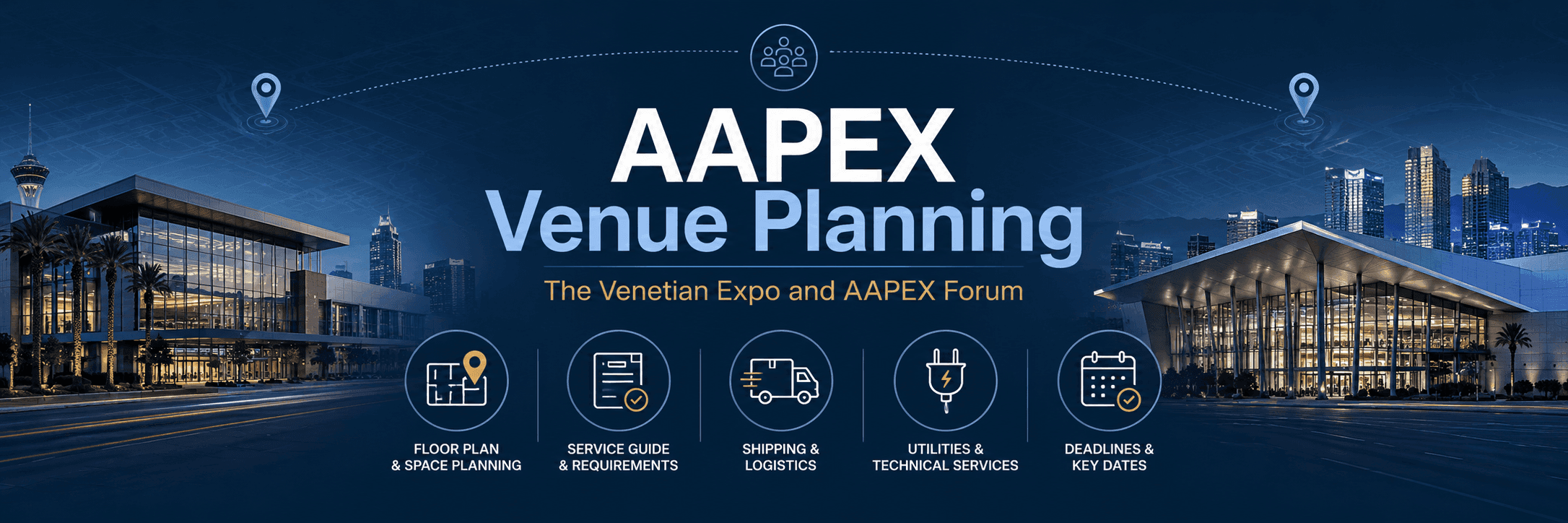
AAPEX is not a one-hall event, and that matters more than many exhibitors expect. The 2026 show is scheduled for November 3–5, 2026 in Las Vegas at The Venetian Expo and Caesars Forum, with attendee and exhibitor registration points listed at both venues. AAPEX also maintains separate exhibitor service pathways for exhibitors based in each venue, which is the first signal that planning should be handled by actual booth location, not by the event name alone.
A lot of teams start with the broad idea that they are “exhibiting at AAPEX.” That is true, but it is not specific enough to run the project well. A better starting point is to ask a simpler question: are we in Venetian or Caesars Forum, and what does that change about how the booth should be prepared? Since AAPEX splits venue information, exhibitor services, and service contacts by location, exhibitors have a practical reason to treat the venue as part of the booth strategy from the beginning.
Venue matters because setup is never completely generic
From the outside, it is easy to think of AAPEX as one continuous Las Vegas trade show environment. In practice, the show uses more than one venue and asks exhibitors to work from venue-specific guidance. The official Online Exhibitor Services Guides separate Venetian Expo booths from Caesars Forum booths, and the FAQ confirms that AAPEX 2026 takes place across both locations.
That does not mean an exhibitor has to redesign the entire booth concept based on venue alone. It does mean the team should stop treating logistics, service requests, and setup assumptions as one-size-fits-all. If your booth is assigned to one venue, that is the venue your team should use when checking services, confirming setup needs, and preparing the final execution plan.
For exhibitors working with a Las Vegas trade show booth builder, this is one of the first details that should be locked. Not because the venue changes the brand story, but because it changes how cleanly the booth gets from pre-show planning into a finished on-site setup.
The venue should shape how you think about services
AAPEX does not just list two venue names and leave exhibitors to figure out the rest. Its contact page breaks out service contacts for Caesars Forum Services and Venetian Expo Services, while also listing separate contacts for freight/material handling, graphics, carpet, furnishings, power, internet, rigging, lighting, and venue-level exhibitor support.
That structure tells you something important. Booth execution is not only about design approval and shipping dates. It is also about knowing where service questions go, who handles which part of the install process, and how your team should coordinate support once materials reach the floor.
This is why AAPEX exhibitor services should be treated as part of planning, not just a checklist to review at the last minute. The more product-heavy the booth is, the more useful it becomes to match layout, freight sequence, utility needs, and booth finishing details to the actual venue before move-in begins.
Venetian and Caesars Forum should be read as execution contexts, not just map labels
A common planning mistake is using the venue name only as a location reference. A better approach is to treat the venue as an execution context.
That means asking practical questions early:
where will exhibitor services be handled
which contact applies to the booth
how should freight and setup timing be organized
what should the crew confirm before the final install sequence starts
AAPEX’s official materials support that mindset. The FAQ gives both venue addresses, registration locations, and exhibit dates, while the service pages and contact listings separate venue support in a way that points exhibitors toward location-based preparation.
For many exhibitors, that alone improves decision-making. It keeps the team from building one broad plan and then adjusting too much on-site.
Booth size and booth type still need to fit the venue plan
The venue does not replace booth planning. It sharpens it.
AAPEX’s exhibitor information states that peninsula booths and island booths both have a minimum size of 20' x 20'. That means once an exhibitor moves into a more open booth format, the planning question becomes less about whether the booth is “big enough” and more about whether the size, display density, and visitor flow make sense together.
This matters because a booth that feels workable in a rendering can still become tight once real products, shelves, samples, demo points, and meetings are added. If the booth is in a large, busy AAPEX environment where buyers are comparing categories quickly, spacing and readability matter. That is one reason a 20x20 trade show booth layout and a 30x40 island booth layout should be planned around actual use, not just square footage.
Product category logic matters more at AAPEX than at many general shows
AAPEX has leaned into product and service segmentation on the show floor. The event has described its floor plan by product and service category and highlights more than 1,400 product categories overall, which reinforces the fact that visitors are navigating the show with category intent rather than random browsing.
That is a useful planning clue for exhibitors. If buyers are already moving through the event by category logic, your booth should help them understand your product group quickly. The venue and the booth layout should support that same clarity. Products should not feel buried. Meeting areas should not interrupt the read of the main offer. Demo elements should not take over the front edge unless they help explain the category immediately.
For an automotive aftermarket exhibitor, this is where venue planning, booth layout, and product display start working together instead of as separate decisions.
Venue planning becomes more important as booth complexity increases
A simple booth can tolerate a certain amount of improvisation. A more layered booth usually cannot.
Once the exhibit includes multiple display zones, a larger SKU count, more shelving, screens, utility coordination, or several parallel conversations, the planning margin gets smaller. That is when venue-specific prep starts paying off. If your team already knows which venue support path applies, which contacts to use, and what the setup sequence should look like, there is less guesswork once the materials arrive.
This is also where logistics and pre-show coordination becomes one of the most important support pieces around AAPEX. A booth does not become easier to install just because it looks organized on paper. It becomes easier when layout, service coordination, and sequence are resolved before the on-site push begins.
The best AAPEX planning starts with the real venue, not the generic event label
The strongest AAPEX booths usually do not come from more complexity. They come from better alignment.
That alignment starts with knowing where the booth actually lives, which services apply, how the space will be used, and how the team wants buyers to move through it. AAPEX is large, category-driven, and split across The Venetian Expo and Caesars Forum. The event’s own structure makes it clear that exhibitors should plan with that reality in mind.
If your booth planning starts with the real venue instead of a generic event label, the rest of the decisions usually get better. The layout gets tighter. Service coordination gets clearer. Setup gets cleaner. And the booth is more likely to feel ready when buyers actually arrive.
Planning to exhibit at AAPEX in Las Vegas? See how a Las Vegas trade show booth builder can help you plan for the right venue, organize setup details, and build a booth that works across The Venetian Expo and Caesars Forum.
AAPEX is not a one-hall event, and that matters more than many exhibitors expect. The 2026 show is scheduled for November 3–5, 2026 in Las Vegas at The Venetian Expo and Caesars Forum, with attendee and exhibitor registration points listed at both venues. AAPEX also maintains separate exhibitor service pathways for exhibitors based in each venue, which is the first signal that planning should be handled by actual booth location, not by the event name alone.
A lot of teams start with the broad idea that they are “exhibiting at AAPEX.” That is true, but it is not specific enough to run the project well. A better starting point is to ask a simpler question: are we in Venetian or Caesars Forum, and what does that change about how the booth should be prepared? Since AAPEX splits venue information, exhibitor services, and service contacts by location, exhibitors have a practical reason to treat the venue as part of the booth strategy from the beginning.
Venue matters because setup is never completely generic
From the outside, it is easy to think of AAPEX as one continuous Las Vegas trade show environment. In practice, the show uses more than one venue and asks exhibitors to work from venue-specific guidance. The official Online Exhibitor Services Guides separate Venetian Expo booths from Caesars Forum booths, and the FAQ confirms that AAPEX 2026 takes place across both locations.
That does not mean an exhibitor has to redesign the entire booth concept based on venue alone. It does mean the team should stop treating logistics, service requests, and setup assumptions as one-size-fits-all. If your booth is assigned to one venue, that is the venue your team should use when checking services, confirming setup needs, and preparing the final execution plan.
For exhibitors working with a Las Vegas trade show booth builder, this is one of the first details that should be locked. Not because the venue changes the brand story, but because it changes how cleanly the booth gets from pre-show planning into a finished on-site setup.
The venue should shape how you think about services
AAPEX does not just list two venue names and leave exhibitors to figure out the rest. Its contact page breaks out service contacts for Caesars Forum Services and Venetian Expo Services, while also listing separate contacts for freight/material handling, graphics, carpet, furnishings, power, internet, rigging, lighting, and venue-level exhibitor support.
That structure tells you something important. Booth execution is not only about design approval and shipping dates. It is also about knowing where service questions go, who handles which part of the install process, and how your team should coordinate support once materials reach the floor.
This is why AAPEX exhibitor services should be treated as part of planning, not just a checklist to review at the last minute. The more product-heavy the booth is, the more useful it becomes to match layout, freight sequence, utility needs, and booth finishing details to the actual venue before move-in begins.
Venetian and Caesars Forum should be read as execution contexts, not just map labels
A common planning mistake is using the venue name only as a location reference. A better approach is to treat the venue as an execution context.
That means asking practical questions early:
where will exhibitor services be handled
which contact applies to the booth
how should freight and setup timing be organized
what should the crew confirm before the final install sequence starts
AAPEX’s official materials support that mindset. The FAQ gives both venue addresses, registration locations, and exhibit dates, while the service pages and contact listings separate venue support in a way that points exhibitors toward location-based preparation.
For many exhibitors, that alone improves decision-making. It keeps the team from building one broad plan and then adjusting too much on-site.
Booth size and booth type still need to fit the venue plan
The venue does not replace booth planning. It sharpens it.
AAPEX’s exhibitor information states that peninsula booths and island booths both have a minimum size of 20' x 20'. That means once an exhibitor moves into a more open booth format, the planning question becomes less about whether the booth is “big enough” and more about whether the size, display density, and visitor flow make sense together.
This matters because a booth that feels workable in a rendering can still become tight once real products, shelves, samples, demo points, and meetings are added. If the booth is in a large, busy AAPEX environment where buyers are comparing categories quickly, spacing and readability matter. That is one reason a 20x20 trade show booth layout and a 30x40 island booth layout should be planned around actual use, not just square footage.
Product category logic matters more at AAPEX than at many general shows
AAPEX has leaned into product and service segmentation on the show floor. The event has described its floor plan by product and service category and highlights more than 1,400 product categories overall, which reinforces the fact that visitors are navigating the show with category intent rather than random browsing.
That is a useful planning clue for exhibitors. If buyers are already moving through the event by category logic, your booth should help them understand your product group quickly. The venue and the booth layout should support that same clarity. Products should not feel buried. Meeting areas should not interrupt the read of the main offer. Demo elements should not take over the front edge unless they help explain the category immediately.
For an automotive aftermarket exhibitor, this is where venue planning, booth layout, and product display start working together instead of as separate decisions.
Venue planning becomes more important as booth complexity increases
A simple booth can tolerate a certain amount of improvisation. A more layered booth usually cannot.
Once the exhibit includes multiple display zones, a larger SKU count, more shelving, screens, utility coordination, or several parallel conversations, the planning margin gets smaller. That is when venue-specific prep starts paying off. If your team already knows which venue support path applies, which contacts to use, and what the setup sequence should look like, there is less guesswork once the materials arrive.
This is also where logistics and pre-show coordination becomes one of the most important support pieces around AAPEX. A booth does not become easier to install just because it looks organized on paper. It becomes easier when layout, service coordination, and sequence are resolved before the on-site push begins.
The best AAPEX planning starts with the real venue, not the generic event label
The strongest AAPEX booths usually do not come from more complexity. They come from better alignment.
That alignment starts with knowing where the booth actually lives, which services apply, how the space will be used, and how the team wants buyers to move through it. AAPEX is large, category-driven, and split across The Venetian Expo and Caesars Forum. The event’s own structure makes it clear that exhibitors should plan with that reality in mind.
If your booth planning starts with the real venue instead of a generic event label, the rest of the decisions usually get better. The layout gets tighter. Service coordination gets clearer. Setup gets cleaner. And the booth is more likely to feel ready when buyers actually arrive.
Planning to exhibit at AAPEX in Las Vegas? See how a Las Vegas trade show booth builder can help you plan for the right venue, organize setup details, and build a booth that works across The Venetian Expo and Caesars Forum.
Exhibition Cases
Message
Leave your message and we will get back to you ASAP
Send a Message
We’ll Be in Touch!
Message
Leave your message and we will get back to you ASAP
Address:
4915 Steptoe Street #300
Las Vegas, NV 89122