How Booth Entry Angles Change First-Stop Behavior at CES

Circle Exhibit Team
Industry professionals
Exhibition industry professional dedicated to delivering the latest insights and curated recommendations to you.
At CES, booth entry angle changes how people slow down, where they stop, and whether they step in at all. A strong booth is not only open. It opens in the right direction for aisle behavior.
A booth entry is not just an opening
At CES, the entry angle does more than let people walk in.
It shapes the first moment of hesitation.
That moment matters because CES visitors rarely stop in a neutral way. They are already moving, scanning, comparing, and deciding while they pass the booth. By the time someone slows down, the booth has already made several small decisions for them:
where to look first
whether stepping in feels easy
whether the demo feels approachable
whether the booth edge feels clear or confusing
That is why entry angle matters more than many exhibitors expect.
First-stop behavior usually begins before the visitor reaches the booth
A lot of teams plan the booth as if the stop happens at the edge.
Usually, it starts earlier.
At CES in Las Vegas, people are often reading the booth while still in motion. They may glance across the aisle, approach from a diagonal line, or slow slightly without committing. That means the booth is already being judged before anyone reaches the front boundary.
This is where entry angle becomes important.
A booth that opens in the wrong direction can stay technically open and still feel harder to enter. A booth that opens in the right direction can make the stop feel natural before the visitor has fully decided to step in.
CES traffic usually rewards easy directional logic
Visitors at CES do not want to solve the booth first.
They want to understand it quickly.
That means the booth entry should help answer simple questions immediately:
Where is the main interaction?
Can I step in without interrupting something?
Is the demo happening at the edge or farther inside?
Do I move straight in, curve in, or just keep walking?
When those answers are unclear, the booth often loses the stop.
Not because the booth is weak.
Because the entry is making the visitor work too hard in motion.
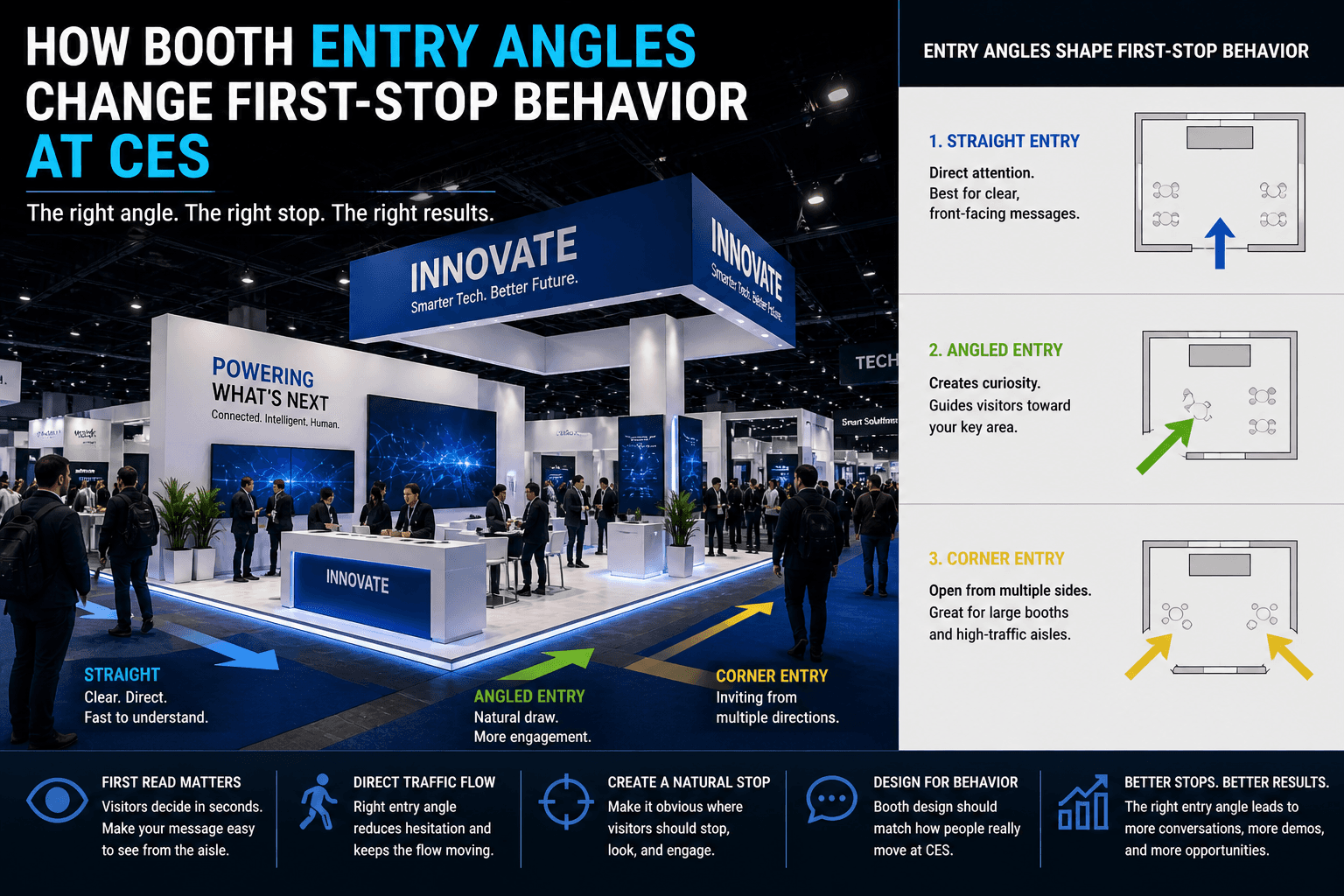
A front-facing opening and an angled opening do different jobs
This is one of the most useful ways to think about CES entry planning.
A straight front-facing opening
Usually works well when the booth needs immediate visual clarity and a simple, direct first step.
A slightly angled opening
Often works better when the booth needs to catch cross-aisle attention or guide visitors toward a more specific first-stop zone.
An overly open corner or wide front edge
Can sometimes weaken the booth if the first-stop point becomes too vague.
This is why “more open” is not always better.
At CES, the booth often performs better when the opening creates direction, not just access.
The first-stop point should feel obvious, not accidental
A lot of CES booths lose people right here.
The visitor slows down, but the booth does not tell them where to stop.
That usually happens when:
the entry is too wide and unstructured
the first screen is too deep inside
the counter is too close to the aisle
the demo zone and talk zone share the same front edge
graphics and structure pull attention in different directions
The result is hesitation.
The visitor may still look.
They may even pause.
But they do not quite commit.
That is usually a booth-entry problem, not a traffic problem.
Entry angle changes how the booth handles aisle speed
This matters a lot at CES because not every aisle behaves the same way.
A faster aisle often needs a clearer and more directional opening. People do not have much patience for figuring out a booth while moving at pace.
A slightly slower aisle may allow a softer entry angle, especially if the booth wants to guide traffic into a demo or product interaction without creating immediate congestion at the edge.
That is why the opening should respond to how people are moving past the booth, not only to the booth footprint itself.
The booth is not opening into empty space.
It is opening into behavior.
A 20x20 booth feels this pressure more strongly
This is especially true in a 20x20 trade show booth.
In a 20x20, the entry decision carries more weight because the booth has less room to recover from a weak first-stop condition. If the visitor stops in the wrong place, the booth can feel crowded quickly. If the demo sits too close to the edge, aisle spill begins earlier. If the entry line is vague, the front zone becomes confused before the booth has had a chance to explain itself.
That is why smaller CES booths often need more disciplined edge planning, not less.
A 20x20 does not need a giant gesture.
It needs a clean first move.
Graphics help the entry angle make sense
This is where graphics and brand presentation play a major role.
An entry angle works better when the visitor can understand the booth from the same direction the booth is asking them to approach.
That usually means:
the main message is visible from the likely approach path
the first-read surface supports the opening, not contradicts it
the category is clear before the visitor fully enters
the booth does not force the eye to bounce across too many competing surfaces
A strong entry angle without clear graphics can still feel unfinished.
Strong graphics without a readable entry angle can still feel slow.
The booth works best when both support the same first-stop behavior.
The wrong entry angle can make a good booth feel closed
This happens even on well-designed booths.
A booth may look open on plan view and still feel awkward live if the entry angle causes people to:
approach from the wrong side of the message
arrive at the edge beside the main demo instead of in front of it
feel like they are entering through a side seam instead of a clear front
stop too close to an active conversation or product counter
That is when the booth starts feeling more closed than it actually is.
The issue is not wall count.
The issue is direction.
Better entry planning usually creates cleaner traffic inside the booth
This is another reason the first-stop point matters.
If the booth catches the visitor in the right place, the next movement gets easier:
the visitor notices the booth
the visitor slows at the intended stop point
the visitor understands what to look at first
the visitor steps deeper without colliding with the next person
That sequence makes the booth feel smoother even when traffic is high.
If the first-stop point is wrong, the inside of the booth usually gets messy faster because the opening already fed traffic into the wrong zone.
That is why entry angle is not only an edge issue.
It affects the whole booth rhythm.
Builder planning matters because first-stop behavior is physical
This is one reason exhibitors benefit from working with a Las Vegas trade show booth builder that understands traffic behavior, not just booth form.
Because first-stop behavior is not a copywriting problem alone.
It is not a graphics problem alone either.
It is physical.
It depends on:
the angle of approach
the booth opening
what surface is seen first
where the demo sits
where the aisle pressure is strongest
where the visitor feels invited to pause
A booth can look polished and still lose the stop if those things are not aligned.
That is where better builder planning makes a real difference.
A practical way to judge the entry angle
Before finalizing a CES booth, it helps to ask:
From what direction will most people notice the booth first?
That should influence the front read.
Where do you want the first pause to happen?
That should influence the opening angle.
Is the first stop too close to the aisle or too deep inside?
That usually reveals whether the booth will spill or stall.
Does the graphics hierarchy support the approach path?
If not, the entry will feel slower than it should.
Will the same opening still work once real traffic appears?
That is the question that matters most.
These are simple questions, but they often reveal the difference between an open booth and a booth that actually catches people well.
Final thought
At CES, booth entry angles change first-stop behavior because visitors do not enter the booth as a blank slate.
They approach while moving, scanning, comparing, and deciding in real time. That means the booth has only a short moment to make the stop feel natural.
A strong booth does not just stay open.
It opens in the right direction, creates a clear first-stop point, and supports that movement with the right message and the right physical hierarchy.
That is usually what turns aisle traffic into real booth traffic.
Planning a booth for CES in Las Vegas?
Start with CES booth planning, then shape the opening with a Las Vegas trade show booth builder approach that makes the first stop feel obvious, natural, and easy to act on.
A booth entry is not just an opening
At CES, the entry angle does more than let people walk in.
It shapes the first moment of hesitation.
That moment matters because CES visitors rarely stop in a neutral way. They are already moving, scanning, comparing, and deciding while they pass the booth. By the time someone slows down, the booth has already made several small decisions for them:
where to look first
whether stepping in feels easy
whether the demo feels approachable
whether the booth edge feels clear or confusing
That is why entry angle matters more than many exhibitors expect.
First-stop behavior usually begins before the visitor reaches the booth
A lot of teams plan the booth as if the stop happens at the edge.
Usually, it starts earlier.
At CES in Las Vegas, people are often reading the booth while still in motion. They may glance across the aisle, approach from a diagonal line, or slow slightly without committing. That means the booth is already being judged before anyone reaches the front boundary.
This is where entry angle becomes important.
A booth that opens in the wrong direction can stay technically open and still feel harder to enter. A booth that opens in the right direction can make the stop feel natural before the visitor has fully decided to step in.
CES traffic usually rewards easy directional logic
Visitors at CES do not want to solve the booth first.
They want to understand it quickly.
That means the booth entry should help answer simple questions immediately:
Where is the main interaction?
Can I step in without interrupting something?
Is the demo happening at the edge or farther inside?
Do I move straight in, curve in, or just keep walking?
When those answers are unclear, the booth often loses the stop.
Not because the booth is weak.
Because the entry is making the visitor work too hard in motion.
A front-facing opening and an angled opening do different jobs
This is one of the most useful ways to think about CES entry planning.
A straight front-facing opening
Usually works well when the booth needs immediate visual clarity and a simple, direct first step.
A slightly angled opening
Often works better when the booth needs to catch cross-aisle attention or guide visitors toward a more specific first-stop zone.
An overly open corner or wide front edge
Can sometimes weaken the booth if the first-stop point becomes too vague.
This is why “more open” is not always better.
At CES, the booth often performs better when the opening creates direction, not just access.
The first-stop point should feel obvious, not accidental
A lot of CES booths lose people right here.
The visitor slows down, but the booth does not tell them where to stop.
That usually happens when:
the entry is too wide and unstructured
the first screen is too deep inside
the counter is too close to the aisle
the demo zone and talk zone share the same front edge
graphics and structure pull attention in different directions
The result is hesitation.
The visitor may still look.
They may even pause.
But they do not quite commit.
That is usually a booth-entry problem, not a traffic problem.
Entry angle changes how the booth handles aisle speed
This matters a lot at CES because not every aisle behaves the same way.
A faster aisle often needs a clearer and more directional opening. People do not have much patience for figuring out a booth while moving at pace.
A slightly slower aisle may allow a softer entry angle, especially if the booth wants to guide traffic into a demo or product interaction without creating immediate congestion at the edge.
That is why the opening should respond to how people are moving past the booth, not only to the booth footprint itself.
The booth is not opening into empty space.
It is opening into behavior.
A 20x20 booth feels this pressure more strongly
This is especially true in a 20x20 trade show booth.
In a 20x20, the entry decision carries more weight because the booth has less room to recover from a weak first-stop condition. If the visitor stops in the wrong place, the booth can feel crowded quickly. If the demo sits too close to the edge, aisle spill begins earlier. If the entry line is vague, the front zone becomes confused before the booth has had a chance to explain itself.
That is why smaller CES booths often need more disciplined edge planning, not less.
A 20x20 does not need a giant gesture.
It needs a clean first move.
Graphics help the entry angle make sense
This is where graphics and brand presentation play a major role.
An entry angle works better when the visitor can understand the booth from the same direction the booth is asking them to approach.
That usually means:
the main message is visible from the likely approach path
the first-read surface supports the opening, not contradicts it
the category is clear before the visitor fully enters
the booth does not force the eye to bounce across too many competing surfaces
A strong entry angle without clear graphics can still feel unfinished.
Strong graphics without a readable entry angle can still feel slow.
The booth works best when both support the same first-stop behavior.
The wrong entry angle can make a good booth feel closed
This happens even on well-designed booths.
A booth may look open on plan view and still feel awkward live if the entry angle causes people to:
approach from the wrong side of the message
arrive at the edge beside the main demo instead of in front of it
feel like they are entering through a side seam instead of a clear front
stop too close to an active conversation or product counter
That is when the booth starts feeling more closed than it actually is.
The issue is not wall count.
The issue is direction.
Better entry planning usually creates cleaner traffic inside the booth
This is another reason the first-stop point matters.
If the booth catches the visitor in the right place, the next movement gets easier:
the visitor notices the booth
the visitor slows at the intended stop point
the visitor understands what to look at first
the visitor steps deeper without colliding with the next person
That sequence makes the booth feel smoother even when traffic is high.
If the first-stop point is wrong, the inside of the booth usually gets messy faster because the opening already fed traffic into the wrong zone.
That is why entry angle is not only an edge issue.
It affects the whole booth rhythm.
Builder planning matters because first-stop behavior is physical
This is one reason exhibitors benefit from working with a Las Vegas trade show booth builder that understands traffic behavior, not just booth form.
Because first-stop behavior is not a copywriting problem alone.
It is not a graphics problem alone either.
It is physical.
It depends on:
the angle of approach
the booth opening
what surface is seen first
where the demo sits
where the aisle pressure is strongest
where the visitor feels invited to pause
A booth can look polished and still lose the stop if those things are not aligned.
That is where better builder planning makes a real difference.
A practical way to judge the entry angle
Before finalizing a CES booth, it helps to ask:
From what direction will most people notice the booth first?
That should influence the front read.
Where do you want the first pause to happen?
That should influence the opening angle.
Is the first stop too close to the aisle or too deep inside?
That usually reveals whether the booth will spill or stall.
Does the graphics hierarchy support the approach path?
If not, the entry will feel slower than it should.
Will the same opening still work once real traffic appears?
That is the question that matters most.
These are simple questions, but they often reveal the difference between an open booth and a booth that actually catches people well.
Final thought
At CES, booth entry angles change first-stop behavior because visitors do not enter the booth as a blank slate.
They approach while moving, scanning, comparing, and deciding in real time. That means the booth has only a short moment to make the stop feel natural.
A strong booth does not just stay open.
It opens in the right direction, creates a clear first-stop point, and supports that movement with the right message and the right physical hierarchy.
That is usually what turns aisle traffic into real booth traffic.
Planning a booth for CES in Las Vegas?
Start with CES booth planning, then shape the opening with a Las Vegas trade show booth builder approach that makes the first stop feel obvious, natural, and easy to act on.
Exhibition Cases
Message
Leave your message and we will get back to you ASAP
Send a Message
We’ll Be in Touch!
Message
Leave your message and we will get back to you ASAP
Address:
4915 Steptoe Street #300
Las Vegas, NV 89122