How 20x20 Booths Behave Differently at CES, NAB, and SEMA

Circle Exhibit Team
Industry professionals
Exhibition industry professional dedicated to delivering the latest insights and curated recommendations to you.
The same 20x20 footprint behaves differently at CES, NAB, and SEMA. Product type, visitor expectations, and demo behavior all change how the booth should open, what should sit at the edge, and where traffic pressure builds first.
A 20x20 booth is not one fixed solution
A lot of exhibitors treat a 20x20 booth like a standard answer.
It is a familiar size.
It feels manageable.
It is big enough to do something serious, but still compact enough to stay disciplined.
All of that is true.
But a 20x20 trade show booth does not behave the same way at every event. The footprint may stay the same, but the way people approach it, read it, stop in it, and move through it can change a lot depending on the show.
That is why a 20x20 booth should not be planned only by size.
It should also be planned by context.
The footprint stays the same, but the pressure changes
A 20x20 booth always gives you a limited amount of space to solve several jobs at once.
Usually some mix of:
first-read messaging
demo or display
staff conversation
product presentation
storage
circulation
The challenge is that CES, NAB, and SEMA do not put pressure on those elements in the same way.
At one show, the booth needs faster message clarity.
At another, it needs more controlled viewing.
At another, it needs to protect a hero display from crowding.
So the square footage may be fixed, but the booth behavior is not.
At CES, a 20x20 usually needs to work fast
At CES in Las Vegas, people move quickly.
They scan booths while walking. They compare categories fast. They decide in a few seconds whether something looks worth stepping into.
That means a 20x20 CES booth usually works best when it does three things clearly:
1. Explains itself quickly
The visitor should understand what category the booth is in before needing a full conversation.
2. Shows the demo without blocking the edge
The booth needs an easy first read, but it cannot let the whole interaction spill directly into the aisle.
3. Creates an obvious next step
If the visitor slows down, it should be clear where to stand, what to look at, and how to move deeper.
At CES, a 20x20 often succeeds when it feels open, fast, and easy to decode.
CES usually punishes slow first reads
This is one reason some 20x20 booths feel smaller at CES than they actually are.
Not because the footprint is too tight.
Because the booth is trying to say too much too early.
A 20x20 CES booth usually becomes weaker when it includes:
too many equal messages
an unclear front edge
a demo too close to the aisle
conversation space competing with the main stop
visual clutter that slows the first read
In that environment, the booth needs to create momentum quickly.
If it hesitates, traffic often keeps moving.
At NAB, a 20x20 often needs more control than speed
A NAB Show booth behaves differently.
The challenge there is not always getting attention. Many NAB booths already have screens, operator areas, technical hardware, or visible activity. The harder part is helping visitors understand what they are seeing.
That changes the role of the same 20x20 footprint.
At NAB, a 20x20 often works best when it creates:
1. A clear viewing line
The visitor needs to know where to stand to understand the demo.
2. A readable workflow
The booth should show what the system is doing, not just display multiple active elements at once.
3. Separation between watching and talking
The audience should be able to observe without immediately colliding with deeper technical conversations.
That makes the booth feel more structured than a typical CES layout.
NAB often turns a 20x20 into a watch-first environment
This is the major shift.
At CES, the booth is often trying to convert a passerby into a participant.
At NAB, the booth is often trying to convert an observer into an informed viewer first.
That means the same 20x20 footprint usually needs:
stronger screen hierarchy
more deliberate operator placement
clearer control over standing positions
less random mixing of viewing and discussion zones
If that structure is missing, the booth starts feeling busy without becoming clear.
That is a common NAB problem.
At SEMA, a 20x20 usually becomes more display-sensitive
At SEMA Show, the same footprint changes again.
Automotive traffic behaves differently. A vehicle, wheel display, or performance-parts wall can create a very strong visual stop. That sounds helpful, and often it is, but it also changes how the booth uses space.
At SEMA, a 20x20 often needs to protect:
1. The hero display angle
Visitors should immediately understand what the visual centerpiece is.
2. The path around the display
Traffic needs a way to pause without freezing the whole booth.
3. The product-context layer
Once the hero stop happens, the visitor still needs a second layer of information to keep moving deeper.
This makes a 20x20 SEMA booth feel more circulation-sensitive than a tech or broadcast booth.
SEMA can make a 20x20 feel tighter very quickly
A 20x20 booth at SEMA often fills up faster than people expect.
That happens because the visual stop is strong. Visitors may cluster near the center or near the booth edge before the layout has room to absorb them. If the display object is large, the booth has even less flexibility left for product context, staff conversations, or secondary movement.
That is why a 20x20 SEMA booth usually benefits from:
a very clear hero zone
controlled side circulation
disciplined product placement
fewer competing front-edge elements
The booth does not have enough room to let everything compete equally.
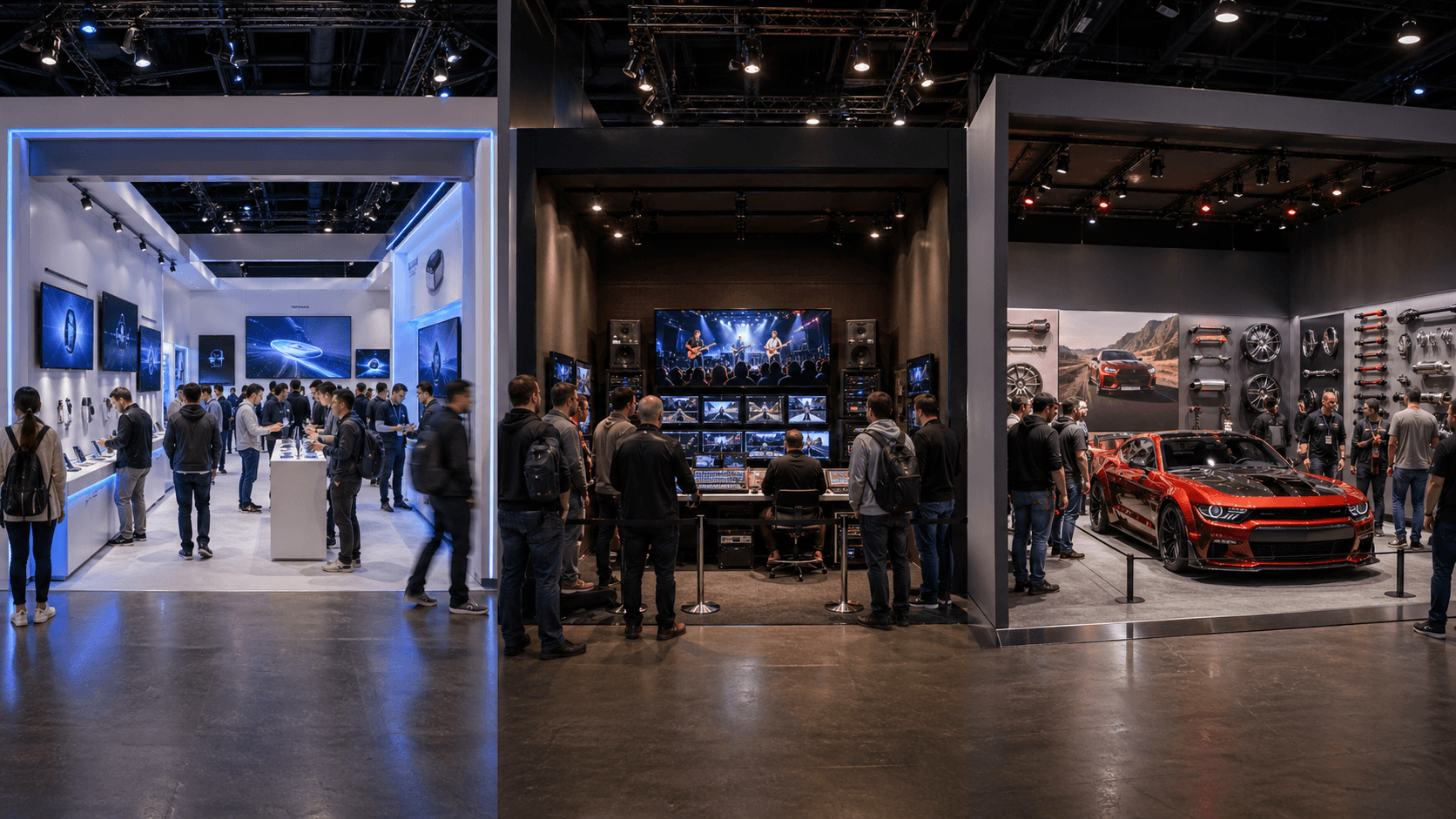
The same 20x20 footprint supports three different behaviors
This is the cleanest way to compare them.
CES = quick entry
The booth has to read fast and convert attention quickly.
NAB = controlled viewing
The booth has to help people understand technical proof before they engage deeply.
SEMA = display-led circulation
The booth has to control what happens after the first visual stop.
Same footprint.
Different booth behavior.
That is why exhibitors get into trouble when they copy one 20x20 logic from one show straight into another.
Product type changes the booth as much as the show does
Another reason these 20x20 booths behave differently is the product itself.
A tech product often needs:
faster headline clarity
lighter demo access
cleaner front-edge messaging
A broadcast product often needs:
workflow explanation
output clarity
better watch positions
An automotive product often needs:
stronger object hierarchy
cleaner hero framing
supporting product context around the main display
So it is not only the audience.
It is also what the booth is physically trying to present.
That combination changes the layout.
Audience behavior changes where pressure builds first
This matters a lot in a 20x20 because there is not much extra room for recovery.
At CES
Pressure often builds at the first decision point:
“Should I step in or keep walking?”
At NAB
Pressure often builds at the viewing line:
“Where do I stand to understand this?”
At SEMA
Pressure often builds around the display edge:
“How do I look at this without blocking everyone else?”
Those are different crowd behaviors, and they create different layout priorities.
That is why 20x20 booths should not be planned as a generic box with interchangeable content.
A practical planning shortcut
If you are comparing 20x20 booth planning across the three shows, here is the simplest working lens:
CES 20x20
Prioritize first-read clarity, open entry, and quick demo capture.
NAB 20x20
Prioritize viewing logic, screen hierarchy, and watch-first spacing.
SEMA 20x20
Prioritize hero display control, traffic shaping, and clean product layering.
That framework usually gets you closer to the right answer than thinking only about square footage.
The best 20x20 booths know what they are sacrificing
This is an important point.
A 20x20 is useful because it is flexible, but it is still finite.
That means every strong version of a 20x20 booth makes decisions about what matters most.
At CES, that may mean sacrificing some lounge comfort for faster demo access.
At NAB, that may mean sacrificing some openness for better viewer control.
At SEMA, that may mean sacrificing some extra display density to keep the hero object readable.
That is not weakness.
That is what makes the booth work.
Event context should shape the booth before design details begin
This is why the event page matters so much during planning.
A 20x20 booth becomes much easier to plan when the team starts with the event logic first:
What kind of traffic does this show create?
What kind of first stop happens here?
What does the visitor need to understand first?
What is most likely to create crowd pressure in this footprint?
Once those questions are answered, the layout decisions usually become more obvious.
Without that context, the booth often stays generic for too long.
Final thought
A 20x20 booth does not behave differently at CES, NAB, and SEMA because the size changes.
It behaves differently because the show changes what the booth has to do.
At CES, it has to work fast.
At NAB, it has to organize complexity.
At SEMA, it has to control attention around a stronger visual stop.
That is why the same footprint can feel open at one event, structured at another, and crowded at a third if it is not planned around the right product and audience behavior.
The footprint may stay the same.
The planning should not.
Planning a 20x20 booth for an upcoming show?
Start with the 20x20 trade show booth approach first, then align the layout to the right event context for CES, NAB, or SEMA so the same footprint works the way the show actually behaves.
A 20x20 booth is not one fixed solution
A lot of exhibitors treat a 20x20 booth like a standard answer.
It is a familiar size.
It feels manageable.
It is big enough to do something serious, but still compact enough to stay disciplined.
All of that is true.
But a 20x20 trade show booth does not behave the same way at every event. The footprint may stay the same, but the way people approach it, read it, stop in it, and move through it can change a lot depending on the show.
That is why a 20x20 booth should not be planned only by size.
It should also be planned by context.
The footprint stays the same, but the pressure changes
A 20x20 booth always gives you a limited amount of space to solve several jobs at once.
Usually some mix of:
first-read messaging
demo or display
staff conversation
product presentation
storage
circulation
The challenge is that CES, NAB, and SEMA do not put pressure on those elements in the same way.
At one show, the booth needs faster message clarity.
At another, it needs more controlled viewing.
At another, it needs to protect a hero display from crowding.
So the square footage may be fixed, but the booth behavior is not.
At CES, a 20x20 usually needs to work fast
At CES in Las Vegas, people move quickly.
They scan booths while walking. They compare categories fast. They decide in a few seconds whether something looks worth stepping into.
That means a 20x20 CES booth usually works best when it does three things clearly:
1. Explains itself quickly
The visitor should understand what category the booth is in before needing a full conversation.
2. Shows the demo without blocking the edge
The booth needs an easy first read, but it cannot let the whole interaction spill directly into the aisle.
3. Creates an obvious next step
If the visitor slows down, it should be clear where to stand, what to look at, and how to move deeper.
At CES, a 20x20 often succeeds when it feels open, fast, and easy to decode.
CES usually punishes slow first reads
This is one reason some 20x20 booths feel smaller at CES than they actually are.
Not because the footprint is too tight.
Because the booth is trying to say too much too early.
A 20x20 CES booth usually becomes weaker when it includes:
too many equal messages
an unclear front edge
a demo too close to the aisle
conversation space competing with the main stop
visual clutter that slows the first read
In that environment, the booth needs to create momentum quickly.
If it hesitates, traffic often keeps moving.
At NAB, a 20x20 often needs more control than speed
A NAB Show booth behaves differently.
The challenge there is not always getting attention. Many NAB booths already have screens, operator areas, technical hardware, or visible activity. The harder part is helping visitors understand what they are seeing.
That changes the role of the same 20x20 footprint.
At NAB, a 20x20 often works best when it creates:
1. A clear viewing line
The visitor needs to know where to stand to understand the demo.
2. A readable workflow
The booth should show what the system is doing, not just display multiple active elements at once.
3. Separation between watching and talking
The audience should be able to observe without immediately colliding with deeper technical conversations.
That makes the booth feel more structured than a typical CES layout.
NAB often turns a 20x20 into a watch-first environment
This is the major shift.
At CES, the booth is often trying to convert a passerby into a participant.
At NAB, the booth is often trying to convert an observer into an informed viewer first.
That means the same 20x20 footprint usually needs:
stronger screen hierarchy
more deliberate operator placement
clearer control over standing positions
less random mixing of viewing and discussion zones
If that structure is missing, the booth starts feeling busy without becoming clear.
That is a common NAB problem.
At SEMA, a 20x20 usually becomes more display-sensitive
At SEMA Show, the same footprint changes again.
Automotive traffic behaves differently. A vehicle, wheel display, or performance-parts wall can create a very strong visual stop. That sounds helpful, and often it is, but it also changes how the booth uses space.
At SEMA, a 20x20 often needs to protect:
1. The hero display angle
Visitors should immediately understand what the visual centerpiece is.
2. The path around the display
Traffic needs a way to pause without freezing the whole booth.
3. The product-context layer
Once the hero stop happens, the visitor still needs a second layer of information to keep moving deeper.
This makes a 20x20 SEMA booth feel more circulation-sensitive than a tech or broadcast booth.
SEMA can make a 20x20 feel tighter very quickly
A 20x20 booth at SEMA often fills up faster than people expect.
That happens because the visual stop is strong. Visitors may cluster near the center or near the booth edge before the layout has room to absorb them. If the display object is large, the booth has even less flexibility left for product context, staff conversations, or secondary movement.
That is why a 20x20 SEMA booth usually benefits from:
a very clear hero zone
controlled side circulation
disciplined product placement
fewer competing front-edge elements
The booth does not have enough room to let everything compete equally.
The same 20x20 footprint supports three different behaviors
This is the cleanest way to compare them.
CES = quick entry
The booth has to read fast and convert attention quickly.
NAB = controlled viewing
The booth has to help people understand technical proof before they engage deeply.
SEMA = display-led circulation
The booth has to control what happens after the first visual stop.
Same footprint.
Different booth behavior.
That is why exhibitors get into trouble when they copy one 20x20 logic from one show straight into another.
Product type changes the booth as much as the show does
Another reason these 20x20 booths behave differently is the product itself.
A tech product often needs:
faster headline clarity
lighter demo access
cleaner front-edge messaging
A broadcast product often needs:
workflow explanation
output clarity
better watch positions
An automotive product often needs:
stronger object hierarchy
cleaner hero framing
supporting product context around the main display
So it is not only the audience.
It is also what the booth is physically trying to present.
That combination changes the layout.
Audience behavior changes where pressure builds first
This matters a lot in a 20x20 because there is not much extra room for recovery.
At CES
Pressure often builds at the first decision point:
“Should I step in or keep walking?”
At NAB
Pressure often builds at the viewing line:
“Where do I stand to understand this?”
At SEMA
Pressure often builds around the display edge:
“How do I look at this without blocking everyone else?”
Those are different crowd behaviors, and they create different layout priorities.
That is why 20x20 booths should not be planned as a generic box with interchangeable content.
A practical planning shortcut
If you are comparing 20x20 booth planning across the three shows, here is the simplest working lens:
CES 20x20
Prioritize first-read clarity, open entry, and quick demo capture.
NAB 20x20
Prioritize viewing logic, screen hierarchy, and watch-first spacing.
SEMA 20x20
Prioritize hero display control, traffic shaping, and clean product layering.
That framework usually gets you closer to the right answer than thinking only about square footage.
The best 20x20 booths know what they are sacrificing
This is an important point.
A 20x20 is useful because it is flexible, but it is still finite.
That means every strong version of a 20x20 booth makes decisions about what matters most.
At CES, that may mean sacrificing some lounge comfort for faster demo access.
At NAB, that may mean sacrificing some openness for better viewer control.
At SEMA, that may mean sacrificing some extra display density to keep the hero object readable.
That is not weakness.
That is what makes the booth work.
Event context should shape the booth before design details begin
This is why the event page matters so much during planning.
A 20x20 booth becomes much easier to plan when the team starts with the event logic first:
What kind of traffic does this show create?
What kind of first stop happens here?
What does the visitor need to understand first?
What is most likely to create crowd pressure in this footprint?
Once those questions are answered, the layout decisions usually become more obvious.
Without that context, the booth often stays generic for too long.
Final thought
A 20x20 booth does not behave differently at CES, NAB, and SEMA because the size changes.
It behaves differently because the show changes what the booth has to do.
At CES, it has to work fast.
At NAB, it has to organize complexity.
At SEMA, it has to control attention around a stronger visual stop.
That is why the same footprint can feel open at one event, structured at another, and crowded at a third if it is not planned around the right product and audience behavior.
The footprint may stay the same.
The planning should not.
Planning a 20x20 booth for an upcoming show?
Start with the 20x20 trade show booth approach first, then align the layout to the right event context for CES, NAB, or SEMA so the same footprint works the way the show actually behaves.
Exhibition Cases
Message
Leave your message and we will get back to you ASAP
Send a Message
We’ll Be in Touch!
Message
Leave your message and we will get back to you ASAP
Address:
4915 Steptoe Street #300
Las Vegas, NV 89122