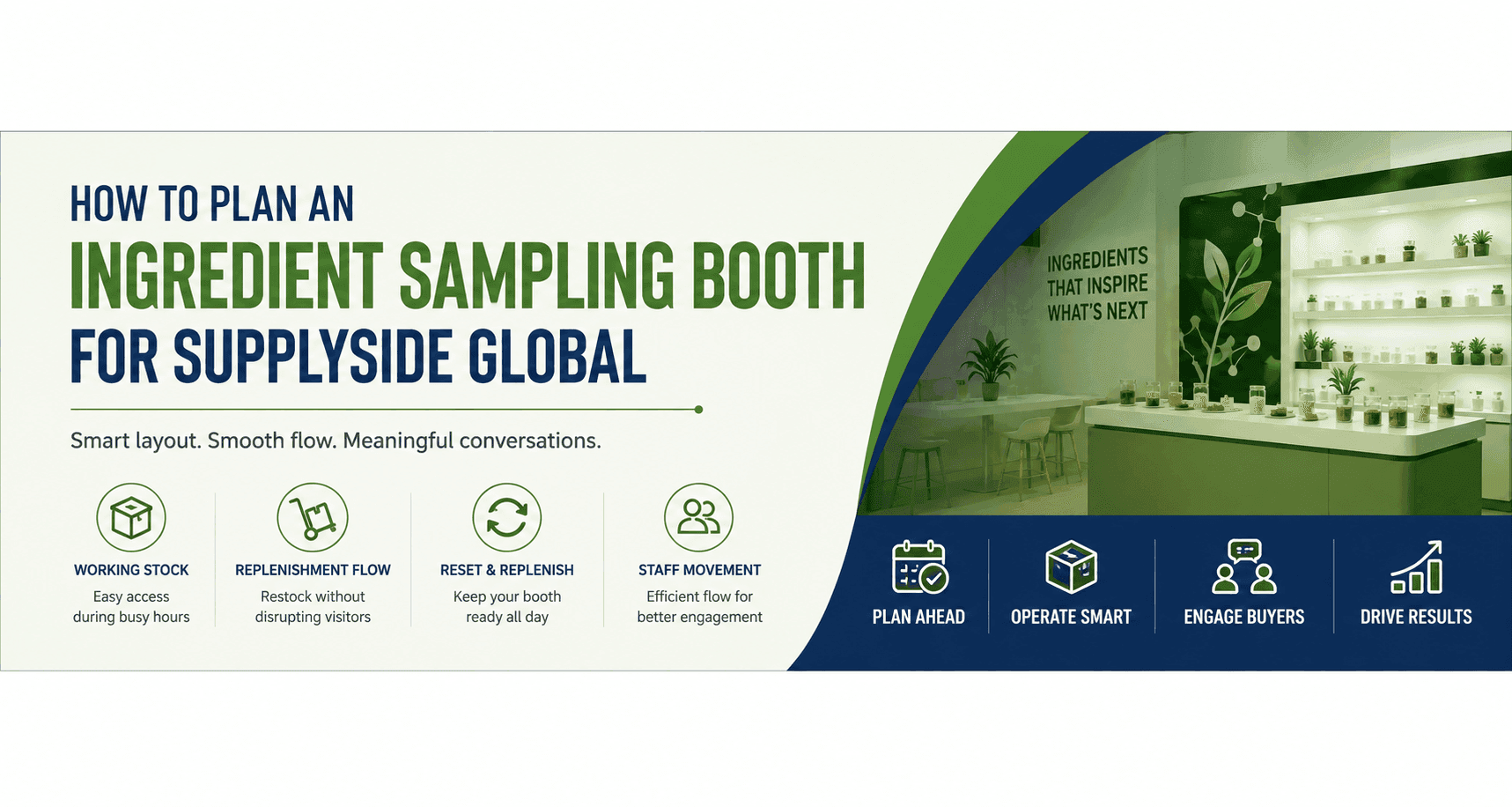
How Ingredient Brands Should Plan Sampling Booths at SupplySide Global

Circle Exhibit Team
Industry professionals
Exhibition industry professional dedicated to delivering the latest insights and curated recommendations to you.
Ingredient brands at SupplySide Global need sampling booths that separate quick product tasting from qualified buyer conversations. A strong layout should control sampling traffic, product explanation, documentation access, staff movement, storage, and follow-up discussions without crowding the aisle.
Ingredient sampling booths have a different job from standard product display booths.
At SupplySide Global, visitors are often evaluating ingredients, applications, documentation, sourcing fit, and formulation potential. The 2026 expo hall is scheduled for Oct. 28–30 at Mandalay Bay in Las Vegas, which makes booth planning less about general brand presence and more about how the space supports sampling, explanation, and buyer follow-up.
Quick Answer
Ingredient brands should plan SupplySide Global sampling booths by separating the front sampling counter from the buyer conversation area. The front zone should support tasting, product explanation, and quick qualification, while the rear or side zone should support formulation questions, documentation review, sourcing discussions, and follow-up conversations.
For show-specific layout planning, SupplySide Global booth planning should start with how visitors move from first sample to qualified buyer conversation.
Why Do Ingredient Sampling Booths Need a Different Layout?
Sampling changes booth behavior immediately.
A visitor does not interact with a sample the same way they interact with a brochure, screen, or product shelf. They need a place to stop, receive or review the sample, understand what they are tasting, and ask a quick question without blocking the aisle.
For ingredient brands, the booth also needs to explain things that may not be obvious visually. A botanical extract, protein ingredient, flavor system, functional blend, sweetener, capsule format, or powder application often needs context before a buyer understands where it fits.
That means the booth should be planned around three actions:
sample
explain
qualify
If these actions happen in one crowded spot, the booth becomes harder to manage.
Where Should the Sampling Counter Go?
The sampling counter should sit near the front, but not directly across the full entry.
This position lets visitors engage quickly without forcing them deep into the booth. It also allows staff to qualify interest before moving serious buyers into a longer conversation.
A good sampling counter should support:
staff-served tasting or sample pickup
short ingredient explanation
product cards or application notes
controlled cup, scoop, or sample handling
staff access behind the counter
hidden storage for small service materials
easy cleanup during busy traffic periods
The counter should not become a wall. If it blocks the entry, visitors may stop outside the booth and create aisle congestion.
The best sampling counter creates a quick pause, then gives qualified visitors a clear next step.
How Should a 20x20 SupplySide Booth Handle Sampling Traffic?
A 20x20 sampling booth needs clear priorities because space fills quickly.
The front area should handle sample interaction. The back or side area should support one focused buyer conversation point. Storage should stay hidden because visible boxes, cups, sample packs, and service items can make the booth feel unorganized.
Good 20x20 booth planning for SupplySide Global should usually include:
one front sampling counter
one ingredient message wall
one small product or application display
one buyer conversation area
hidden service storage
enough staff room behind the counter
The goal is not to fit every possible booth function into the footprint. The goal is to create a clear movement path from tasting to qualified discussion.
In a 20x20 booth, sampling traffic should stay fast. Buyer conversations should move slightly away from the counter so the next visitor can step in.
Sampling Zone vs Buyer Conversation Zone
Booth Area | Main Role | Best Placement | Planning Need |
|---|---|---|---|
Sampling counter | Taste, test, or introduce the ingredient | Front or aisle-facing side | Clear access, staff serving space, hidden supplies |
Ingredient message wall | Explain product category and application | Behind or beside sampling zone | Simple copy, application visuals, strong hierarchy |
Product display | Show ingredient format, packaging, sample jars, or application examples | Near counter, but not blocking service | Clean shelving, labels, limited clutter |
Documentation point | Support spec sheet, COA, certification, or sourcing discussion | Near sales zone, not front traffic | Organized materials, tablet access, staff guidance |
Buyer conversation area | Discuss formulation, sourcing, MOQ, or partnership fit | Rear or side zone | Quieter placement, seating or counter, follow-up materials |
Storage / service area | Hold cups, samples, tools, documents, and staff materials | Hidden from main aisle | Easy staff access, clean visual control |
How Should Ingredient Graphics Support Sampling?
Graphics should explain the ingredient before the visitor asks.
At SupplySide Global, many exhibitors compete around health and nutrition ingredient categories, including dietary supplements, food and beverage, sports nutrition, personal care, and related supply chain services. The official exhibitor sales material also identifies ingredient suppliers, contract manufacturers, flavor and fragrance suppliers, packaging and labeling suppliers, lab testing and analytical labs among the exhibitor profile.
That means the booth’s graphics need to make the category clear quickly.
The front sampling zone should use graphics for fast recognition:
what the ingredient is
what application it supports
what format is being sampled
what visitor question it answers
where the visitor should stop first
The buyer conversation area can carry more detailed messaging. That may include application notes, formulation use cases, documentation readiness, certification points, sourcing details, or category-specific proof.
Ingredient graphics should not only look clean. They should help visitors understand what they are tasting and why it belongs in a formulation discussion.
How Should Staff Manage Sampling and Qualification?
Staff roles should be separated just like booth zones.
If the same person is serving samples, explaining the ingredient, cleaning the counter, and handling buyer follow-up, the booth will slow down quickly. A stronger layout gives each staff role a clear position.
A sampling booth may need:
one staff member serving or introducing samples
one person answering quick ingredient questions
one sales or technical lead handling qualified buyers
one floating person managing supplies, cleaning, or traffic during busy periods
The staff path should not cut through the buyer conversation area. Visitors should see a booth that feels calm and controlled, even during heavy sampling moments.
At ingredient shows, trust is built through clarity. If the booth feels messy, the product can feel harder to evaluate.
What Happens When Sampling and Sales Conversations Compete?
The booth loses both speed and buyer quality.
When sampling and sales conversations happen in the same spot, visitors waiting for a taste may stand too close to a serious discussion. Staff may be interrupted during follow-up. Buyers may feel rushed because the counter is crowded.
This is especially risky for ingredient brands because real buyer conversations often involve formulation needs, application fit, sourcing timelines, quality documentation, certifications, or technical questions. Those conversations need more focus than the front sampling zone can usually provide.
A good booth layout lets casual visitors sample quickly and lets qualified buyers move into a better conversation area.
That separation improves both booth traffic and lead quality.
How Does Las Vegas Show-Site Execution Affect Sampling Booths?
Sampling booths need practical show-site planning, not just a clean rendering.
At Mandalay Bay, the booth has to be installed, stocked, cleaned, and operated within the show schedule. Sampling counters, graphics, storage, product display elements, and documentation areas should be planned before the booth reaches the hall.
This is where booth build support in Las Vegas helps connect layout decisions to show-site execution. The booth needs to work for visitors, but it also needs to work for the team setting it up.
For sampling booths, install planning should consider:
where counters are placed
how samples and supplies are stored
how graphics are installed behind serving zones
where staff can access materials
how the booth stays clean during show hours
how traffic avoids blocking the aisle
how buyer conversations stay separate from sampling traffic
A sampling booth can look simple from the outside, but it depends on small operational details.
How Should Ingredient Brands Handle Documentation Without Crowding the Booth?
Documentation should be easy to access, but not placed in the busiest sampling spot.
Ingredient buyers may ask about specifications, application fit, certifications, sourcing, testing, allergens, lead times, or formulation support. If all of that material sits on the sampling counter, the front zone can become crowded and visually noisy.
A better layout gives documentation its own place.
That may be a tablet station, a small side counter, a meeting table folder, or a clean product literature shelf near the buyer conversation zone. The sampling counter should introduce the product. The documentation point should support deeper evaluation.
This keeps the booth from becoming a table full of papers, cups, and samples.
It also helps staff move serious buyers away from casual tasting traffic.
What Should Ingredient Brands Avoid Saying in the Booth?
Ingredient brands should be careful with claims-heavy messaging.
A sampling booth should explain product category, application, sensory profile, formulation use, or ingredient role. It should avoid making unsupported medical or health outcome promises. The booth can still be clear and persuasive without using language that sounds like a treatment claim.
Better booth messaging focuses on:
ingredient type
application use
sensory profile
formulation role
sourcing or quality documentation
functional category context
buyer next steps
This matters because SupplySide Global is a technical and sourcing-driven environment. Buyers need information they can evaluate, not exaggerated booth copy.
What Should Ingredient Brands Prepare Before Finalizing the Booth?
Ingredient brands should define the sampling behavior before choosing booth components.
The booth should not start with furniture. It should start with how visitors will interact with the product.
Planning Checklist
What ingredient or application should visitors notice first?
Will samples be served by staff or picked up by visitors?
How long does each tasting or product explanation take?
Does the booth need a tasting counter, product shelf, or application display?
Where will cups, tools, samples, and small supplies be stored?
What graphics are needed to explain the ingredient quickly?
Where should qualified buyers move after sampling?
Does the booth need a meeting table or a standing conversation counter?
Where will documentation, spec sheets, or tablets be placed?
How will the booth stay clean during heavy traffic?
Can the layout be installed smoothly within Las Vegas show-site conditions?
These questions prevent the booth from becoming a crowded tasting table. They turn it into a controlled sampling and buyer conversation environment.
When Is a 20x20 Booth Enough for Ingredient Sampling?
A 20x20 booth can work well when the sampling program is focused.
It is usually enough when the brand has one main ingredient story, one clear product application, one sampling counter, and one follow-up conversation area. The layout should stay clean because too many product messages can make a 20x20 space feel crowded.
A 20x20 booth may not be enough if the exhibitor needs multiple sampling stations, several ingredient categories, private meetings, or a larger application display. In those cases, the booth may need a larger footprint or a more controlled zone structure.
The key is not the booth size alone.
The key is how many booth behaviors the space must support at the same time.
What Is the Best Layout Logic for a SupplySide Sampling Booth?
The best layout starts with the sample and builds outward.
First, decide where visitors receive or experience the sample. Then decide what message they need to understand while they stop. After that, create a path for qualified buyers to move into a more focused conversation.
A strong SupplySide Global sampling booth should make three things clear:
what ingredient or application is being sampled
why the product is relevant to the buyer
where a serious conversation should happen next
When those three pieces are clear, the booth can support both high-volume sampling and higher-quality buyer follow-up.
That is the real purpose of the layout.
Planning a Sampling Booth for SupplySide Global?
Start with the SupplySide show context, then plan the sampling counter, ingredient graphics, buyer conversation area, documentation point, and Las Vegas show-site execution as one connected booth system.
Ingredient sampling booths have a different job from standard product display booths.
At SupplySide Global, visitors are often evaluating ingredients, applications, documentation, sourcing fit, and formulation potential. The 2026 expo hall is scheduled for Oct. 28–30 at Mandalay Bay in Las Vegas, which makes booth planning less about general brand presence and more about how the space supports sampling, explanation, and buyer follow-up.
Quick Answer
Ingredient brands should plan SupplySide Global sampling booths by separating the front sampling counter from the buyer conversation area. The front zone should support tasting, product explanation, and quick qualification, while the rear or side zone should support formulation questions, documentation review, sourcing discussions, and follow-up conversations.
For show-specific layout planning, SupplySide Global booth planning should start with how visitors move from first sample to qualified buyer conversation.
Why Do Ingredient Sampling Booths Need a Different Layout?
Sampling changes booth behavior immediately.
A visitor does not interact with a sample the same way they interact with a brochure, screen, or product shelf. They need a place to stop, receive or review the sample, understand what they are tasting, and ask a quick question without blocking the aisle.
For ingredient brands, the booth also needs to explain things that may not be obvious visually. A botanical extract, protein ingredient, flavor system, functional blend, sweetener, capsule format, or powder application often needs context before a buyer understands where it fits.
That means the booth should be planned around three actions:
sample
explain
qualify
If these actions happen in one crowded spot, the booth becomes harder to manage.
Where Should the Sampling Counter Go?
The sampling counter should sit near the front, but not directly across the full entry.
This position lets visitors engage quickly without forcing them deep into the booth. It also allows staff to qualify interest before moving serious buyers into a longer conversation.
A good sampling counter should support:
staff-served tasting or sample pickup
short ingredient explanation
product cards or application notes
controlled cup, scoop, or sample handling
staff access behind the counter
hidden storage for small service materials
easy cleanup during busy traffic periods
The counter should not become a wall. If it blocks the entry, visitors may stop outside the booth and create aisle congestion.
The best sampling counter creates a quick pause, then gives qualified visitors a clear next step.
How Should a 20x20 SupplySide Booth Handle Sampling Traffic?
A 20x20 sampling booth needs clear priorities because space fills quickly.
The front area should handle sample interaction. The back or side area should support one focused buyer conversation point. Storage should stay hidden because visible boxes, cups, sample packs, and service items can make the booth feel unorganized.
Good 20x20 booth planning for SupplySide Global should usually include:
one front sampling counter
one ingredient message wall
one small product or application display
one buyer conversation area
hidden service storage
enough staff room behind the counter
The goal is not to fit every possible booth function into the footprint. The goal is to create a clear movement path from tasting to qualified discussion.
In a 20x20 booth, sampling traffic should stay fast. Buyer conversations should move slightly away from the counter so the next visitor can step in.
Sampling Zone vs Buyer Conversation Zone
Booth Area | Main Role | Best Placement | Planning Need |
|---|---|---|---|
Sampling counter | Taste, test, or introduce the ingredient | Front or aisle-facing side | Clear access, staff serving space, hidden supplies |
Ingredient message wall | Explain product category and application | Behind or beside sampling zone | Simple copy, application visuals, strong hierarchy |
Product display | Show ingredient format, packaging, sample jars, or application examples | Near counter, but not blocking service | Clean shelving, labels, limited clutter |
Documentation point | Support spec sheet, COA, certification, or sourcing discussion | Near sales zone, not front traffic | Organized materials, tablet access, staff guidance |
Buyer conversation area | Discuss formulation, sourcing, MOQ, or partnership fit | Rear or side zone | Quieter placement, seating or counter, follow-up materials |
Storage / service area | Hold cups, samples, tools, documents, and staff materials | Hidden from main aisle | Easy staff access, clean visual control |
How Should Ingredient Graphics Support Sampling?
Graphics should explain the ingredient before the visitor asks.
At SupplySide Global, many exhibitors compete around health and nutrition ingredient categories, including dietary supplements, food and beverage, sports nutrition, personal care, and related supply chain services. The official exhibitor sales material also identifies ingredient suppliers, contract manufacturers, flavor and fragrance suppliers, packaging and labeling suppliers, lab testing and analytical labs among the exhibitor profile.
That means the booth’s graphics need to make the category clear quickly.
The front sampling zone should use graphics for fast recognition:
what the ingredient is
what application it supports
what format is being sampled
what visitor question it answers
where the visitor should stop first
The buyer conversation area can carry more detailed messaging. That may include application notes, formulation use cases, documentation readiness, certification points, sourcing details, or category-specific proof.
Ingredient graphics should not only look clean. They should help visitors understand what they are tasting and why it belongs in a formulation discussion.
How Should Staff Manage Sampling and Qualification?
Staff roles should be separated just like booth zones.
If the same person is serving samples, explaining the ingredient, cleaning the counter, and handling buyer follow-up, the booth will slow down quickly. A stronger layout gives each staff role a clear position.
A sampling booth may need:
one staff member serving or introducing samples
one person answering quick ingredient questions
one sales or technical lead handling qualified buyers
one floating person managing supplies, cleaning, or traffic during busy periods
The staff path should not cut through the buyer conversation area. Visitors should see a booth that feels calm and controlled, even during heavy sampling moments.
At ingredient shows, trust is built through clarity. If the booth feels messy, the product can feel harder to evaluate.
What Happens When Sampling and Sales Conversations Compete?
The booth loses both speed and buyer quality.
When sampling and sales conversations happen in the same spot, visitors waiting for a taste may stand too close to a serious discussion. Staff may be interrupted during follow-up. Buyers may feel rushed because the counter is crowded.
This is especially risky for ingredient brands because real buyer conversations often involve formulation needs, application fit, sourcing timelines, quality documentation, certifications, or technical questions. Those conversations need more focus than the front sampling zone can usually provide.
A good booth layout lets casual visitors sample quickly and lets qualified buyers move into a better conversation area.
That separation improves both booth traffic and lead quality.
How Does Las Vegas Show-Site Execution Affect Sampling Booths?
Sampling booths need practical show-site planning, not just a clean rendering.
At Mandalay Bay, the booth has to be installed, stocked, cleaned, and operated within the show schedule. Sampling counters, graphics, storage, product display elements, and documentation areas should be planned before the booth reaches the hall.
This is where booth build support in Las Vegas helps connect layout decisions to show-site execution. The booth needs to work for visitors, but it also needs to work for the team setting it up.
For sampling booths, install planning should consider:
where counters are placed
how samples and supplies are stored
how graphics are installed behind serving zones
where staff can access materials
how the booth stays clean during show hours
how traffic avoids blocking the aisle
how buyer conversations stay separate from sampling traffic
A sampling booth can look simple from the outside, but it depends on small operational details.
How Should Ingredient Brands Handle Documentation Without Crowding the Booth?
Documentation should be easy to access, but not placed in the busiest sampling spot.
Ingredient buyers may ask about specifications, application fit, certifications, sourcing, testing, allergens, lead times, or formulation support. If all of that material sits on the sampling counter, the front zone can become crowded and visually noisy.
A better layout gives documentation its own place.
That may be a tablet station, a small side counter, a meeting table folder, or a clean product literature shelf near the buyer conversation zone. The sampling counter should introduce the product. The documentation point should support deeper evaluation.
This keeps the booth from becoming a table full of papers, cups, and samples.
It also helps staff move serious buyers away from casual tasting traffic.
What Should Ingredient Brands Avoid Saying in the Booth?
Ingredient brands should be careful with claims-heavy messaging.
A sampling booth should explain product category, application, sensory profile, formulation use, or ingredient role. It should avoid making unsupported medical or health outcome promises. The booth can still be clear and persuasive without using language that sounds like a treatment claim.
Better booth messaging focuses on:
ingredient type
application use
sensory profile
formulation role
sourcing or quality documentation
functional category context
buyer next steps
This matters because SupplySide Global is a technical and sourcing-driven environment. Buyers need information they can evaluate, not exaggerated booth copy.
What Should Ingredient Brands Prepare Before Finalizing the Booth?
Ingredient brands should define the sampling behavior before choosing booth components.
The booth should not start with furniture. It should start with how visitors will interact with the product.
Planning Checklist
What ingredient or application should visitors notice first?
Will samples be served by staff or picked up by visitors?
How long does each tasting or product explanation take?
Does the booth need a tasting counter, product shelf, or application display?
Where will cups, tools, samples, and small supplies be stored?
What graphics are needed to explain the ingredient quickly?
Where should qualified buyers move after sampling?
Does the booth need a meeting table or a standing conversation counter?
Where will documentation, spec sheets, or tablets be placed?
How will the booth stay clean during heavy traffic?
Can the layout be installed smoothly within Las Vegas show-site conditions?
These questions prevent the booth from becoming a crowded tasting table. They turn it into a controlled sampling and buyer conversation environment.
When Is a 20x20 Booth Enough for Ingredient Sampling?
A 20x20 booth can work well when the sampling program is focused.
It is usually enough when the brand has one main ingredient story, one clear product application, one sampling counter, and one follow-up conversation area. The layout should stay clean because too many product messages can make a 20x20 space feel crowded.
A 20x20 booth may not be enough if the exhibitor needs multiple sampling stations, several ingredient categories, private meetings, or a larger application display. In those cases, the booth may need a larger footprint or a more controlled zone structure.
The key is not the booth size alone.
The key is how many booth behaviors the space must support at the same time.
What Is the Best Layout Logic for a SupplySide Sampling Booth?
The best layout starts with the sample and builds outward.
First, decide where visitors receive or experience the sample. Then decide what message they need to understand while they stop. After that, create a path for qualified buyers to move into a more focused conversation.
A strong SupplySide Global sampling booth should make three things clear:
what ingredient or application is being sampled
why the product is relevant to the buyer
where a serious conversation should happen next
When those three pieces are clear, the booth can support both high-volume sampling and higher-quality buyer follow-up.
That is the real purpose of the layout.
Planning a Sampling Booth for SupplySide Global?
Start with the SupplySide show context, then plan the sampling counter, ingredient graphics, buyer conversation area, documentation point, and Las Vegas show-site execution as one connected booth system.
Exhibition Cases
Message
Leave your message and we will get back to you ASAP
Send a Message
We’ll Be in Touch!
Message
Leave your message and we will get back to you ASAP
Address:
4915 Steptoe Street #300
Las Vegas, NV 89122