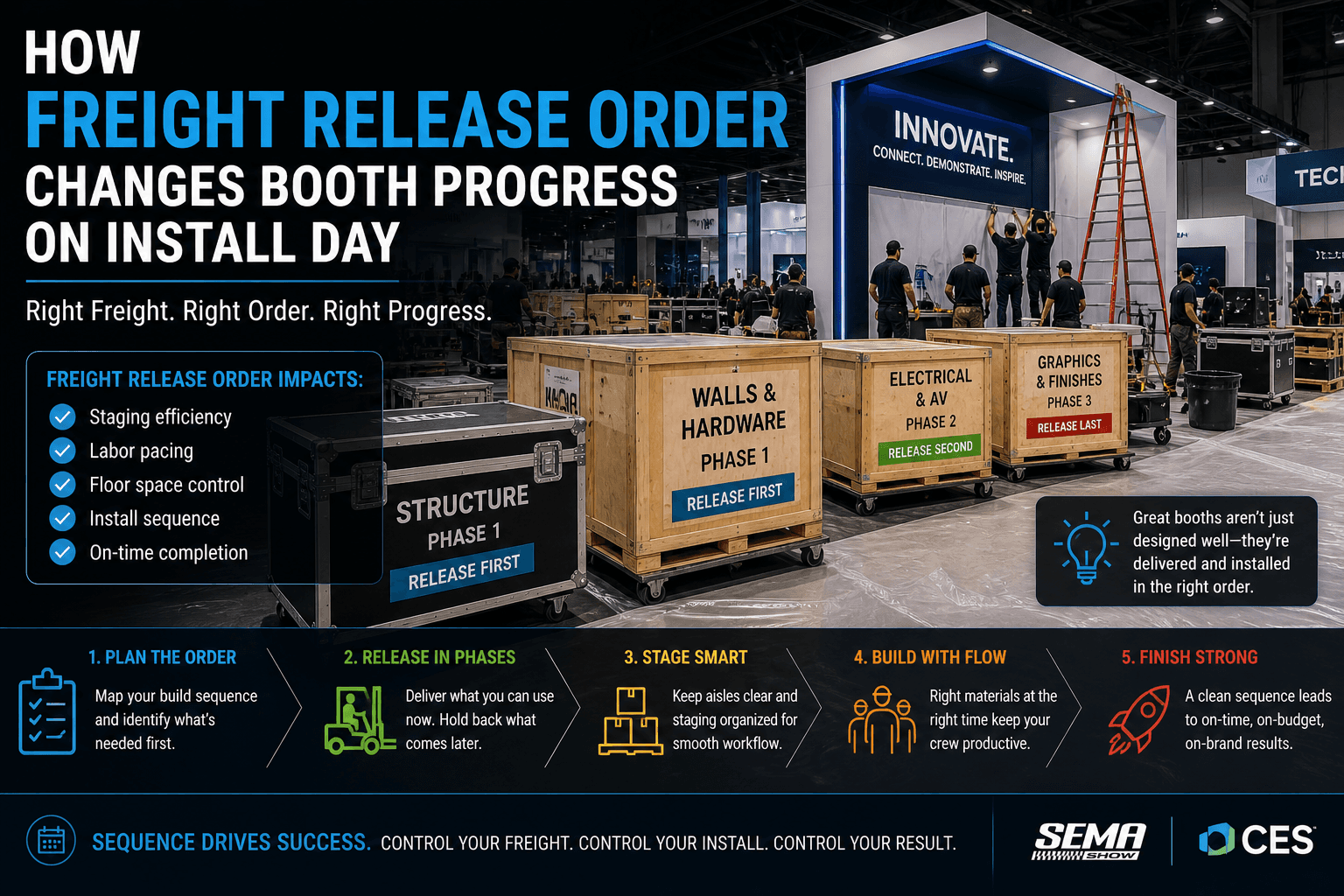
Freight on site is not the same as progress
A lot of teams feel relieved the moment freight reaches the venue.
That reaction makes sense.
But on install day, the booth does not move forward simply because materials are somewhere in the building. It moves forward when the right materials reach the booth in the right order, with enough room left for the crew to use them properly.
That is why freight release order matters so much.
The issue is not just whether the freight arrives.
It is whether the booth receives usable sequence instead of random volume.
Install day usually gets slower when the booth receives the wrong things first
This is where problems begin.
A booth may technically have everything it needs somewhere in the hall, but if later-phase materials land first, the crew often loses time before the real work even starts.
That usually looks like:
crates opened too early
finish materials exposed before structure stabilizes
staging zones filling before the active phase is ready
first-pass components trapped behind nonessential freight
the center of the booth tightening up too soon
None of this looks dramatic in isolation.
But together, it changes the pace of the whole install day.
Freight release order is really a sequencing issue
A lot of exhibitors think freight release is just a delivery step.
In reality, it is part of the build logic.
The order of release affects:
what the crew can start with
how much walking and shifting happens
whether staging supports the install or blocks it
when the booth starts feeling workable
how soon the install moves from reaction to control
That is why release order should not be treated like a background logistics detail.
It is helping decide how the booth becomes itself.
The first phase should receive first-phase materials
This sounds obvious, but it is where many installs get weaker.
The opening stage of a booth usually needs:
core structure
first-pass hardware
essential footprint components
early access-sensitive materials
What it does not need first is often:
delicate finish layers
later graphics
secondary product display pieces
nonessential accessories
anything that narrows the floor before the booth is stable
When release order ignores that difference, the crew starts using time to sort around pressure instead of building through sequence.
That is when install day starts feeling harder than it should.
Bad release order usually turns staging into overflow
This is one of the clearest field effects.
Good staging feels intentional.
Bad staging feels temporary, crowded, and defensive.
When the wrong freight lands first, staging often stops behaving like a support system and starts behaving like overflow storage. The booth begins carrying items it cannot use yet, and every open corner starts getting filled by something that belongs to a later phase.
That creates several problems fast:
access paths get tighter
working edges become less clear
structure crews have less room
protected areas stop feeling protected
the booth feels active without actually becoming more buildable
That is why release order changes staging quality so quickly.
Labor pacing depends on what the floor can actually support
This is where freight release affects labor more than many teams realize.
A crew can be fully ready and still lose productive time if the booth is fed in the wrong rhythm.
That usually leads to one of three outcomes:
1. Waiting
The crew stands by because the first materials are still not usable.
2. Premature opening
The team opens what is available, even though it belongs to a later step.
3. Improvised sequencing
The booth starts out of order and creates more pressure later in the day.
None of those are really labor problems.
They are release-order problems that become labor-efficiency problems.
SEMA booths feel release-order pressure early
This becomes especially obvious on SEMA Show installs.
Automotive booths often carry:
heavier freight
more display-sensitive center zones
vehicles or large hero objects
product walls and layered product categories
stronger dependence on controlled staging
That means the booth cannot afford random early congestion.
If the wrong materials land too early at SEMA, the hero zone gets crowded, the circulation path tightens, and the booth starts losing the exact space it still needs to remain usable. The release order has to support the booth’s display logic, not just the freight schedule.
That is why SEMA teams usually feel the consequences quickly.
CES projects feel it differently, but just as clearly
At CES in Las Vegas, the pressure often shows up in a cleaner-looking but equally damaging form.
CES booths usually depend on:
faster first-read clarity
tighter finish control
cleaner demo readiness
stronger edge discipline
fewer visible install leftovers by the time the booth starts tightening up
If freight release order is weak, the booth can look busy before it looks coherent. The wrong materials may sit too close to the demo zone, message surfaces may not be ready in the right order, and the floor may fill with items that make the booth harder to read while it is still under construction.
That slows the install in a different way.
The booth is not just delayed.
It becomes visually disorganized longer than it should.
Better release order usually starts with phase discipline
The strongest installs usually ask a simple question:
What does the active phase actually need right now?
That question often leads to better freight control.
For example:
Early phase
Structure, first-pass hardware, and setup-critical materials.
Middle phase
Secondary build materials, systems that depend on the footprint being stable, and staged support elements.
Later phase
Finish layers, graphics, refined product display, and other visually sensitive materials.
When release order respects those phases, the booth usually stays more workable throughout the day.
When it does not, one phase starts colliding with the next before the booth is ready.
Builder planning matters because freight should arrive in a buildable rhythm
This is one reason exhibitors benefit from working with a Las Vegas trade show booth builder that treats release order as part of the install plan, not as something the floor will sort out by itself.
Because the booth is not only being built from materials.
It is being built from timing.
If the timing is right, the same booth often feels faster, cleaner, and more controlled without changing the design. If the timing is wrong, even a well-designed booth starts losing time to avoidable pressure.
That is why builder logic and freight logic need to stay connected.
A practical way to think about release order
The cleanest install days usually follow a simple pattern:
1. Receive what the booth can use immediately
Do not flood the floor with later-phase freight.
2. Protect staging before it becomes crowded
The booth should still have room to work after the first release wave.
3. Keep the center from becoming early storage
Open space should remain functional, not convenient overflow.
4. Let later freight arrive into more stable conditions
The booth should get tighter as it progresses, not more chaotic.
5. Make labor readiness match material readiness
The crew should not have to improvise around the wrong release sequence.
That rhythm is often what separates a clean install day from a reactive one.
Software Demo Booths Need Freight Timing Too
Software-focused booths can be just as timing-sensitive as product-heavy exhibits. Screens, kiosks, counters, demo stations, and network-ready devices often need to arrive in the right order so the installation team can build the structure, place the hardware, confirm power access, and prepare the demo area without rework.
For events such as OPTECH, where exhibitors often rely on property management dashboards, leasing automation demos, and semi-private buyer conversations, freight release order can affect whether the booth is ready before scheduled meetings begin. Exhibitors planning OPTECH booth setup at MGM Grand should review freight timing, crate labeling, and install sequencing before move-in.
Final thought
Freight release order changes booth progress on install day because the booth does not move forward based on freight volume alone.
It moves forward based on usable order.
When the release sequence matches the active phase, the crew builds with better rhythm, staging stays more controlled, and the booth reaches its stable condition sooner. When the sequence is wrong, the booth may still be active, but it starts spending energy on pressure instead of progress.
That is the real difference.
Not just whether the freight arrived.
Whether it arrived in a way the booth could actually use.
Trying to make install day feel more controlled from the first release wave?
Start with stronger logistics and pre-show coordination, then connect it to a Las Vegas trade show booth builder approach that turns freight release into cleaner booth progress instead of floor pressure.