How Automotive Aftermarket Products Should Be Displayed at AAPEX Las Vegas

Circle Exhibit Team
Industry professionals
Exhibition industry professional dedicated to delivering the latest insights and curated recommendations to you.
AAPEX is one of the most established trade shows in the automotive aftermarket sector, and the 2026 edition is scheduled for November 3–5 in Las Vegas at The Venetian Expo and Caesars Forum. Official event information makes it clear that AAPEX is built for automotive aftermarket suppliers, distributors, retailers, and service professionals rather than a consumer-facing car show. That distinction matters. For exhibitors, success at AAPEX is not about creating the loudest booth on the floor. It is about presenting parts, repair tools, service equipment, and upgrade components in a way that buyers can understand quickly and evaluate with confidence.
At a show like AAPEX, booth performance is often decided by product clarity rather than scale alone. Automotive aftermarket exhibits usually involve a wide SKU count, detailed fitment logic, and multiple buyer types moving through the same space. Visitors want to know what the product is, what category it belongs to, what problem it solves, and how quickly they can compare it with alternatives. That is why booth planning for AAPEX should prioritize display logic first and visual styling second. In Las Vegas, that also means aligning product grouping, labeling, demo sequencing, and replenishment flow before the booth ever reaches the hall.
1. Group products by how buyers evaluate them, not just by internal product line
A common mistake at AAPEX is displaying products according to internal catalog structure or department ownership. On the show floor, however, buyers and service professionals usually think in terms of application, service workflow, repair category, or vehicle platform. Brake components, filtration systems, shop tools, diagnostics, service consumables, and performance upgrades all attract different conversations. Organizing the booth around real buyer decision paths makes the display easier to scan and easier for sales teams to support.
This is also where it makes sense to naturally link to your AAPEX event page, because users searching for the show itself are often also looking for more practical exhibiting direction. A strong contextual anchor here would be: AAPEX trade show booth builder in Las Vegas.
2. A product wall should not be packed to the limit; core SKUs need to lead
One of the biggest display problems at AAPEX is the attempt to show everything at once. The result is often an overloaded wall, tiny labels, and a booth that looks full but does not communicate priorities. A better structure is usually built in three levels:
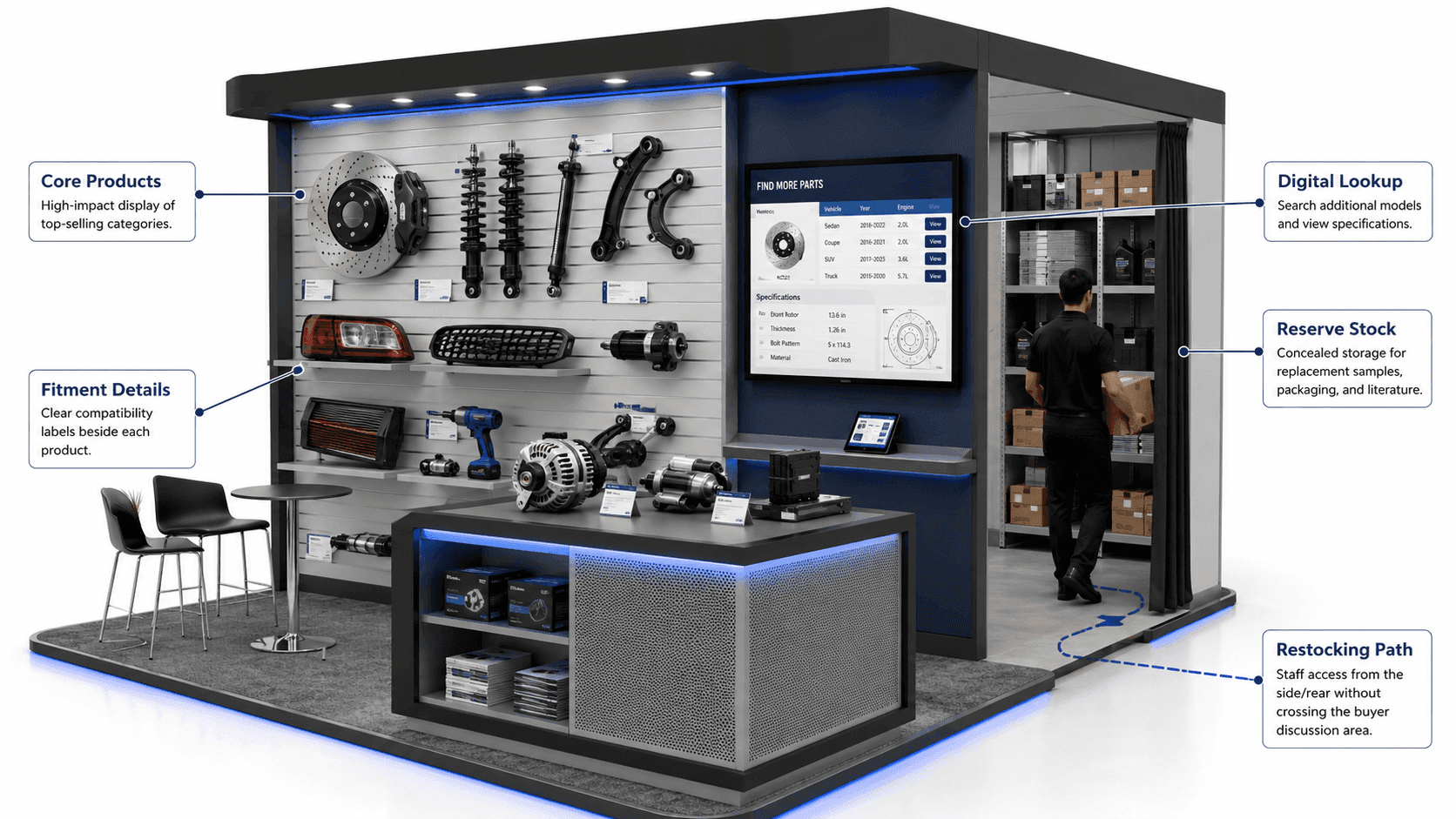
The first level highlights core, high-frequency products so visitors understand the business at a glance.
The second level expands into adjacent categories, compatibility, or supporting series.
The third level handles deeper catalog exploration through printed references, digital lookup, or sales conversation.
This approach becomes especially effective in a 20x20 or 30x40 island layout, where one wall can serve as the hero product surface while other zones support sample comparison, technical explanation, or buyer discussion. At AAPEX, where the show is centered on automotive aftermarket products, tools, and service equipment, booth size and product display logic should be planned together rather than separately. Official AAPEX and Auto Care information both reinforce the event’s role as a professional environment for suppliers, distributors, retailers, and service-focused decision-makers.
A natural internal link here would point to a booth size page with anchor text such as 20x20 trade show booth layout or 30x40 island booth for product display.
3. Separate physical product viewing from technical explanation
Another common issue in automotive aftermarket exhibits is stacking samples, graphics, screens, and sales conversations along the same traffic line. That often creates energy, but not clarity. A stronger booth usually separates the visitor journey into at least two layers:
One area helps people see and identify products quickly.
A second area helps them understand fitment, function, performance, or application in more detail.
In practice, the front of the booth may use actual parts, repair tools, cutaway components, or side-by-side comparisons to establish product recognition. Deeper inside the space, screens, application graphics, exploded views, short demos, or technical discussion surfaces can support more detailed conversation. This prevents the booth from feeling like either a warehouse shelf or a brand wall with no tangible proof.
For exhibitors balancing real samples and explanation-heavy messaging, the graphic system has to stay disciplined. Typography must be readable at distance, category markers must scan fast, and images should support product understanding rather than compete with it. That makes this section a strong place to link to a related service page using anchor text such as graphics and brand presentation for trade shows.
4. At AAPEX, speed of buyer understanding matters more than visual spectacle
AAPEX serves a highly practical, business-driven audience. Visitors are not there to admire form alone. They are there to compare supply options, understand product categories, assess compatibility, and evaluate whether a company fits their distribution or service needs. That is why the most effective booth environments at AAPEX often rely on:
Clearly segmented product category walls
Sample tables that support fast comparison
Label systems showing model, material, fitment, or use case
Semi-open discussion zones where sales teams can explain details
Demo positions that support conversation without blocking the main aisle
When product logic is structured well, the booth starts to behave like a filtering system. It attracts the right people from a distance, helps them qualify quickly up close, and then supports deeper technical discussion in the interior. That is far more valuable at a professional aftermarket event than treating the entire exhibit as a branding backdrop.
5. Freight flow, replenishment, and install order need to be solved before move-in
AAPEX takes place in Las Vegas, and official event information for 2026 confirms activity across The Venetian Expo and Caesars Forum. For exhibitors, that means booth planning is not just a design question. It also includes freight timing, labeled product delivery, install sequencing, packaging control, and sample placement order. This becomes especially important when the exhibit includes heavy components, metal parts, tools, multi-SKU shelving, or technical demo units. If the shipment logic is not aligned with the display plan in advance, it is common to end up with a finished structure but a disorganized product presentation on-site.
A more reliable process is to resolve the operational details before the booth reaches the hall:
Assign each product group to a defined display position
Number every crate or case clearly
Match graphics, shelving, lighting, and hardware to the sample list
Confirm install order and sales review order in advance
Separate demo samples from reserve stock
This is where execution planning stops being a backend task and becomes part of the booth’s selling performance.
6. Conclusion: at AAPEX, display logic is part of sales efficiency
For automotive aftermarket exhibitors, a strong AAPEX booth is not simply a matter of bringing products to Las Vegas. It is about designing the buyer path, the product hierarchy, the explanation sequence, and the on-site execution flow as one system. AAPEX matters not only because it is a major industry show, but because it brings together professionals who make fast judgments about suppliers, product lines, and compatibility on the floor. Official event sources confirm that AAPEX 2026 will again take place in Las Vegas at The Venetian Expo and Caesars Forum, continuing its role as a central gathering point for the automotive aftermarket supply chain.
If your team is preparing to exhibit, the most important questions are not just how the booth will look. They are how products should be grouped, which wall should carry your highest-value SKUs, where technical conversation should happen, which samples must arrive first, and how the visitor path can stay clear under real show-floor pressure. Once those decisions are solved, the exhibit becomes more than a display space. It becomes a working sales tool.
Planning to exhibit at AAPEX in Las Vegas? See how a Las Vegas trade show booth builder can help with layout planning, graphics, and on-site execution for automotive aftermarket exhibits.
AAPEX is one of the most established trade shows in the automotive aftermarket sector, and the 2026 edition is scheduled for November 3–5 in Las Vegas at The Venetian Expo and Caesars Forum. Official event information makes it clear that AAPEX is built for automotive aftermarket suppliers, distributors, retailers, and service professionals rather than a consumer-facing car show. That distinction matters. For exhibitors, success at AAPEX is not about creating the loudest booth on the floor. It is about presenting parts, repair tools, service equipment, and upgrade components in a way that buyers can understand quickly and evaluate with confidence.
At a show like AAPEX, booth performance is often decided by product clarity rather than scale alone. Automotive aftermarket exhibits usually involve a wide SKU count, detailed fitment logic, and multiple buyer types moving through the same space. Visitors want to know what the product is, what category it belongs to, what problem it solves, and how quickly they can compare it with alternatives. That is why booth planning for AAPEX should prioritize display logic first and visual styling second. In Las Vegas, that also means aligning product grouping, labeling, demo sequencing, and replenishment flow before the booth ever reaches the hall.
1. Group products by how buyers evaluate them, not just by internal product line
A common mistake at AAPEX is displaying products according to internal catalog structure or department ownership. On the show floor, however, buyers and service professionals usually think in terms of application, service workflow, repair category, or vehicle platform. Brake components, filtration systems, shop tools, diagnostics, service consumables, and performance upgrades all attract different conversations. Organizing the booth around real buyer decision paths makes the display easier to scan and easier for sales teams to support.
This is also where it makes sense to naturally link to your AAPEX event page, because users searching for the show itself are often also looking for more practical exhibiting direction. A strong contextual anchor here would be: AAPEX trade show booth builder in Las Vegas.
2. A product wall should not be packed to the limit; core SKUs need to lead
One of the biggest display problems at AAPEX is the attempt to show everything at once. The result is often an overloaded wall, tiny labels, and a booth that looks full but does not communicate priorities. A better structure is usually built in three levels:
The first level highlights core, high-frequency products so visitors understand the business at a glance.
The second level expands into adjacent categories, compatibility, or supporting series.
The third level handles deeper catalog exploration through printed references, digital lookup, or sales conversation.
This approach becomes especially effective in a 20x20 or 30x40 island layout, where one wall can serve as the hero product surface while other zones support sample comparison, technical explanation, or buyer discussion. At AAPEX, where the show is centered on automotive aftermarket products, tools, and service equipment, booth size and product display logic should be planned together rather than separately. Official AAPEX and Auto Care information both reinforce the event’s role as a professional environment for suppliers, distributors, retailers, and service-focused decision-makers.
A natural internal link here would point to a booth size page with anchor text such as 20x20 trade show booth layout or 30x40 island booth for product display.
3. Separate physical product viewing from technical explanation
Another common issue in automotive aftermarket exhibits is stacking samples, graphics, screens, and sales conversations along the same traffic line. That often creates energy, but not clarity. A stronger booth usually separates the visitor journey into at least two layers:
One area helps people see and identify products quickly.
A second area helps them understand fitment, function, performance, or application in more detail.
In practice, the front of the booth may use actual parts, repair tools, cutaway components, or side-by-side comparisons to establish product recognition. Deeper inside the space, screens, application graphics, exploded views, short demos, or technical discussion surfaces can support more detailed conversation. This prevents the booth from feeling like either a warehouse shelf or a brand wall with no tangible proof.
For exhibitors balancing real samples and explanation-heavy messaging, the graphic system has to stay disciplined. Typography must be readable at distance, category markers must scan fast, and images should support product understanding rather than compete with it. That makes this section a strong place to link to a related service page using anchor text such as graphics and brand presentation for trade shows.
4. At AAPEX, speed of buyer understanding matters more than visual spectacle
AAPEX serves a highly practical, business-driven audience. Visitors are not there to admire form alone. They are there to compare supply options, understand product categories, assess compatibility, and evaluate whether a company fits their distribution or service needs. That is why the most effective booth environments at AAPEX often rely on:
Clearly segmented product category walls
Sample tables that support fast comparison
Label systems showing model, material, fitment, or use case
Semi-open discussion zones where sales teams can explain details
Demo positions that support conversation without blocking the main aisle
When product logic is structured well, the booth starts to behave like a filtering system. It attracts the right people from a distance, helps them qualify quickly up close, and then supports deeper technical discussion in the interior. That is far more valuable at a professional aftermarket event than treating the entire exhibit as a branding backdrop.
5. Freight flow, replenishment, and install order need to be solved before move-in
AAPEX takes place in Las Vegas, and official event information for 2026 confirms activity across The Venetian Expo and Caesars Forum. For exhibitors, that means booth planning is not just a design question. It also includes freight timing, labeled product delivery, install sequencing, packaging control, and sample placement order. This becomes especially important when the exhibit includes heavy components, metal parts, tools, multi-SKU shelving, or technical demo units. If the shipment logic is not aligned with the display plan in advance, it is common to end up with a finished structure but a disorganized product presentation on-site.
A more reliable process is to resolve the operational details before the booth reaches the hall:
Assign each product group to a defined display position
Number every crate or case clearly
Match graphics, shelving, lighting, and hardware to the sample list
Confirm install order and sales review order in advance
Separate demo samples from reserve stock
This is where execution planning stops being a backend task and becomes part of the booth’s selling performance.
6. Conclusion: at AAPEX, display logic is part of sales efficiency
For automotive aftermarket exhibitors, a strong AAPEX booth is not simply a matter of bringing products to Las Vegas. It is about designing the buyer path, the product hierarchy, the explanation sequence, and the on-site execution flow as one system. AAPEX matters not only because it is a major industry show, but because it brings together professionals who make fast judgments about suppliers, product lines, and compatibility on the floor. Official event sources confirm that AAPEX 2026 will again take place in Las Vegas at The Venetian Expo and Caesars Forum, continuing its role as a central gathering point for the automotive aftermarket supply chain.
If your team is preparing to exhibit, the most important questions are not just how the booth will look. They are how products should be grouped, which wall should carry your highest-value SKUs, where technical conversation should happen, which samples must arrive first, and how the visitor path can stay clear under real show-floor pressure. Once those decisions are solved, the exhibit becomes more than a display space. It becomes a working sales tool.
Planning to exhibit at AAPEX in Las Vegas? See how a Las Vegas trade show booth builder can help with layout planning, graphics, and on-site execution for automotive aftermarket exhibits.
Exhibition Cases
Message
Leave your message and we will get back to you ASAP
Send a Message
We’ll Be in Touch!
Message
Leave your message and we will get back to you ASAP
Address:
4915 Steptoe Street #300
Las Vegas, NV 89122