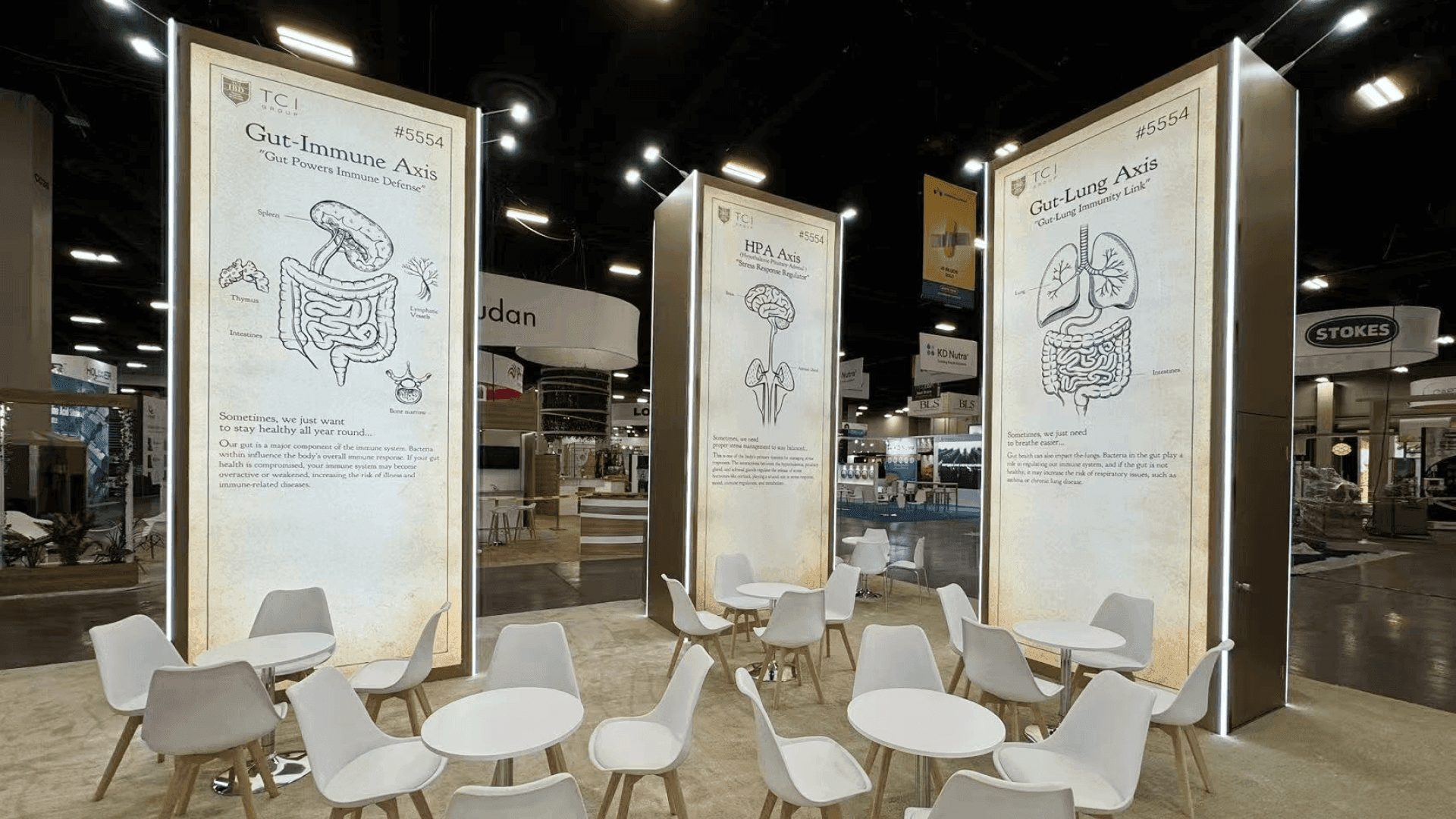
Most exhibitors still talk about booth size, layout, and visual impact as if those were the end goal.
In reality, space is never the objective. Outcomes are.
A trade show booth is only successful when it delivers measurable results—qualified conversations, clear brand positioning, and long-term business value.
This is where many exhibits fail, not because they look bad, but because they were never designed to perform.
Signal: What the Best Exhibits Signal Before Anyone Walks In
High-performing booths communicate something immediately, often without a single word.
They signal:
Who this brand is for
What problem it solves
Why it matters now
This signal is not created by graphics alone.
It is shaped by proportion, openness, hierarchy, and how visitors instinctively understand where to go and what to do.
When the signal is unclear, visitors hesitate.
When it is clear, engagement happens naturally.
This idea of signal as a performance driver sits at the core of the Signal → Story → Sale framework discussed in
Signal → Story → Sale: Islands Built to Perform.
Story: How Space Turns Interest into Understanding
Once attention is captured, the booth must carry visitors forward.
This is where many designs collapse—by overwhelming visitors with information, screens, or products without structure.
A strong exhibit tells a story through space:
Where visitors enter
What they see first
How the experience progresses
Where conversations happen
The story is not linear like a brochure.
It is experiential, intuitive, and paced.
Well-designed booths do not explain everything.
They guide visitors toward the right conversations.
When this spatial story is missing, performance often breaks down long before the show opens—a pattern examined more deeply in
Why Most Trade Show Booths Fail Before the Show Even Opens.
Performance Is Not Visual — It Is Behavioral
Performance is not measured by how impressive a booth looks in photos.
It is measured by behavior:
Do visitors step in or walk past?
Do they stop or keep moving?
Do conversations start naturally or require effort?
Do staff members feel supported or overwhelmed?
Design decisions directly influence these behaviors.
That is why performance-driven exhibits are planned from the inside out—not from the renderings inward.
Sale: When Design Aligns With Business Objectives
The final layer of a high-performance booth is alignment.
Alignment between:
Marketing goals
Sales conversations
Staff workflow
Physical space
This is where design stops being decoration and becomes infrastructure.
At Circle Exhibit, we design exhibits as systems—systems that support storytelling, interaction, and conversion across multiple shows, not just a single event.
Whether through custom environments or scalable modular exhibit systems, the goal is always the same:
build spaces that work as hard as the teams inside them.
Conclusion: The Shift From Booths to Business Tools
Trade shows are expensive. Attention is limited. Expectations are higher than ever.
The brands that win are not those with the biggest booths, but those with the clearest intent.
When exhibits are designed around outcomes—not aesthetics alone—they become business tools, not marketing expenses.
That is the difference between showing up and performing.
If you’re rethinking how your next booth should function as a business tool—not just a visual presence—the most effective first step is a strategic conversation.
👉 Contact Circle Exhibit to explore how outcome-driven exhibit planning changes results.